
Google's 400MW Fervo Geothermal Deal Powers Utah AI Data Centers and Paves Way for 1 Gigawatt Expansion
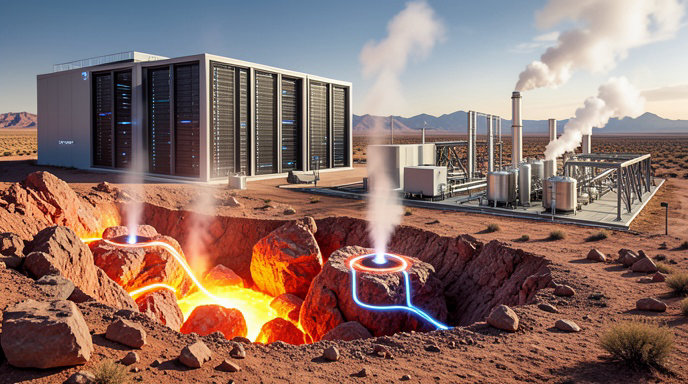
TL;DR
- Google has signed a 400 MW deal with Fervo Energy to power its AI data centers from Fervo's Cape Station enhanced geothermal project in Utah, marking the world's largest corporate enhanced geothermal agreement to date.
- The project will deliver 24/7 carbon-free firm power using Fervo's next-generation drilling and fiber-optic monitoring tech, solving the intermittency problem of wind and solar for energy-hungry AI workloads.
- The deal includes an option to scale to 1 gigawatt as Cape Station expands, signaling a major bet on geothermal as the backbone for decarbonizing data centers.
Beyond the Headlines: Google's Biggest Geothermal Bet Yet
Google is putting serious power behind its AI ambitions — and it's coming from deep underground. The tech giant has finalized a landmark agreement with Houston-based Fervo Energy to procure 400 megawatts of enhanced geothermal power for its data center operations, with the electricity generated at Fervo's massive Cape Station development in southwestern Utah.
The deal dwarfs Google's previous geothermal efforts and represents a pivotal moment for both the clean energy industry and the race to sustainably power artificial intelligence. While the initial 400 MW is enough to power roughly 300,000 homes, the agreement is structured to allow Google to scale its offtake to a full gigawatt as Fervo brings more capacity online.
Why AI Needs Power That Never Sleeps
The timing is no coincidence. A single large AI training run and the subsequent inference workloads can consume as much electricity as thousands of households. As Google, Microsoft, Amazon, and Meta race to build gigawatt-scale AI data center campuses, their energy demand is skyrocketing — and their climate goals are under pressure.
Wind and solar are cheap but intermittent. Nuclear is firm but slow and expensive to build. For Google, which has pledged to run entirely on 24/7 carbon-free energy by 2030, that intermittency gap is a critical problem.
Enhanced geothermal systems, or EGS, promise to fill it. Unlike traditional geothermal which requires rare natural reservoirs of heat and water, EGS can work almost anywhere by creating its own reservoir. That means firm, always-on, carbon-free power — the holy grail for data centers that cannot afford a millisecond of downtime.
Inside Fervo's Technology: Fracking for Clean Heat
Fervo's breakthrough is adapting techniques perfected by the oil and gas industry for a completely different purpose. At Cape Station in Beaver County, Utah, the company drills deep — up to 8,000 feet — into hot, dry granite, then drills long horizontal wells and uses hydraulic fracturing to create fractures in the rock.
Water is pumped down one well, circulates through the fractures where it is superheated by the earth's natural heat to over 400 degrees Fahrenheit, and then returns to the surface through a second well as steam to drive turbines and generate electricity. The water is then recirculated in a closed loop, making the system largely water-efficient and emissions-free.
What makes Fervo's approach different is its use of advanced fiber-optic sensing, analytics, and horizontal drilling to dramatically improve efficiency and lower costs. The company proved the model at its 3.5 MW Project Red pilot with Google in Nevada in 2023, where it successfully delivered carbon-free power to the grid powering Google's data centers there. Cape Station is that pilot at an entirely different scale.
Cape Station was already billed as the world's largest enhanced geothermal project, with a planned full capacity of 500 MW in its first phase and potential for 2 gigawatts at full build-out. Google's 400 MW commitment effectively underwrites a huge portion of that initial phase, with first power expected to come online in 2028 and full delivery by 2030.
What the 400 MW Deal Really Means
For Google, the agreement is more than a power purchase. It's a strategic infrastructure play. The company will use the geothermal power to supply its data centers in the region and has been working with local utility partners and grid operators to ensure the firm power can be integrated to support its expanding cloud and AI footprint in the western U.S.
Financial terms were not disclosed, but deals of this scale typically involve long-term power purchase agreements spanning 15 to 25 years, giving Fervo the revenue certainty needed to finance billions in drilling and plant construction.
For Fervo, which has raised over $600 million from investors including Breakthrough Energy Ventures and Devon Energy, the Google contract is a definitive commercial validation. It proves that EGS can move from a promising pilot to a bankable, utility-scale power source that the world's most demanding energy customers are willing to bet on.
The Path to a Gigawatt and Beyond
The most telling part of the announcement is the 1 gigawatt provision. Google has secured the right to expand its procurement as Fervo expands Cape Station, which sits on a vast geothermal resource capable of supporting up to 2 GW.
If executed, a 1 GW geothermal portfolio would rival the output of a large nuclear reactor — but with a much smaller footprint, faster deployment timeline, and no long-lived waste. It would also provide Google with a blueprint for replicating the model near other data center hubs.
The implications extend far beyond one company. Data centers are projected to account for up to 12% of U.S. electricity consumption by 2028, up from 4% today. If Fervo can deliver firm geothermal power at a competitive price in Utah, it can be deployed across the American West and eventually globally.
The Race to Decarbonize Data Centers Just Got Hotter
Google's move puts pressure on its rivals to secure their own firm clean power. Microsoft has already invested in nuclear restarts and fusion bets, while Amazon has pursued small modular reactors. Geothermal now enters that conversation as a proven, scalable alternative that is available today.
Challenges remain. EGS still faces permitting hurdles, drilling costs, and questions about induced seismicity and long-term reservoir performance. But with a tech giant willing to be the anchor customer, the economics have shifted.
What started as a small 3.5 MW experiment in the Nevada desert has now become a 400 MW cornerstone of Google's AI future. If Cape Station delivers as promised, the heat beneath our feet may finally become the engine that powers the cloud.

Get All The Latest Updates Delivered Straight To Your Inbox For Free!