
US Government Backs OpenAI in AI Copyright Battle Over LLM Training Data
TL;DR
- The U.S. government has filed a formal brief supporting OpenAI's position that training large language models on copyrighted data constitutes fair use, framing it as a matter of national competitiveness.
- The brief argues that restricting AI training data would severely hinder American AI development and cede technological leadership to China and other rivals.
- The intervention could reshape the future of copyright law, setting a powerful precedent for ongoing lawsuits brought by publishers, authors, and artists against AI companies.
Washington Throws Its Weight Behind AI
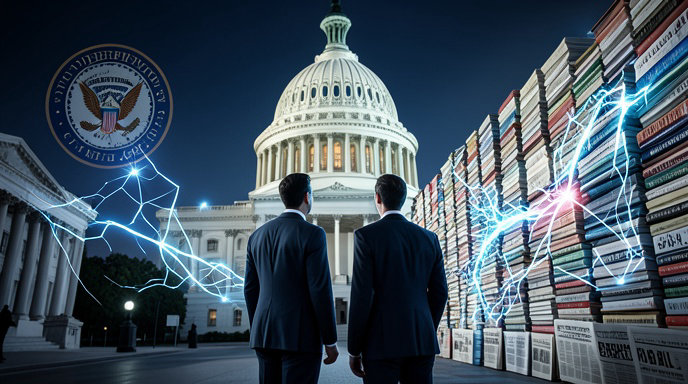
In a landmark intervention that could define the future of artificial intelligence and copyright law in the United States, the federal government has officially sided with OpenAI in the escalating legal battle over how AI models are trained. In a statement of interest and amicus brief filed in federal court, the government argued that the ability to train large language models on vast amounts of publicly available, copyrighted material is not only legal under the fair use doctrine, but essential to maintaining America's global edge in AI.
The move marks the most definitive pro-AI stance yet from Washington and provides a massive boost to OpenAI and other generative AI developers facing a wave of infringement lawsuits from The New York Times, authors, record labels, and visual artists. While the government is not a direct party in the most prominent cases, its voice carries significant weight with the courts deciding them.
The National Security and Competitiveness Argument
At the heart of the government's filing is not just a legal argument, but a geopolitical one. The brief contends that AI supremacy is a critical national security and economic imperative, and that the United States cannot afford to handicap its own innovators with overly restrictive copyright interpretations.
Government lawyers argued that requiring AI companies to license every single copyrighted work used in training - potentially billions of books, articles, images, and web pages - would be logistically impossible and financially crippling. Such a requirement, the brief states, would create an insurmountable barrier to entry for U.S. startups and researchers, effectively handing a decisive advantage to adversaries like China, where data restrictions are far looser and state support for AI is aggressive.
The filing frames unfettered access to training data as the raw material for innovation, akin to how earlier technological revolutions relied on open access to information.
Inside the Brief: A Transformative Use
Legally, the government's support hinges on a broad interpretation of fair use, the doctrine that allows limited use of copyrighted material without permission. The brief leans heavily on the concept of "transformative use."
It argues that the process of training an LLM is not about reproducing copyrighted works for human consumption, but about extracting statistical patterns, facts, and linguistic relationships from them. In the government's view, ingesting a book to teach an AI how language works is fundamentally different from copying a book to sell it, much like a human reading a library of books to learn how to write.
The brief asserts that the purpose and character of the use is highly transformative, as the resulting model does not contain copies of the works but a new, functional system capable of generating original text, code, and analysis. It also downplayed the market harm factor of fair use, suggesting that an AI-generated summary or answer is not a market substitute for the original copyrighted work itself.
What This Means for Copyright Holders
For publishers, authors, musicians, and artists, the government's position is a devastating blow. Copyright holders have argued that AI companies are engaging in mass, systematic infringement on an unprecedented scale, building multi-billion-dollar products by scraping their work without consent, credit, or compensation.
They contend that AI outputs directly compete with and devalue their original works, and that fair use was never intended to cover the wholesale copying of entire creative industries for commercial gain. Many had hoped the courts would force a licensing market where AI companies would have to pay to use high-quality training data.
The government's brief directly challenges that vision. If courts adopt its reasoning, it would largely immunize the training phase of AI development from copyright liability, leaving creators with limited legal recourse except in cases where an AI output is a near-identical copy of their work. Creator advocacy groups have already condemned the filing, calling it a giveaway to Big Tech at the expense of human creativity.
A Precedent-Setting Moment for AI Law
While an amicus brief is not legally binding, judges often give substantial deference to the government's interpretation of law, especially on matters involving national interest and evolving technology. This filing will likely be cited in every major AI copyright case currently moving through the federal courts.
The immediate impact will be felt in the high-profile lawsuit brought by The New York Times against OpenAI and Microsoft, where the question of whether training on news articles is fair use is central. A ruling influenced by the government's logic could effectively end that line of attack.
More broadly, the intervention signals a clear policy direction from the White House and federal agencies: fostering AI innovation will take precedence over expanding copyright protections. It sets the stage for a potential legislative battle in Congress, where copyright holders will now push for new laws to explicitly require licensing and compensation, arguing that the courts and the executive branch have failed to protect them.

Get All The Latest Updates Delivered Straight To Your Inbox For Free!