
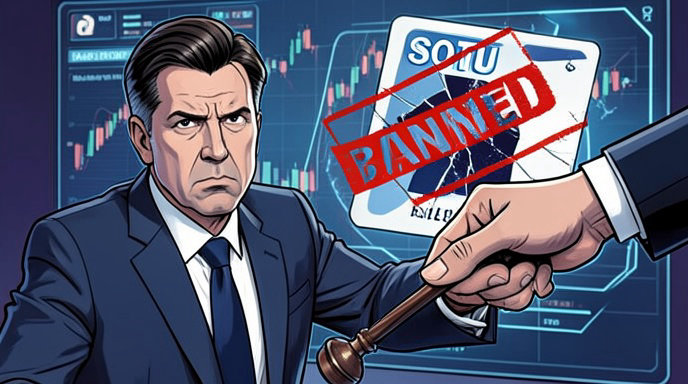
Kalshi Bans George Santos for Life After State of the Union Betting Scandal
TL;DR
- Kalshi has issued a permanent, lifetime ban on former Congressman George Santos for placing bets on State of the Union speech content, violating the platform’s terms of service.
- The ban comes just two months after the Commodity Futures Trading Commission (CFTC) settled civil charges against Santos related to his undisclosed political betting activity.
- Kalshi’s action signals a stricter enforcement posture, aiming to protect market integrity and prevent insider-style advantages in political prediction markets.
The Bet That Broke the Ban: What Santos Did
George Santos, the disgraced former New York congressman, has been permanently banned from Kalshi, the leading US-regulated political prediction market. The move follows Santos’s active betting during President Biden’s 2024 State of the Union address—an event where Santos, as a former member of Congress, had access to non-public details about the speech’s timing, themes, and potential live responses.
Kalshi’s rules explicitly prohibit users with material non-public information from trading on related events. Santos, who was expelled from the House in late 2023, nonetheless registered on Kalshi and placed a series of wagers on specific phrases and topics that would be mentioned during the address. Platform monitors flagged the activity within hours, noting the unusual accuracy and timing of his bets.
A Kalshi spokesperson confirmed the lifetime ban in a statement: “George Santos violated our terms of service regarding insider information and political integrity. His access to privileged information from his prior role created an unfair advantage. He is no longer welcome on our platform, permanently.”
The CFTC Settlement: A Preceding Legal Blow
This ban is not Santos’s first brush with betting regulators. In late 2024, the CFTC settled civil charges against him for failing to register as a “political event contract trader” and for making false statements about his trading activity. The settlement required Santos to pay a $375,000 civil penalty and disgorge $85,000 in ill-gotten gains—without admitting or denying wrongdoing.
The CFTC’s investigation revealed that Santos had used multiple accounts and aliases to place bets on congressional leadership races and primary outcomes, some of which he had direct knowledge about due to his position. The agency’s settlement was seen as a landmark case, establishing that former lawmakers are still subject to strict disclosure rules when participating in prediction markets.
Kalshi’s new ban effectively extends that regulatory censure into the private sphere. While the CFTC focused on financial penalties, Kalshi’s action removes Santos’s ability to participate in any future political betting, a marketplace he had increasingly used as a revenue stream after leaving office.
Why a Lifetime Ban? Kalshi’s Enforcement Philosophy
Kalshi has positioned itself as the “regulated, transparent” alternative to offshore betting platforms like Polymarket. To maintain that reputation, the company has developed a robust compliance framework that includes real-time monitoring, identity verification, and algorithmic detection of suspicious trading patterns.
The Santos case was a stress test. His bets were not large in dollar value—totaling roughly $4,700—but their precision was alarming. For example, Santos correctly predicted that Biden would use the phrase “right to choose” and that he would mention “Ukraine” within the first 15 minutes, bets that carried long odds.
Kalshi’s head of market integrity, in an internal memo obtained by tech press, wrote: “We cannot allow former officials to monetize their privileged access. A lifetime ban is the only proportionate response. It sends a clear signal that our markets are for public information, not private knowledge.”
The platform has also updated its user agreement to explicitly bar former federal elected officials from trading on events related to their previous committees or legislative responsibilities for a period of five years—though Santos’s ban is permanent, reflecting the egregiousness of his conduct.
Political Integrity vs. Market Freedom: The Debate
The ban reignites a broader debate about who should be allowed to trade on political events. Proponents of prediction markets argue that they aggregate information and improve democratic accountability. Critics, however, warn that they create perverse incentives for politicians to leak or act on confidential information.
Santos’s case is a cautionary tale. He was already a figure of profound ethical failure—convicted of wire fraud and identity theft in a separate federal case in 2024, and expelled from the House. His foray into betting was less about financial gain and more about remaining relevant, but it violated a core principle: markets only work if everyone operates on the same information.
Kalshi’s decision to impose a lifetime ban—rather than a temporary suspension—is notable because it treats political integrity as a non-negotiable condition of participation. The platform has also pledged to cooperate with federal authorities in any future investigations of similar behavior.
What This Means for the Future of Prediction Markets
The Santos ban is likely to have ripple effects across the industry. Other platforms, including Polymarket and PredictIt, are now under pressure to adopt similar lifetime bans for former officials who abuse their access. The CFTC is also drafting new rules that would require all political event contract traders to disclose any prior government employment, with enhanced penalties for non-compliance.
For Kalshi, the move is a double-edged sword. On one hand, it reinforces its image as a responsible, US-compliant platform. On the other, it may deter high-profile individuals—including legitimate former policymakers with genuine insights—from participating, potentially reducing market liquidity and predictive accuracy.
Still, the company appears willing to accept that trade-off. In its public communication, Kalshi emphasized that “the integrity of our markets is more important than any single trader’s participation. We are building a system that rewards honest public analysis, not privileged access.”
The Bottom Line: A Scandal That Reshaped the Rules
George Santos’s lifetime ban from Kalshi is more than a personal punishment—it is a regulatory and ethical milestone for the young prediction market industry. It demonstrates that platforms can and will police insider behavior aggressively, even without a formal court order. And it sets a precedent that former lawmakers cannot simply pivot to betting on the political system they once influenced.
As the 2026 midterm cycle approaches, Kalshi’s enforcement will be closely watched. The platform has already hired additional compliance staff and deployed new machine-learning models to detect anomalous trading tied to political insiders. Santos, meanwhile, has announced plans to appeal the ban, though legal experts note that Kalshi’s terms of service grant the company broad discretion.
For now, the message is clear: in the world of regulated prediction markets, knowledge is power—but only if you obtained it legally, and only if you use it fairly. George Santos learned that lesson the hard way.

Get All The Latest Updates Delivered Straight To Your Inbox For Free!