
Travis Kalanick’s Atoms Robotaxi Ambition Aims to Finish His Uber Unfinished Business
TL;DR
- Travis Kalanick says his new startup Atoms is his chance to finish the autonomous ride-hailing mission he started at Uber, calling robotaxis his unfinished business.
- Atoms is pursuing a low-cost, operations-first robotaxi strategy focused on purpose-built vehicles, remote assistance, and rapid city-by-city deployment rather than trying to win the autonomy tech race alone.
- The startup faces a brutal fight against Waymo's scale, Tesla's manufacturing power, and Uber's network dominance, with its first commercial pilots expected in 2027.
The Ghost From Uber's Past
Travis Kalanick never got his driverless Uber. During his tenure as Uber CEO from 2009 to 2017, he bet the company on autonomy, famously declaring that Uber's survival depended on being first to self-driving cars. He poured hundreds of millions into Uber's Advanced Technologies Group, poached top talent from Carnegie Mellon, and acquired Otto for $680 million in a move that triggered the explosive Waymo trade secrets lawsuit.
That bet collapsed. After the fatal 2018 Tempe crash, mounting losses, and boardroom battles, Uber sold its self-driving unit to Aurora in 2020. Kalanick, who had been forced to resign in 2017, watched from the sidelines as Waymo and others commercialized what he had envisioned.
Now he wants back in. In recent interviews, Kalanick has framed his stealthy new venture, Atoms, as a direct continuation of that mission — a second chance to get robotaxis right without the baggage, burn rate, and board fights that doomed Uber's effort.
What Is Atoms, Really
Atoms is the autonomous mobility arm emerging out of Kalanick's broader City Storage Systems empire, best known for CloudKitchens. While Kalanick has kept technical details tight, people familiar with the project describe Atoms not as a traditional AV developer, but as a full-stack robotaxi operator.
The strategy has three pillars. First, don't reinvent the driver. Instead of building foundational self-driving models from scratch, Atoms is expected to integrate existing autonomy stacks and lidar-heavy sensor kits from partners, focusing its own engineering on fleet orchestration, teleoperations, and cost-per-mile optimization.
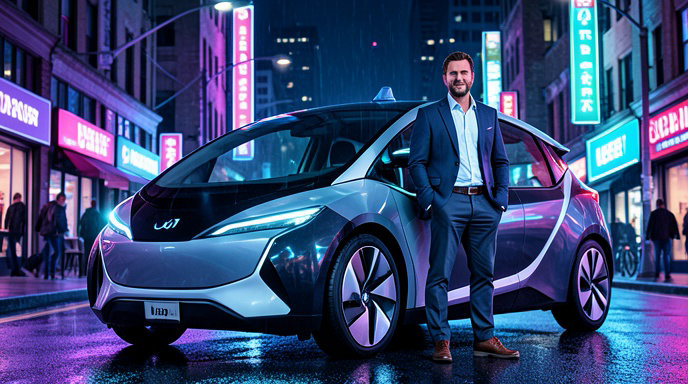
Second, own the vehicle economics. Kalanick has long obsessed over purpose-built cars with no steering wheel, swappable batteries, and easy-to-clean interiors designed for 20-hour-a-day utilization. Atoms prototypes are rumored to be compact, electric, and built with contract manufacturers in Asia to undercut Waymo's Jaguar I-PACE and Zeekr-based fleet on price.
Third, control the real estate. Leveraging CloudKitchens' playbook of buying distressed urban properties, Atoms plans to build its own depots, charging hubs, and cleaning stations in dense cities — the unsexy infrastructure that determines whether robotaxis actually make money.
Why Now Is The Robotaxi Moment
Kalanick's timing is not accidental. After years of hype and disappointment, autonomous ride-hailing finally tipped into commercial reality in 2025 and 2026.
Waymo now completes over a million paid rides per week across Phoenix, San Francisco, Los Angeles, Austin, and Miami. Tesla launched its long-promised Robotaxi service in Austin in June 2026 and is expanding to the Bay Area. Uber, having abandoned building its own tech, has reinvented itself as the aggregator for everyone else, partnering with Waymo, Wayve, Nuro, and others.
Investor appetite has returned. Lower lidar costs, advances in end-to-end AI driving models, and friendlier regulation in states like Texas and Florida have slashed the cost to launch. Kalanick is betting the window is open for a lean, operations-obsessed newcomer to move faster than slow-moving incumbents.
How Atoms Plans To Challenge Waymo, Tesla And Uber
Taking on all three giants at once sounds audacious, but Kalanick sees a gap in each.
Against Waymo, Atoms is betting on speed and cost. Waymo's technology leads the industry, but its expansion is methodical and expensive, reliant on detailed mapping and premium vehicles. Atoms aims to undercut it with cheaper cars and a playbook for launching in second-tier Sun Belt cities where permits are easier and demand for late-night rides is high.
Against Tesla, Atoms is betting on operations. Tesla has massive manufacturing scale and a vision-only approach powered by real-world data, but it still relies on safety monitors and faces regulatory scrutiny over its Full Self-Driving system. Kalanick believes winning robotaxis is less about the smartest AI and more about cleaning, charging, maintenance, customer support, and uptime — the gritty logistics Uber mastered.
Against Uber, Atoms is betting on independence. Uber CEO Dara Khosrowshahi has turned Uber into the platform where most Americans will hail a robotaxi, taking a cut of every Waymo or Tesla ride booked through its app. Kalanick reportedly has no interest in being a supplier to his former company. Atoms is expected to launch with its own consumer app, keeping the full fare and customer relationship, a direct challenge to Uber's asset-light network strategy.
What Comes Next
Atoms remains in stealth mode, but hiring signals suggest acceleration. The company has been recruiting autonomy engineers from Argo AI, Cruise, and Zoox, mapping specialists, and fleet operations managers in Las Vegas, Dallas, and Miami. Kalanick's team has also been linked to closed-course testing and depot acquisitions.
Industry watchers expect Atoms to announce its first pilot city in late 2026 or early 2027, likely starting with a small, geofenced fleet with remote safety operators before removing drivers entirely.
The hurdles are enormous: proving safety to regulators, raising billions for vehicles and infrastructure, and earning rider trust in a market where Waymo already has brand recognition and Tesla has a fanatical following.
But if anyone thrives on an unwinnable street fight, it's Kalanick. He built Uber by waging war against taxis, regulators, and rivals simultaneously. With Atoms, he's telling Silicon Valley he left one war unfinished — and this time, there is no board to fire him.

Get All The Latest Updates Delivered Straight To Your Inbox For Free!