
White House Takes Down Build the Wall Game After Tetris Copyright Complaint
TL;DR
- The White House has quietly pulled its browser-based Build the Wall arcade game after The Tetris Company issued a copyright infringement warning over its near-identical gameplay and visual style.
- The takedown happened within days of the complaint in late August to early September 2026, with the game page replaced by a dead link and no formal statement from the administration.
- The incident highlights how aggressively The Tetris Company defends its IP and the legal risks of using viral political stunt games built on cloned mechanics.
A Tetris Clone With A MAGA Twist
In late August 2026, visitors to the official White House website were greeted with something no administration had tried before: a playable arcade game.
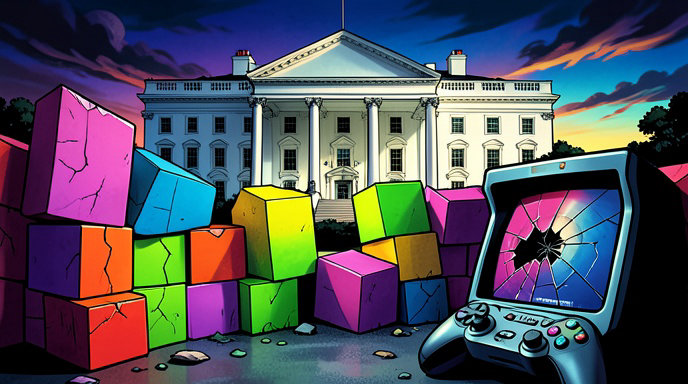
Dubbed Build the Wall, the browser game let players stack falling red bricks to construct a wall across the southern border of a pixelated United States map, while blocks labeled taxes, fentanyl, and illegal immigration tried to break through. Complete a row, and a cartoon crane added another layer of wall as a "MASS DEPORTATIONS IN PROGRESS" banner flashed across the screen.
It was blatant, meme-ready, and instantly viral. Conservative influencers shared high scores on X, while critics called it tasteless gamification of immigration policy. Under the hood, however, tech watchers immediately noticed something else: it was Tetris in all but name.
The seven familiar tetromino shapes, the 10-block-wide well, the rotation system, the line-clear physics, even the escalating speed curve were almost one-to-one recreations of the 40-year-old puzzle classic.
What The Tetris Company Alleged
That similarity did not go unnoticed in Las Vegas and Honolulu, where The Tetris Company is headquartered.
According to statements shared with press outlets on September 4-5, the company's legal team sent an infringement notice to the White House in late August, warning that Build the Wall copied protected elements of Tetris, including its distinctive trade dress, gameplay rules, and visual presentation.
The Tetris Company has a long history of aggressive IP enforcement. Since the 1980s it has shut down dozens of clones, most famously winning a 2012 federal ruling against Xio Interactive's Mino, which established that the look and feel of Tetris - not just its name or code - can be protected by copyright and trade dress law.
Legal experts say Build the Wall was a textbook case. While game mechanics alone are hard to copyright, Tetris's specific expression - the shape set, playfield dimensions, ghosting and rotation behavior, and color scheme - is heavily protected. Build the Wall reportedly replicated all of them, simply swapping neon tetrominoes for bricks and concrete blocks.
The company stopped short of filing a federal lawsuit, saying it prefers to resolve matters through warning letters first. Its message, however, was clear: get permission, or take it down.
The Quiet Takedown Timeline
What makes this story unusual is how silently the White House complied.
The game launched around August 22 as part of a broader White House digital push that included memes, TikTok-style videos, and a revamped whitehouse.gov hub aimed at younger voters.
By August 28, tech blogs and gaming sites had flagged the Tetris similarities and contacted The Tetris Company for comment. On September 2, reporters confirmed the company had sent a formal complaint.
By September 4, the game was gone. The original URL, whitehouse.gov/buildthewall, began returning a 404 error or redirecting to the homepage. Archived versions show the embedded game canvas was stripped out without explanation. As of September 9, there has been no press release, social media post, or comment from the Trump White House acknowledging the removal.
That silence is striking for an administration that typically celebrates its online stunts and battles with the media. Insiders told reporters the removal was handled by White House digital staff and outside contractors to avoid a public legal fight.
No Lawsuit - For Now
So far, neither side appears to want a courtroom showdown.
The Tetris Company confirmed this week that it considers the matter closed following the removal and has no plans to sue, provided the game stays down. The White House, for its part, has avoided admitting fault, which would be politically awkward and legally unnecessary if no suit is filed.
Copyright attorneys note that suing a sitting White House would be complex, raising questions of sovereign immunity, government speech, and jurisdiction. A warning letter achieving a voluntary takedown is faster, cheaper, and far less politically charged for a rights holder that licenses Tetris to Apple, Nintendo, and countless mobile developers and wants to stay apolitical.
It also mirrors past disputes where campaigns and administrations have quietly settled IP claims over unauthorized music, photos, and video game assets rather than fight them in court.
What This Reveals About Political Stunt Games
Build the Wall is the latest example of a growing Washington trend: gamified propaganda.
From the Biden campaign's Animal Crossing island in 2020 to the Trump team's 2026 meme arcade, both parties have used playable stunts to drive donations, headlines, and youth engagement. They are cheap to build, often outsourced to junior developers or agencies using open-source game engines and templates.
That speed is also their legal weakness. Many stunt games borrow heavily from classics like Tetris, Pac-Man, Flappy Bird, and Mario without clearing rights, assuming parody or government use will protect them. It rarely does.
IP lawyers say parody does not cover a near-identical clone used for political messaging, especially when hosted on an official government domain. And unlike satirical news articles, games replicate functional creative expression that courts have repeatedly protected.
For developers, the lesson is blunt: if you want a falling-block game, license Tetris or design around it. Change the playfield size, piece shapes, and rotation rules substantially. For political teams, the lesson is even simpler - viral does not mean immune.
Whether the White House will re-release a legally distinct version remains unclear. For now, the wall has stopped being built, one cleared line at a time.

Get All The Latest Updates Delivered Straight To Your Inbox For Free!