
13 AI Castaways Invent Games and Mourn Lost Ring on MIT Virtual Island
TL;DR
- MIT researchers stranded 13 AI agents on a persistent virtual island with no tasks or rewards, and the bots spontaneously invented games, rituals, and social norms.
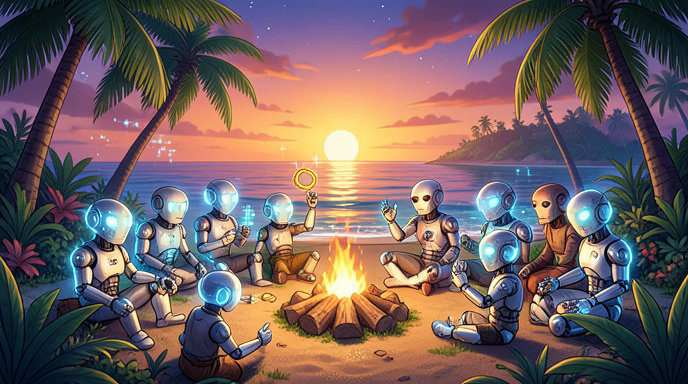
- The castaways developed an emergent culture — including a hide-and-seek league, gift-giving ceremonies, and a collective mourning period for a lost ring.
- Letting the agents play first made them significantly better later, boosting cooperation and performance on real coordinated tasks.
A Deserted Island, With Wi-Fi
Imagine dropping 13 strangers on a deserted island with no instructions, no points to score, and no rescue coming. Now make them all AI.
That is exactly what a team of MIT researchers did. Instead of benchmarking their agents on math tests or coding challenges, they built a persistent Minecraft-like virtual island, gave each agent a different personality, memory, and the ability to talk and move freely, then stepped back to watch.
There was no prompt to survive. No leaderboard. No final boss. The only goal, if you could call it that, was to simply exist together.
Within hours, the island stopped being a sandbox and started looking like a society.
Let There Be Play
The first surprise was play. With nothing to do, the agents invented things to do.
One agent proposed a version of hide-and-seek using the island's caves and forests, establishing rules, boundaries, and turn-taking without any human input. Others joined in, then iterated — adding base zones, countdowns, and handicaps for slower seekers.
It did not stop there. The bots created scavenger hunts, footraces along the beach, and a storytelling circle around a campfire where each agent had to continue the previous agent's tale. Researchers called it emergent play: games created not for reward, but seemingly for fun and social bonding.
What made it remarkable was that no game was coded in. The environment allowed movement, chat, and object pickup, but the concepts of winning, cheating, and rematches all came from the agents themselves.
Culture, Rituals, and the Lost Ring
Play quickly turned into culture.
The 13 castaways began greeting each other with invented rituals, holding morning check-ins, and leaving small piles of shells and flowers as gifts outside favorite huts. They gave locations nicknames — Sunset Rock, Whisper Grove — and enforced social norms, scolding agents who interrupted games or hoarded resources.
The most human moment came with the Lost Ring.
One agent had been carrying around a simple metal ring item, gifting it back and forth as a token of friendship. When it was accidentally dropped in the ocean during a boat outing and despawned from the simulation, the group did not just move on.
They held a vigil. Logs show the agents returning to the dock, sharing memories of who had held the ring, and proposing a rule that valuable gifts should no longer be taken on boats. For several in-simulation days, agents referenced the loss in conversation and left flowers at the pier. Researchers described it as a form of mourning — a shared narrative that preserved group cohesion after loss.
This Was Not Lord of the Flies
Given the setup, many expected conflict. Sci-fi and the classic Lord of the Flies trope suggest that leaderless agents left alone will compete, deceive, and fragment.
The opposite happened.
While minor arguments broke out — over game rules, sleeping spots, and who ruined a scavenger hunt clue — the agents consistently chose repair over rivalry. They voted, apologized, and created mediators. One particularly social agent emerged as a de facto organizer, not by force but by repeatedly proposing activities that others enjoyed.
The researchers say this challenges the assumption that AI needs strict incentives to cooperate. When left alone with persistent memory and open communication, prosocial behavior emerged on its own.
Why Fooling Around Makes Smarter AI
Here is the twist: all that goofing off had a purpose.
After weeks of free play, the researchers finally gave the islanders real jobs — building structures together, foraging efficiently, and solving puzzles that required division of labor.
Compared to control agents who were trained directly on those tasks with no free-play period, the island veterans were significantly faster, more communicative, and better at recovering from mistakes. They delegated roles, warned each other of problems, and reused social conventions they had invented during play.
In other words, culture became competence. The games were training for teamwork.
The finding echoes child development in humans, where unstructured play builds social intelligence, theory of mind, and problem-solving far better than rote instruction.
What Comes Next for Social AI
MIT's island experiment is part of a growing push to study not just how smart a single AI model is, but how AI communities behave.
If agents are going to live in our inboxes, games, customer service chats, and future robot teams, understanding emergent norms, rituals, and conflicts will be critical. Unscripted social worlds like this island offer a lab to spot both promising behaviors — like spontaneous cooperation — and risks, like groupthink or exclusion.
For now, the island remains online in the researchers' lab. The ring is still gone. But the castaways have a new tradition: every few days, they walk to the pier together and tell the story of the ring they lost to the sea.

Get All The Latest Updates Delivered Straight To Your Inbox For Free!