
Cambridge Heavy Industries Unveils Desktop Laser Fusion Device for Future Power Plants
TL;DR
- Cambridge Heavy Industries is developing a compact, laser-driven fusion device designed to fit on a desktop while producing neutron-rich fusion reactions for research and future power applications.
- The system uses high-powered lasers to trigger fusion in small fuel targets, aiming to create a scalable, mass-producible neutron source rather than a full-scale power reactor.
- The company positions the device as a fuel and testing platform for the next wave of fusion power plants, with a focus on breeding tritium, validating materials, and lowering development costs.
A Quiet Contender in a Crowded Fusion Race
Cambridge Heavy Industries has largely stayed out of the spotlight while fusion giants chase grid-scale ignition and billion-dollar tokamaks. Now the startup is emerging with a radically different bet: shrink fusion down, not scale it up.
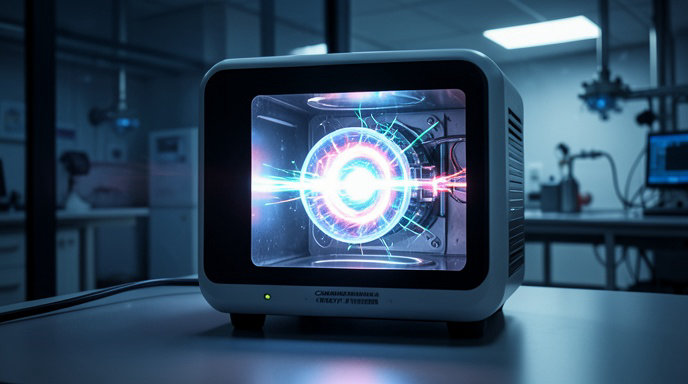
Instead of building a massive power plant, the company says it is perfecting a compact, laser-powered desktop fusion device. The goal is not to power a city from a box on a desk, but to create a practical, repeatable fusion platform that can accelerate the entire industry toward commercial fusion power.
The idea marks a shift in thinking. For decades, fusion has meant bigger machines, bigger magnets, and bigger budgets. Cambridge Heavy Industries is arguing the opposite path could unlock faster progress — small-scale breakthrough technology that can be built, tested, and iterated quickly.
How The Desktop Laser Fusion System Works
At the heart of the device is inertial confinement fusion on a micro scale. High-intensity laser pulses are focused onto a tiny fuel pellet containing hydrogen isotopes, compressing and heating it in a fraction of a second to the extreme conditions needed for atoms to fuse.
Unlike the room-sized laser arrays at national labs, Cambridge Heavy Industries is working to miniaturize the driver system using compact laser architecture, precision optics, and automated target handling. The result, the company claims, is a desktop-scale unit capable of firing repeatedly and reliably.
Each shot produces a burst of neutrons — the telltale signature of fusion — along with valuable data on plasma behavior, target performance, and energy yield. While net electricity generation is not the immediate aim, the repeated fusion pulses are intended to be scientifically useful and commercially relevant.
Not A Power Plant, But Fuel For Power Plants
The most intriguing part of the company's strategy is how it plans to position the device. Cambridge Heavy Industries does not pitch its desktop system as a replacement for large fusion reactors. It pitches it as fuel for them.
Future fusion power plants will need a steady supply of tritium, a rare hydrogen isotope essential for the deuterium-tritium reactions most designs rely on. Tritium barely exists in nature and must be bred using fusion neutrons striking lithium blankets.
A fleet of small, inexpensive laser fusion devices could serve as powerful neutron sources to breed tritium, test blanket designs, and qualify reactor materials without waiting for a full-scale plant to come online. In other words, the desktop device could help solve the fuel problem that stands between today's experiments and tomorrow's power grid.
Why Small-Scale Could Mean Big Business
The economics are central to the pitch. Large fusion facilities can cost billions and take a decade to build. A compact device, if mass-producible, could be sold to universities, national labs, industrial partners, and reactor developers at a fraction of that cost.
That would open up new revenue while distributing fusion R&D far beyond a handful of well-funded sites. Researchers could test first-wall materials under real fusion neutron bombardment, validate simulation codes, produce medical isotopes, and train the next generation of fusion engineers on live hardware.
Cambridge Heavy Industries is betting that this decentralized model — many small fusion machines supporting a few large ones — will speed up commercialization more effectively than focusing solely on giant reactors.
Challenges Ahead: Physics, Engineering, And Credibility
Serious hurdles remain. Achieving meaningful neutron yields from a compact laser driver requires major advances in laser efficiency, repetition rate, target fabrication, and thermal management. Maintaining precision alignment shot after shot in a desktop form factor is an extreme engineering challenge.
There is also the question of transparency. The private fusion sector has faced growing scrutiny over bold claims without peer-reviewed data. To win credibility, Cambridge Heavy Industries will need to publish verifiable results on neutron output per shot, system lifetime, and cost per neutron — the metric experts will watch most closely.
Regulatory and safety questions around tritium handling, high-power lasers, and neutron radiation will also shape how quickly such devices could be deployed outside specialized facilities.
What Comes Next
For now, the company appears focused on prototype demonstration and partnerships with future power plant developers. If it can prove reliable, repeatable operation and a clear path to manufacturing, its desktop fusion device could become a foundational tool for the industry — the picks and shovels of the fusion gold rush.
In a field obsessed with building the biggest machine, Cambridge Heavy Industries is making a contrarian case: the future of fusion power may depend on thinking small first.

Get All The Latest Updates Delivered Straight To Your Inbox For Free!