
Laplace Intelligence Red-Teams Robots and Self-Driving Cars Before Real-World Deployment
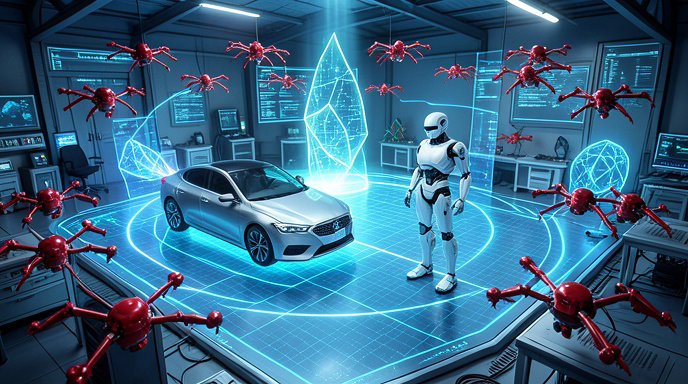
TL;DR
- Laplace Intelligence, a profitable University of Michigan spinout, is bringing red-teaming to physical AI with interactive simulation that hunts for robot and AV failures before deployment.
- The platform uses AI agents to generate edge-case traffic, pedestrian, and warehouse scenarios, helping customers find safety-critical bugs in hours instead of months of real-world testing.
- The team will pitch its safety technology on stage at TechCrunch Disrupt's Startup Battlefield as it looks to scale beyond autonomous vehicles into humanoids and industrial robotics.
From Lab to Launch
Laplace Intelligence didn't start as a startup idea. It started as a frustration inside the University of Michigan's robotics labs, where testing autonomous systems meant logging thousands of miles just to encounter the one rare scenario that actually breaks them.
The spinout, founded by Michigan researchers working on verification and safety for AI-driven machines, is taking a fundamentally different approach: don't wait for the real world to surprise you. Simulate an adversary that actively tries to make your robot fail.
That concept, known as red-teaming in cybersecurity, is now being applied to robots and self-driving cars. And it's landing at exactly the right moment, as humanoid developers, robotaxi operators, and Tier 1 auto suppliers race to deploy AI-driven systems that can't afford high-profile failures.
Red-Teaming Robots Instead of Road-Testing Them
Traditional AV and robotics testing relies on two extremes: passive log replay and brute-force mileage accumulation. Both miss the long tail.
Laplace Intelligence replaces that with interactive, agent-driven simulation. Instead of cars and pedestrians following pre-recorded paths, its AI agents react to the autonomy stack under test. A simulated delivery van cuts you off at the worst moment. A jaywalking pedestrian hesitates, then darts. A forklift in a warehouse takes an unnatural but physically plausible line.
The system searches for the boundaries of safe behavior, automatically generating thousands of variations around near-misses and ranking them by risk, novelty, and realism. Developers can plug in their autonomy stack, run closed-loop tests in the cloud, and wake up to a prioritized list of failure modes with full sensor playback.
For customers, the pitch is simple: find the crash in simulation on Tuesday, not on the highway on Friday.
Why Interactive Simulation Changes the Math
The key difference is interactivity. Older simulators were essentially movie sets — the background actors did the same thing no matter what the robot did. Laplace's agents respond, creating the kind of causal feedback loops that cause real-world disengagements.
The company says that lets safety teams stress-test planning, perception, and end-to-end learned policies against adversarial but realistic behavior, not just cartoon chaos. Scenarios remain constrained by physics and human-like motion models, which helps avoid false positives that waste engineering time.
It's a timely sell. As the industry shifts from hand-coded rules to end-to-end neural planners and vision-language-action models for robots, brute-force testing breaks down. Learned systems fail in unexpected, non-intuitive ways. Automated red-teaming gives teams a way to probe those blind spots systematically.
Profitable, Real-World Traction Before the Spotlight
Unlike most Startup Battlefield hopefuls burning cash to find product-market fit, Laplace Intelligence says it is already profitable.
The bootstrapped, customer-funded approach came from early pilots with autonomous vehicle developers and robotics companies that needed better pre-deployment validation to satisfy internal safety gates and regulators. According to the team, its tools have already been used to surface safety-critical edge cases that were missed by millions of miles of on-road data and conventional scenario testing.
That real-world impact spans robotaxis navigating dense urban cut-ins and unprotected turns, to ADAS features dealing with erratic two-wheelers, to mobile robots operating around unpredictable humans. By catching failures earlier, customers can shorten validation cycles from months to days and build safety cases backed by evidence, not just mileage.
The business model is software-as-a-service for simulation at scale, with usage-based pricing for large test campaigns and enterprise integrations for continuous integration pipelines.
The Startup Battlefield Pitch
Now Laplace Intelligence is taking that story to TechCrunch Disrupt's Startup Battlefield, one of tech's most competitive early-stage stages.
On stage, the company plans to demo live how its AI agents break an otherwise competent autonomy stack — then show how the same failure can be diagnosed, fixed, and re-tested in a tight loop. It's a visceral demo format that plays well with judges: watch the robot fail safely here so it doesn't fail dangerously out there.
The timing aligns with surging investor interest in infrastructure for physical AI. Venture capital has poured into humanoids, world models, and robot data, but safety and evaluation remain bottlenecks to commercial deployment. Laplace is positioning itself as the trust layer for that entire stack.
What's Next for Physical AI Safety
Competition is heating up, from large in-house simulators at Waymo, Tesla, and Nvidia to startups offering synthetic data and scenario generation. Laplace's bet is that interactivity and adversarial search — not just prettier graphics or more miles — will define the next generation of validation.
Next up for the company is expansion beyond autonomous driving into humanoid robots, warehouse automation, and embodied AI, where regulators, enterprise buyers, and insurers are all demanding stronger proof of safety.
If red-teaming became mandatory for large language models, the founders argue, it will become mandatory for machines that move in the physical world. Laplace Intelligence wants to be the company that does the breaking before the world does.

Get All The Latest Updates Delivered Straight To Your Inbox For Free!