
Niobia’s AI Inspection Tech Targets Costly Battery and Chip Defects
TL;DR
- Niobia, a San Francisco-based startup, is building AI-powered inspection systems designed to catch microscopic defects in batteries and semiconductors before they cause costly failures.
- The company's approach combines high-resolution imaging with machine learning models trained to spot anomalies in real time on fast-moving production lines.
- If widely adopted, the technology could significantly cut scrap, downtime, and safety risks for EV battery and chip makers facing intense pressure on yield and quality.
The High Cost of a Tiny Flaw
In battery and chip manufacturing, a defect invisible to the human eye can cost millions. A single metal particle inside a lithium-ion cell can trigger a short, a fire, or a full-scale recall. A nanoscale patterning error on a wafer can scrap an entire batch of high-value chips.
That is the problem Niobia is trying to solve. The San Francisco startup is developing automated inspection technology aimed at catching production-line defects early, when they are still fixable — or at least before they cascade into waste, downtime, and customer failures.
Why Inspection Is Now Mission-Critical
Battery and semiconductor factories are among the most expensive industrial facilities in the world to build and run. Gigafactories and fabs can cost billions of dollars, and profitability hinges on yield — the percentage of products that come off the line working perfectly.
With EV makers pushing for higher energy density and chipmakers pushing toward 3nm and below, tolerances are getting tighter while production speeds are getting faster. Traditional sampling methods, where only a fraction of products are checked, and rule-based machine vision systems are struggling to keep up with new materials, new form factors, and increasingly subtle defect types.
How Niobia's Approach Works
While still early in disclosing technical details, Niobia's system follows a model becoming standard in advanced manufacturing: high-speed sensors plus AI.
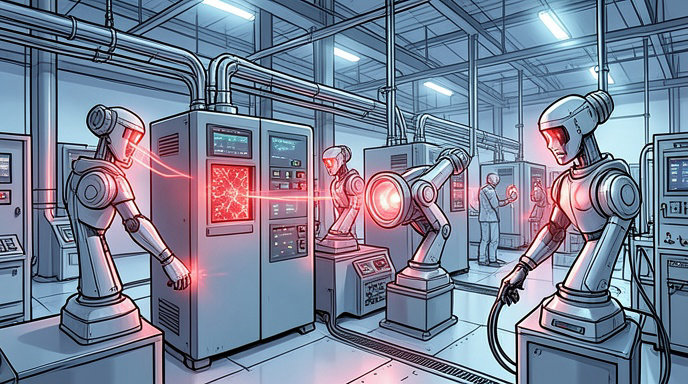
The concept is to image electrodes, cells, wafers, or packages at line speed, then use trained AI models to flag anomalies in real time — from coating streaks, pinholes, and contaminants in battery electrode films to cracks, particles, and pattern deviations in semiconductor processes.
Unlike conventional vision systems that require engineers to manually program defect rules, AI-based inspection can learn what "good" looks like and detect novel deviations, reducing false alarms while catching previously unseen failure modes. The goal is inline, 100% inspection without slowing throughput.
From Reactive to Predictive Quality
A key promise of Niobia's technology is shifting factories from reactive to predictive quality control.
By detecting defects at the electrode, cell assembly, or wafer stage rather than at final test, manufacturers can pull bad material early, adjust process parameters faster, and trace root causes back to specific tools or conditions. For battery makers, that means less scrapped cathode material, electrolyte, and energy. For chipmakers, it means protecting weeks of front-end processing work.
Industry watchers say that data loop — inspection data feeding back into process control — is where the real value lies, turning quality stations into optimization engines.
What It Could Mean for Batteries and Chips
For battery manufacturers, better inspection directly addresses safety and scale. As U.S. and global players race to localize battery production, scrap rates of 10% to 30% during ramp-up are common and financially painful. Even a few percentage points of yield improvement can decide whether a plant is profitable.
For chip manufacturers, AI inspection is becoming essential as geometries shrink and advanced packaging gets more complex. As AI accelerators drive a boom in demand, fabs cannot afford unplanned downtime or escaped defects that show up in data centers.
If Niobia can prove high accuracy at production speeds and easy integration with existing lines, it could find a receptive market among cell makers, automotive OEMs, and semiconductor suppliers all under pressure to do more with less waste.
Challenges Ahead
Niobia is entering a crowded and demanding field. Established inspection giants and well-funded AI vision startups already serve batteries and semiconductors, and factory customers are famously cautious about deploying unproven tools on live lines.
The startup will need to demonstrate robust performance across varied lighting, materials, and defect types, seamless MES integration, and clear ROI in terms of reduced scrap and increased uptime. Data access and validation with pilot customers will be critical.
Still, with manufacturing yield now a strategic advantage, the timing is favorable. In industries where perfection is profit, helping factories see problems sooner could be a big business.

Get All The Latest Updates Delivered Straight To Your Inbox For Free!