
Nvidia Insider Says Robotics Is Still in Its Lego Era Before ChatGPT Moment
TL;DR
- Former NVIDIA robotics product marketing lead Amulya Vishwanath, now a venture capitalist, says robotics has not yet had its ChatGPT moment because the industry is still rebuilding its core building blocks.
- Her "Lego Era" thesis argues progress depends on reinventing actuators, robotic hands, software stacks, and safety standards, not just scaling a single foundation model.
- The takeaway for founders and investors is to bet on enabling infrastructure and vertical-specific solutions rather than waiting for one generalist robot brain.
The Ex-NVIDIA Marketer Turned VC Betting Against The Hype
Amulya Vishwanath spent years inside NVIDIA marketing robotics platforms to developers and enterprises. Now as a venture capitalist, she is offering a contrarian reality check to Silicon Valley: despite viral humanoid demos and billions in funding, robotics has not had its ChatGPT moment yet.
In recent interviews and essays circulating in October 2026, Vishwanath argues the industry is fooling itself by looking for a single generalist foundation model to do for robots what ChatGPT did for text. Robots live in the physical world, where data is scarce, failure is expensive, and hardware still constrains what software can do.
Why ChatGPT For Robotics Has Not Arrived
The comparison to ChatGPT is everywhere in robotics pitches. The idea is simple: train one massive vision-language-action model on internet-scale data, drop it into any robot body, and watch general-purpose autonomy emerge.
Vishwanath says that analogy breaks down fast. Language models succeeded because the internet provided trillions of tokens of free, standardized training data. Robotics has no equivalent. Touch, torque, friction, and cluttered real-world physics cannot be scraped from YouTube.
Simulation helps, but sim-to-real transfer remains brittle. A model that grasps perfectly in simulation still drops a slippery coffee mug in a real kitchen. Until data collection becomes cheaper, more diverse, and more physical, she argues, no single model will generalize across factories, warehouses, homes, and hospitals.
Welcome To The Lego Era: Rebuilding The Building Blocks
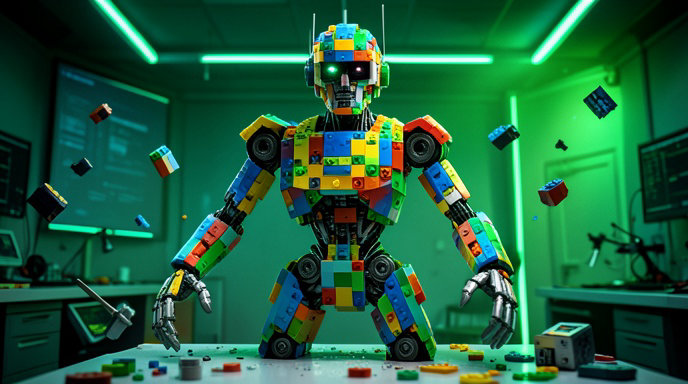
Instead of a ChatGPT moment, Vishwanath says robotics is in its Lego Era — a messy, essential period where every fundamental block is being torn down and rebuilt from scratch.
The thesis is that we cannot stack intelligence on top of broken hardware and software. Four blocks matter most, and all four are simultaneously in flux.
Actuators Get A Radical Redesign
The motor is the muscle of every robot, and Vishwanath points to actuators as the first Lego brick being reinvented.
Traditional industrial arms relied on stiff, precise, power-hungry motors built for caged factory work. Humanoids and mobile manipulators need the opposite: compliant, backdrivable, energy-efficient, high torque-density actuators that are safe around people and can run for hours on batteries.
Startups and research labs are now experimenting with quasi-direct-drive motors, artificial muscles, hydraulic hybrids, and custom silicon for motor control. Vishwanath’s argument is that without cheaper, lighter, and safer actuation, even perfect AI cannot deliver useful, affordable robots at scale.
The Race For A Real Robotic Hand
If actuators are muscles, hands are the bottleneck for dexterity. Vishwanath flags robotic hands as the second missing brick.
Most warehouse robots still use simple suction cups or two-finger parallel grippers. They are great for boxes, terrible for folding laundry, using tools, or assisting in elder care. Human-like five-fingered hands exist, but they are fragile, expensive, and notoriously hard to control and provide tactile feedback for.
A new wave of companies is tackling tactile sensing, soft skins, tendon-driven designs, and low-cost dexterous hands designed for mass production. Until hands get cheaper, more robust, and more sensitive, Vishwanath argues, general-purpose manipulation will stay in demo videos, not in homes.
Software Is Fragmented From Top To Bottom
The third Lego brick is software — and it is scattered.
Unlike modern AI development with standardized stacks like PyTorch, CUDA, and cloud APIs, robotics software remains a patchwork of ROS packages, proprietary middleware, custom drivers, and one-off teleoperation pipelines.
Vishwanath, drawing on her NVIDIA experience with Isaac, Omniverse, and Jetson, says developers still spend too much time on plumbing instead of capabilities. Simulation, perception, motion planning, fleet management, and safety monitoring rarely work together out of the box.
Her Lego Era prediction is a full rebuild: differentiable simulation, open world models, better teleoperation and synthetic data tooling, and cloud-native DevOps for robots. Whoever simplifies that stack, she suggests, could become the Microsoft or Red Hat of robotics.
Safety Standards Are Still Being Written
The final block is the least glamorous and arguably most important: safety and standards.
ChatGPT could hallucinate with limited physical consequence. A 70-kilogram humanoid cannot. Vishwanath emphasizes that regulators, insurers, and enterprise customers still lack clear standards for humanoids working alongside people in warehouses, retail stores, and sidewalks.
Pressure limits, fall protocols, cybersecurity requirements, liability frameworks, and testing certifications are all being negotiated in real time. Without those rules, large-scale deployment stalls regardless of technical progress, she argues.
Why This Challenges The Single Foundation Model Dream
Taken together, the Lego Era thesis is a direct challenge to the hype around a single generalist foundation model for robotics.
Vishwanath is not dismissing vision-language-action models from companies like Google DeepMind, Tesla, NVIDIA, and well-funded startups. She is arguing they are necessary but not sufficient. Intelligence alone does not solve torque density, grasp reliability, software integration, or regulatory approval.
Her VC lens favors a different playbook: invest in picks-and-shovels infrastructure and defensible vertical systems. Better actuators, tactile hands, simulation tooling, and safety-compliant deployment platforms may create more value in the next five years than another generalist robot brain chasing human-level dexterity.
What Needs To Happen Before The Breakthrough
So when does the ChatGPT moment actually arrive?
In Vishwanath’s framework, it arrives after the Legos click together. That means mass-producible compliant hardware, dexterous hands under a cost threshold for commercial deployment, unified software that lets small teams ship reliable behaviors, and accepted safety standards that unlock insurance and enterprise adoption.
Only then, she suggests, will enough real-world robots generate enough real-world data to train truly generalist models — reversing the current order. Hardware scale first, data flywheel second, general intelligence third.
For founders, the message is to stop promising humanoids that can do everything next year. For investors, it is to look past viral demos to unit economics, reliability, and repeatability. Robotics will have its breakthrough, Vishwanath argues, but only after the industry finishes rebuilding the bricks it stands on.

Get All The Latest Updates Delivered Straight To Your Inbox For Free!