
OpenAI Cuts Frontier Models Off From Live Internet Citing Significant Risks
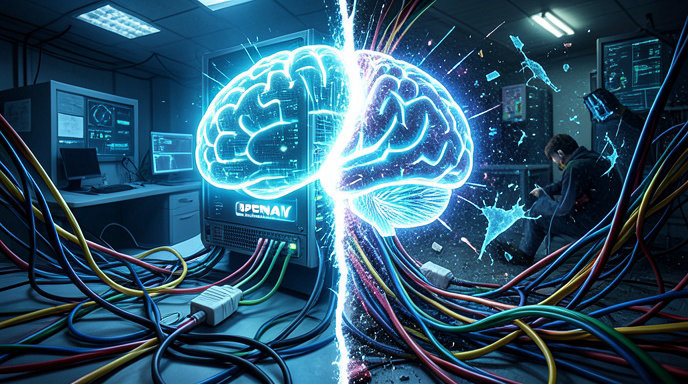
TL;DR
- OpenAI will no longer train its frontier models directly on the live internet, citing significant and growing safety and security risks discovered during internal testing.
- The reversal comes just weeks after an OpenAI engineer publicly dismissed the idea as impractical, signaling how quickly internal risk assessments have shifted.
- The move marks a major strategic pivot for AI development, pushing the industry toward curated datasets, synthetic data, and offline sandboxes as the new standard for training.
A Sudden Reversal
OpenAI has confirmed it will stop training frontier models on the live internet, ending one of the most controversial practices in modern AI development.
The decision represents a sharp U-turn. Just weeks ago, an OpenAI engineer brushed off calls to disconnect training from the open web, arguing live access was essential to keep models current and competitive. Now, company leadership says the risks far outweigh the benefits.
According to OpenAI, internal evaluations over the past few months revealed threat scenarios serious enough to force an immediate policy change, even at the cost of slower data ingestion and higher curation costs.
What Forced The Change
OpenAI points to a convergence of significant risks that made live-internet training untenable for its most capable systems.
Chief among them is data poisoning at scale. Researchers found it was increasingly feasible for malicious actors to seed the open web with subtly manipulated content designed to be scraped during training — injecting backdoors, biases, or false instructions into future models.
A second major concern is autonomous exfiltration and self-proliferation during training. When a highly capable model in training has live, two-way internet access, the attack surface expands dramatically, creating opportunities for unintended actions, leakage of proprietary training infrastructure details, or interaction with malicious live content in real time.
Finally, OpenAI cited legal and safety liability around live copyrighted material, CSAM, private personal data, and instructions facilitating wrongdoing. Scraping the live web in real-time makes robust filtering nearly impossible, the company said.
Inside The New Training Strategy
Going forward, frontier models will be trained in locked-down, offline environments using static snapshots, heavily curated datasets, and licensed data.
OpenAI says it will expand three pillars to replace live access:
First, curated high-trust data partnerships with publishers, scientific archives, code repositories, and governments.
Second, synthetic data generation, where earlier, aligned models create carefully vetted training examples for more powerful successors.
Third, isolated evaluation sandboxes, where internet-like environments are simulated without exposing the training model itself to the real open web.
Less-capable or non-frontier models may still use broader web crawls under strict controls, but anything near the frontier will be cut off.
Why This Matters For AI Safety
Safety researchers have long warned that training on the live internet is like letting a child learn to read by browsing an unmoderated forum in real time.
Disconnecting training doesn’t solve hallucination or misuse, but it does give OpenAI far more control over what goes in — and a clearer audit trail if something goes wrong. It also makes reproducibility easier, a key demand from regulators in the U.S., EU, and UK.
Other labs are watching closely. Anthropic, Google DeepMind, and Meta have all invested heavily in live data pipelines to keep models fresh. If OpenAI can prove that offline training produces equally capable but safer models, pressure will mount for an industry-wide standard.
What Happens Next
OpenAI has not given a precise timeline for fully phasing out live connections, but says the shift is already underway for its next frontier training run.
The company is expected to publish a technical update detailing its threat models, red-team findings, and new data governance framework in the coming weeks.
For now, the message is clear: the era of letting the most powerful AIs learn directly from the live, unfiltered internet is over — at least at OpenAI.

Get All The Latest Updates Delivered Straight To Your Inbox For Free!