
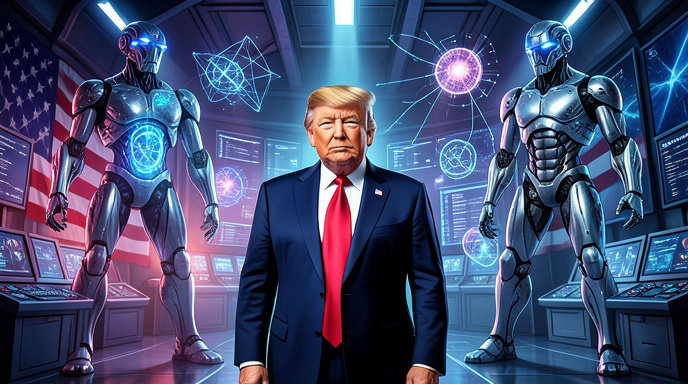
Trump Unveils Super Intelligence Force Amid AI Safety Debate
TL;DR
- President Trump has unveiled a new Super Intelligence Force tasked with preparing the U.S. for superintelligent AI while balancing safety concerns and innovation.
- The task force brings together White House officials, AI czar David Sacks, OSTP leadership, and advisors from OpenAI, Nvidia, Meta, and other major labs.
- The move signals a major shift in U.S. AI policy toward accelerated development, light-touch federal oversight, and aggressive competition with China.
A New Play for the Superintelligence Era
Washington is entering a new phase of the AI race. This week, President Donald Trump announced the formation of a Super Intelligence Force, a high-level task force charged with steering U.S. policy as industry leaders warn that highly capable, superintelligent systems could arrive within just a few years.
The announcement, made from the White House alongside tech executives and administration officials, frames superintelligence not as distant science fiction but as an imminent national challenge. Trump said the group will ensure America leads in building powerful AI while preventing safety failures, misuse, and foreign adversaries from gaining an edge.
The timing is no accident. It comes amid a heated national debate over AI safety, following open letters from researchers, whistleblower warnings from lab employees, and growing bipartisan concern in Congress about loss of control, biosecurity risks, and AI-enabled cyberattacks.
What Is the Super Intelligence Force
The Super Intelligence Force is described as an interagency-plus-industry task force rather than a new regulatory agency. It will operate out of the White House Office of Science and Technology Policy in coordination with the Department of Commerce, Department of Defense, Department of Energy, and the National Security Council.
Unlike the Biden-era AI Safety Institute, which focused heavily on testing, red-teaming, and voluntary guardrails, the new force is explicitly pro-acceleration with a safety mandate. Officials say its job is not to slow down labs, but to create a fast lane for safe American models to reach deployment first.
Key priorities outlined so far include national evaluations for frontier models, securing AI data centers and chip supply chains, countering Chinese open-source advances, and developing rapid-response protocols for dangerous AI capabilities.
Mission Goals: Safety, Speed, and Supremacy
The White House laid out three core pillars for the task force.
First is anticipatory safety. The force will develop government evaluation capacity for next-generation reasoning models, agentic systems, and potential superintelligent prototypes, focusing on scheming behavior, self-replication, cyber-offense, and weapons-related uplift.
Second is infrastructure dominance. Tied closely to the administration's AI Action Plan and the Stargate data center initiative, the force will fast-track permits for AI-ready power plants, federal land for data centers, and export controls to keep advanced Nvidia and AMD chips in allied hands.
Third is ideological positioning. Administration officials have repeatedly criticized what they call biased or woke AI. The force is expected to push for models rooted in free speech, open inquiry, and American values, while opposing state-level safety laws the White House views as innovation killers.
Key Players to Watch
The task force will be chaired by Vice President JD Vance, who has become the administration's leading voice on AI nationalism, alongside AI and Crypto Czar David Sacks and OSTP Director Michael Kratsios.
Other central figures include Secretary of Commerce Howard Lutnick on chips and export controls, Energy Secretary Chris Wright on AI power needs, and National Security Advisor leadership on AI competition with China.
On the industry side, the White House has signaled close involvement from OpenAI CEO Sam Altman, Nvidia CEO Jensen Huang, Meta's superintelligence leadership, Anthropic's national security team, xAI, Microsoft, and Google DeepMind. Former Scale AI CEO Alexandr Wang, now leading Meta Superintelligence Labs after the company's high-profile hiring spree, was also name-checked as an informal advisor.
Critics note the heavy industry presence raises conflict-of-interest questions, with safety advocates warning the foxes may be guarding the henhouse.
What This Signals for U.S. AI Policy
The launch of the Super Intelligence Force confirms a decisive pivot in U.S. AI policy: from precaution to preemption.
Where previous efforts centered on voluntary commitments, NIST frameworks, and international safety summits at Bletchley and Seoul, Trump's approach bets that American speed is itself a safety strategy. The logic is simple: if superintelligence is coming, it had better be built in Texas or California, not in Beijing.
Expect fewer new federal AI regulations, more executive orders preempting state AI safety bills, expanded public-private testing partnerships, and a national security framing of AI similar to the Manhattan Project or Space Race.
Still, the debate is far from settled. AI safety researchers, some Democratic lawmakers, and even insiders at frontier labs argue that without independent oversight and legal teeth, a task force built for winning could miss the risks of losing control. Whether the Super Intelligence Force can deliver both dominance and safety will define the next chapter of American tech power.

Get All The Latest Updates Delivered Straight To Your Inbox For Free!