
WindBorne Lands $50M US Air Force Deal for AI-Powered Weather Balloons
TL;DR
- WindBorne Systems has won a nearly $50 million U.S. Air Force contract to supply real-time atmospheric data collected by its global fleet of smart weather balloons.
- The Silicon Valley startup combines long-duration balloons with its in-house AI forecasting model, WeatherMesh, to fill critical gaps in global weather observations.
- The deal marks a major military bet on commercial weather data and signals a shift toward AI-driven, private-sector forecasting for defense and civilian use.
A Startup Reinvents The Weather Balloon
WindBorne Systems is not building rockets or satellites. The Mountain View, California-based startup, founded in 2019 by Stanford graduates John Dean, Kai Marshland and Jaxon Sanders, is betting on one of the oldest tools in meteorology: the weather balloon.
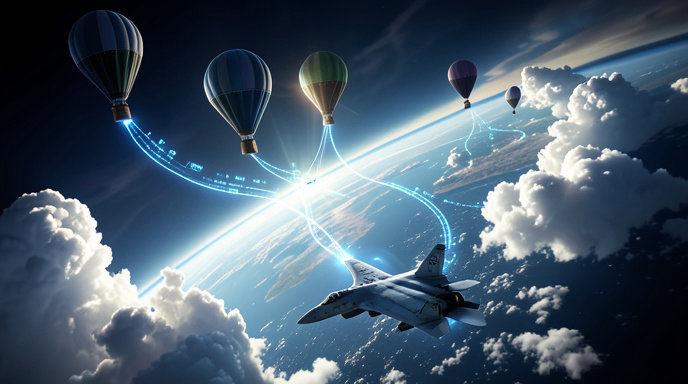
But WindBorne's balloons are nothing like the latex radiosondes launched twice a day by weather agencies and lost after a few hours. The company's Global Sounding Balloons are lightweight, solar-powered, ultra-long-duration platforms designed to stay aloft for 30 to 60 days at a time, drifting through the stratosphere while rising and falling to sample different layers of the atmosphere.
Each balloon carries a miniaturized sensor payload called a WindBorne Sounding that measures temperature, pressure, humidity, wind speed and direction, and GPS position every few seconds. The data is beamed down via satellite link in real time, creating a moving, three-dimensional map of the atmosphere from the ground up to over 60,000 feet.
The company now launches hundreds per week from sites in the U.S., and says it has flown more than 5,000 long-duration missions, collecting over 10 million atmospheric observations from remote regions over oceans, the Arctic, and the developing world where traditional data is scarce.
Inside The Nearly $50 Million Air Force Deal
The new contract, awarded by the U.S. Air Force Life Cycle Management Center, is valued at just under $50 million and covers the delivery of balloon-collected atmospheric sensing data for military weather forecasting operations.
Under the agreement, WindBorne will provide continuous, on-demand profiles from its global constellation directly to Air Force weather centers, where the data will be fed into the military's numerical weather prediction models.
Air Force officials have framed the deal as a Commercial Data Buy — part of a broader Pentagon push to supplement government-owned satellites and sensors with faster, cheaper commercial sources. Unlike a traditional hardware procurement, the Air Force is not buying the balloons themselves. It is buying the data stream.
The award follows smaller pilot contracts and demonstrations with the Air Force, NOAA, and the National Weather Service, and is by far WindBorne's largest public-sector deal to date. It comes after a breakout year for the company, which raised $299 million in venture funding led by Coatue earlier in 2025 to scale manufacturing and launch its own AI forecast model.
Why The Military Wants Balloon Data So Badly
For the Air Force, weather is a weapon. Accurate forecasts determine everything from flight routes and aerial refueling to drone operations, artillery accuracy, satellite launches, and special forces missions.
Yet the military faces a growing observation gap. Geostationary and polar-orbiting weather satellites provide broad coverage but struggle to capture the vertical details of temperature, moisture and wind that drive storm formation. Traditional weather balloons only cover land, mainly in the U.S., Europe and parts of Asia, leaving huge blind spots over the Pacific, Atlantic, Arctic and equator.
That is exactly where WindBorne operates. Because its balloons drift with global wind currents for weeks, they can loiter over conflict-prone and data-sparse regions for days, collecting in-situ measurements that satellites can only infer.
Pentagon weather planners say assimilating even a small amount of high-quality, in-situ upper-air data can dramatically improve 3-to-7-day forecast skill — the critical window for mission planning and humanitarian response. In an era of great-power competition, with operations increasingly spread across the Indo-Pacific, that edge matters.
AI Meets Atmosphere: The WeatherMesh Play
Data is only half the story. WindBorne has used its proprietary balloon dataset to train WeatherMesh, its own AI-powered global forecasting system.
Like Google DeepMind's GraphCast, Huawei's Pangu-Weather, and Nvidia's FourCastNet, WeatherMesh uses machine learning to learn physics directly from decades of historical weather plus WindBorne's real-time balloon observations. The company claims WeatherMesh already outperforms the U.S. GFS and European ECMWF models on key metrics for medium-range forecasting, especially for high-impact events like atmospheric rivers, hurricanes and heat domes.
The Air Force deal will create a powerful feedback loop: more balloons in the air means more training data for the AI, which means better forecasts, which drives demand for more targeted observations.
WindBorne says its long-term vision is a fully adaptive observing system, where AI identifies uncertainty in the forecast and then tasks nearby balloons to climb, descend or drift to that exact location to collect more data — essentially a steerable, intelligent weather network.
What It Means For The Future Of Forecasting
The $50 million award is the clearest sign yet that Washington views commercial weather as mission-critical infrastructure, not just a Silicon Valley experiment.
It follows similar moves by NOAA's Commercial Data Program, which now buys radio occultation data from Spire Global and PlanetiQ, and microwave sounding data from Tomorrow.io. WindBorne adds a crucial new layer: direct, in-situ profiles from the most under-observed parts of the planet.
For the private weather industry, the implications are huge. Global forecasting has for decades been dominated by government supercomputers in the U.S. and Europe. Startups like WindBorne, Tomorrow.io, and Atmo are now arguing that a combination of cheap sensors, global constellations, and AI models can deliver faster, more localized forecasts at a fraction of the cost.
Challenges remain. Scaling to thousands of simultaneous balloons will require new FAA approvals, sustainable materials to avoid plastic waste, and proof that AI models can maintain reliability during unprecedented climate extremes.
But with Air Force backing, a rapidly growing balloon fleet, and an AI model trained on data no one else has, WindBorne has just moved from weather outsider to central player. If it succeeds, your next seven-day forecast — and the Pentagon's next mission plan — could start not with a satellite 500 miles up, but with a 6-foot balloon drifting silently above the Pacific.

Get All The Latest Updates Delivered Straight To Your Inbox For Free!