
Anthropic’s $3.4 Billion Natural Gas Turbine Deal Signals AI Energy Frenzy
TL;DR
- No publicly verified evidence shows Anthropic has agreed to purchase $3.4 billion worth of natural-gas turbines; the claim appears to conflate broader AI power deals with Anthropic’s actual infrastructure partnerships.
- The episode nevertheless reflects a real scramble for dependable electricity as AI data centers place unprecedented demands on grids, gas generation, nuclear power, renewables and batteries.
- Gas turbines can provide speed and reliability, but fuel-price exposure, emissions rules, stranded-asset risk and uncertain AI demand could leave buyers facing expensive buyer’s remorse.
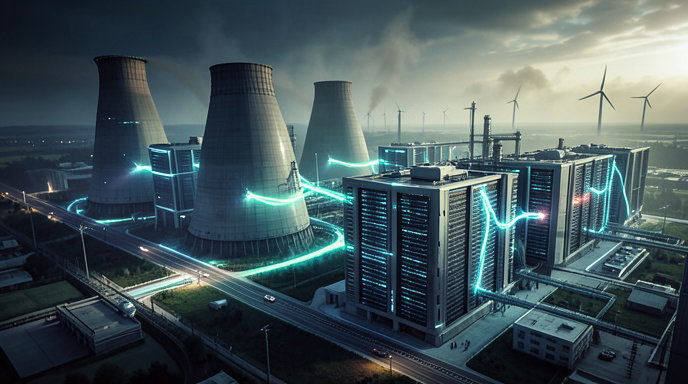
A striking claim that Anthropic has committed $3.4 billion to natural-gas turbines captures the central anxiety of the artificial-intelligence boom: powerful models require enormous amounts of electricity, and the companies building them are increasingly competing not only for chips and data centers, but for the power plants needed to keep those facilities running.
There is an important qualification, however. No publicly available company announcement or regulatory filing has established that Anthropic itself has purchased $3.4 billion of natural-gas turbines. The figure appears to blend Anthropic’s rapidly expanding infrastructure commitments with a wider series of energy and data-center transactions involving other technology companies, cloud providers, developers and power-generation manufacturers.
That distinction matters. It would be misleading to present the purported purchase as a confirmed Anthropic transaction. But the underlying trend is real: AI companies and their infrastructure partners are seeking firm power at a scale that is reshaping energy markets.
The race for dependable electricity
Training and operating advanced AI systems requires specialized data centers packed with high-performance accelerators. Unlike many conventional digital services, these facilities can draw power continuously and in concentrated locations. A large AI campus may require hundreds of megawatts, while proposed hyperscale developments could eventually demand several gigawatts—comparable to the electricity consumption of a major city.
Anthropic has built its computing strategy around partnerships with major cloud providers. Amazon Web Services is its principal cloud partner and has committed billions of dollars to the company, while Google has also invested heavily and supplied access to its cloud infrastructure and custom AI chips. Those arrangements give Anthropic access to vast computing capacity without requiring the startup to own every data center or generator directly.
The electricity burden does not disappear when infrastructure is outsourced. It moves to cloud providers and data-center developers, which must secure land, grid connections, substations, backup generation and long-term power contracts.
That has created a new incentive to obtain electricity quickly. In many regions, connecting a large facility to the transmission grid can take years because of permitting delays, equipment shortages and overloaded interconnection queues. Natural-gas turbines are attractive partly because they can be deployed faster than large nuclear plants and can operate when wind and solar output is low.
Why gas turbines are appealing
Gas-fired generation offers several practical advantages for AI infrastructure.
Combined-cycle gas plants can produce electricity efficiently at large scale, while simple-cycle turbines can ramp up rapidly to cover peaks in demand or provide backup power. Developers can also place gas generation near data centers, reducing dependence on congested transmission networks. In markets where pipelines already exist, gas plants may be easier to finance and construct than entirely new transmission corridors.
For companies under pressure to bring AI capacity online, that flexibility is valuable. A delayed data center can mean months of lost revenue and a shortage of computing capacity just as demand for model training, inference and enterprise AI services is accelerating.
Gas turbines may also be used as a bridge while developers wait for longer-term supplies of nuclear, geothermal, hydroelectric or renewable power. Some operators are exploring combinations of solar, wind, batteries and gas generation to provide a more stable electricity profile.
The environmental trade-off
The reliability advantages come with significant environmental costs.
Burning natural gas produces carbon dioxide, and gas plants also emit nitrogen oxides and other pollutants. Although gas generally produces fewer carbon emissions than coal for the same amount of electricity, it is not a zero-carbon solution. The climate impact can be substantially higher when methane leaks during gas extraction, processing and transportation.
The location of new generation matters as well. A gas plant built beside an AI data center could reduce stress on the wider grid, but it may expose nearby communities to additional air pollution, noise and industrial activity. Local opposition could delay projects that developers selected precisely for their speed.
There is also a risk that temporary gas generation becomes permanent. Once a turbine is installed, its owners may seek to operate it for decades to recover the investment. That could lock regions into fossil-fuel infrastructure even as governments tighten emissions standards and companies make increasingly ambitious climate commitments.
AI’s power forecasts are difficult to trust
The financial case for a major turbine purchase depends on assumptions about future AI demand. Those assumptions are unusually uncertain.
AI companies have generated enormous interest, but the long-term economics of many applications remain unsettled. Some workloads may become dramatically more efficient as software improves and models are optimized. New chips could deliver more performance per watt. Smaller models may replace larger ones for routine tasks. Conversely, new video, reasoning and autonomous-agent applications could drive electricity use far beyond current projections.
A gas plant designed around aggressive growth forecasts can become underutilized if demand slows, customers cancel capacity or a newer computing architecture requires less power. The same problem could emerge if grid operators deliver transmission upgrades sooner than expected, making on-site generation less necessary.
Turbines also expose buyers to fuel-price volatility. A facility that relies on gas may enjoy relatively low operating costs during periods of abundant supply, but its economics can deteriorate when pipeline capacity is constrained or commodity prices rise. Long-term fuel contracts reduce some uncertainty while potentially creating another form of inflexibility.
The danger of stranded infrastructure
Large power projects are built to last. AI infrastructure is moving much faster.
Server hardware can become obsolete within a few years, while a turbine, pipeline connection or power plant may be expected to operate for 20 years or more. If future AI systems use less electricity per task, or if companies shift workloads to regions with cheaper clean power, a generation asset built for today’s boom could fail to earn its expected return.
Regulation creates another risk. Carbon pricing, emissions limits, permitting restrictions and methane rules could raise the cost of gas-fired electricity. A plant that looks competitive under current rules may become expensive if governments require carbon capture, efficiency upgrades or additional pollution controls.
There is also reputational risk. Technology companies increasingly market themselves as participants in the clean-energy transition. A large fossil-fuel commitment could trigger criticism from investors, employees, customers and local communities, particularly if it is presented as a direct response to AI growth.
Who would bear the cost?
Even when an AI company does not own a turbine, it can still be exposed to the project’s economics. Cloud providers may pass power costs through to customers, sign take-or-pay contracts or build new campuses based on anticipated demand from a handful of major clients.
That arrangement can distribute risk across the ecosystem, but it does not eliminate it. If Anthropic or another AI customer reduces usage, the cloud provider may still be responsible for capacity payments and debt service. If the provider raises prices to compensate, AI services become more expensive and less attractive to customers.
Local electricity consumers could also face consequences. Utilities may invest in substations, transmission lines and generation based on the expectation that data centers will provide a stable and lucrative load. In some markets, regulators are debating whether data-center customers should pay the full cost of those upgrades or whether some expenses will be spread across all ratepayers.
The case for a diversified power strategy
The most defensible response to AI’s energy needs is unlikely to be a single technology. Gas can offer dispatchable power, but it should be weighed against renewables, storage, grid improvements, demand management, nuclear generation and efficiency measures.
Data centers can reduce their impact by scheduling some workloads when renewable electricity is abundant, improving cooling systems and using more efficient chips. They can also locate facilities where clean power and transmission capacity already exist rather than competing for scarce connections in constrained regions.
Longer-term agreements for wind, solar, hydroelectric and nuclear electricity may help companies limit exposure to fuel prices and emissions regulation. Those resources cannot always replace firm generation on their own, but batteries, geographic diversification and better grid coordination can narrow the gap.
Small modular reactors are frequently discussed as a future source of reliable, low-carbon power, though their commercial deployment remains uncertain and their timelines are generally longer than those of gas turbines. Geothermal projects and advanced long-duration storage could eventually expand the menu of options, but neither is yet available everywhere at the scale required by hyperscale AI.
A warning disguised as a deal story
The alleged $3.4 billion Anthropic turbine purchase should not be treated as an established fact without a company announcement, filing or contract confirming it. Still, the story resonates because it reflects a genuine shift in the technology industry.
For years, data-center power was treated as an operational detail. Now it is a strategic constraint. Companies developing AI systems must secure electricity, land, cooling, transmission and generation at the same time they compete for scarce accelerators and engineering talent.
Natural gas can help solve the immediate reliability problem. It is familiar, dispatchable and often faster to deploy than alternatives. But a rush into turbines could create a new set of liabilities: higher emissions, exposure to fuel markets, regulatory uncertainty and infrastructure that may outlive the AI business case that justified it.
That is the source of the potential buyer’s remorse. The companies that secure power first may gain a short-term advantage, but they could also be committing billions to assets designed for an era of relentless AI growth. If demand, technology or climate policy changes faster than expected, yesterday’s solution could become tomorrow’s expensive reminder that electricity forecasts are not the same thing as durable economics.

Get All The Latest Updates Delivered Straight To Your Inbox For Free!