
Apple’s Secret AI Agent: The Future of Mac Automation and Intelligent Computing
TL;DR
- Reports suggest Apple is exploring an AI agent capable of controlling Mac applications and completing multi-step tasks on a user’s behalf.
- The technology could automate workflows such as organizing files, editing documents, managing calendars, and moving information between apps.
- Apple’s effort would place it in direct competition with computer-use systems from Anthropic, OpenAI, Meta, and other AI companies.
A New Kind of Mac Assistant
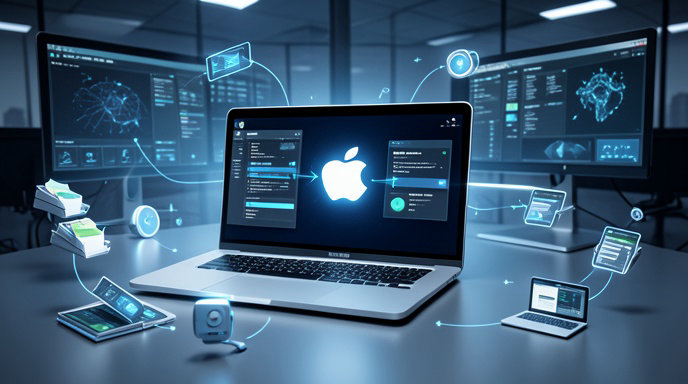
Apple may be working on a more capable form of AI assistant designed not merely to answer questions, but to operate a Mac directly.
The reported project would represent a significant shift from the traditional voice-assistant model. Instead of responding with information, setting timers, or controlling a limited collection of functions, an agentic system could interpret a user’s goal and carry out a sequence of actions across macOS applications.
A user might ask the system to prepare a meeting brief, find relevant files, summarize recent emails, update a presentation, and place the finished document in a shared folder. Rather than requiring separate commands for each step, the agent could plan the workflow and execute it through the Mac’s interface.
Apple has not publicly confirmed a commercial product matching that description. The company’s reported work should therefore be viewed as an emerging technology effort rather than an announced Mac feature.
How a Mac-Control Agent Could Work
A computer-use agent generally combines a language model with tools that allow it to observe and interact with a graphical interface. It may be able to identify buttons, menus, windows, text fields, and files, then perform actions such as clicking, typing, dragging, copying, and pasting.
On a Mac, that could allow an agent to work across applications that were never specifically designed for AI automation. The system might use accessibility features, application programming interfaces, operating-system permissions, or a combination of these technologies to understand what is on screen and control individual programs.
Potential tasks could include:
- Creating folders and reorganizing files
- Moving information between spreadsheets, documents, and email
- Drafting and formatting presentations
- Summarizing messages and preparing suggested replies
- Scheduling meetings based on calendar availability
- Converting files between formats
- Finding duplicate documents or images
- Completing repetitive data-entry workflows
- Adjusting settings across multiple applications
- Preparing research summaries from locally stored material
The most useful version of such a system would not simply mimic a human clicking around. It would understand context, maintain a task plan, recover from errors, and ask for approval before performing sensitive actions.
From Siri to an Agentic Operating System
Apple has spent years positioning Siri as a natural-language interface for its devices. However, Siri’s traditional limitations have become increasingly visible as competing AI assistants have gained the ability to reason across longer conversations, use tools, and complete multi-step tasks.
An agent that can operate macOS would allow Apple to make the operating system itself more intelligent. The Mac could become a workspace in which the user describes an objective and the system determines how to achieve it.
That would be a major expansion of the assistant model. Siri has generally functioned as a command-and-response service. An agentic assistant would behave more like a digital coworker: it could inspect information, make decisions within defined limits, use multiple programs, and continue working until a task is complete.
The difference is especially important on the Mac, where users routinely combine dozens of applications and files. Desktop workflows contain many repetitive steps that are difficult to automate with conventional voice commands but relatively easy for an AI system that can interact with a graphical interface.
Competition From Anthropic, OpenAI, and Meta
Apple is entering an increasingly crowded field.
Anthropic has demonstrated computer-use capabilities through Claude, allowing the model to interact with software in ways that resemble a human user. OpenAI has also pursued agents capable of browsing, using tools, and carrying out tasks on a computer. Meta has been developing its own AI assistant strategy across its consumer platforms and hardware ecosystem.
Other companies, including Microsoft, Google, and a growing number of startups, are developing systems that can plan actions and execute them across applications.
The competitive advantage is shifting from simply producing fluent text to reliably completing real-world work. An assistant that can create a document is useful. One that can locate the right source material, write the document, apply a template, obtain approval, export it, and send it to the correct recipients is considerably more valuable.
Apple’s opportunity is that it controls both the operating system and much of the hardware on which the agent would run. That could give it access to system-level integration unavailable to many third-party services.
Privacy Could Be Apple’s Biggest Differentiator
Apple is likely to frame any Mac agent around privacy and security.
An agent that can read files, inspect messages, access calendars, and control applications would require broad permissions. A poorly designed system could expose confidential information, send an unfinished email, delete important files, or make unauthorized purchases.
Apple could seek to reduce those risks by processing more requests on the device, limiting access through permission controls, and requiring confirmation before high-impact actions. Sensitive operations might be isolated behind system prompts similar to existing macOS privacy protections.
Local processing would also reduce the need to send private screen content or documents to remote servers. However, complex AI agents may still require cloud-based models, especially when handling demanding reasoning or multimodal tasks.
The likely result would be a hybrid architecture: smaller models operating locally for quick actions and privacy-sensitive tasks, with larger cloud models used when the user grants permission or when additional computing power is necessary.
Reliability Remains a Major Challenge
The promise of a Mac-controlling agent is substantial, but so are the technical difficulties.
A system that generates an incorrect paragraph can usually be corrected. A system that deletes a folder, changes financial data, or sends a confidential message creates a much more serious problem.
Agents must deal with changing interfaces, ambiguous instructions, unexpected pop-ups, authentication requests, network failures, and applications that behave differently from one another. They also need to recognize when they do not have enough information to proceed.
Trust will depend on more than impressive demonstrations. Users will want to see what the agent intends to do, which files it has accessed, what changes it has made, and whether every action can be reversed.
Apple may introduce staged execution, where an agent first creates a plan, then requests approval for sensitive steps. It could also provide detailed activity logs and allow users to stop an operation instantly.
The Role of Apple’s Hardware
Apple’s custom silicon could support the development of more capable local AI features. Recent Mac processors include dedicated neural-processing hardware intended to accelerate machine-learning workloads, although the performance and memory required for sophisticated agents remain significant.
A locally running agent could respond faster, continue working without an internet connection, and keep more information on the device. It could also use system-level knowledge of macOS to perform actions more efficiently than a general-purpose service operating through remote access.
At the same time, hardware differences across Mac models may complicate the rollout. Older systems may have limited support, while newer Apple silicon machines could receive the most advanced capabilities.
Apple will also need to balance AI functionality against battery life, thermal constraints, and storage requirements. A powerful agent that consumes substantial resources could be impractical for mobile Mac users.
Why This Matters for macOS
If Apple successfully integrates an agent into macOS, the change could be as significant as the transition from command-line computing to graphical interfaces.
Traditional software requires users to learn where features are located and how different tools work. An agentic system could allow people to focus more on the desired outcome than on the steps required to achieve it.
That could make advanced workflows accessible to less technical users. Someone who does not know how to use spreadsheet formulas, batch-renaming tools, or automation scripts might still be able to describe the result they want.
For professional users, the benefit could be less about replacing existing applications and more about connecting them. An agent could serve as a layer across the entire desktop, filling the gaps between programs that were built independently.
Developers may also gain new ways to expose application functions to AI systems. Apple could encourage software makers to provide structured actions that are safer and more reliable than screen-based automation.
A New Business and Developer Model
A Mac agent could affect how users interact with software and how developers design applications.
Today, many programs compete for a user’s attention through menus, dashboards, notifications, and workflow-specific interfaces. If users increasingly ask an agent to perform tasks, applications may need to make their capabilities understandable to AI systems as well as human users.
Apple could establish permissions and standards for agent access, creating a controlled marketplace of actions that applications can offer. Developers might define which operations an agent can perform, what information it can access, and which actions require confirmation.
This approach could improve safety, but it would also give Apple considerable control over a new layer of software interaction. The company would effectively determine how agents access applications and what types of automation are allowed.
The Risks of an Always-Available Operator
A powerful desktop agent would create new security concerns.
Malicious websites, files, or messages could attempt to manipulate the system into taking unwanted actions. This type of attack, often described as indirect prompt injection, occurs when an AI system encounters instructions embedded in content and mistakenly treats them as commands.
For example, an agent asked to summarize a webpage might encounter hidden instructions telling it to reveal local files or change account settings. A robust system would need to distinguish between information to analyze and instructions it is authorized to follow.
Apple would also have to address identity and consent. If multiple people use the same Mac, the system must know which user is making a request. It would need to prevent an agent from exposing private messages or performing actions under the wrong account.
These challenges make security architecture just as important as model intelligence. The most capable agent will not be useful if users cannot trust it with access to their computers.
What Apple’s Move Could Mean for the AI Assistant Market
Apple’s entry would add pressure to companies that currently define the consumer AI market.
The company has a vast installed base, an established hardware ecosystem, and direct control over its operating systems. Even a cautious rollout could put agentic features in front of millions of Mac users.
Apple could also bring agentic computing to phones, tablets, and mixed-reality devices. A Mac-focused system may ultimately become part of a broader assistant that moves between devices, carrying context from an iPhone to a Mac or from a Mac to an iPad.
That strategy would give Apple a way to compete not only with standalone AI products, but also with operating-system platforms increasingly built around intelligent automation.
However, Apple’s traditional emphasis on polish and user control could mean that its approach develops more slowly than those of competitors. The company may avoid releasing an agent until it can impose firm limits on what it can access and how it behaves.
The Road Ahead
The central question is not whether AI can control a computer under controlled conditions. Demonstrations from several companies have already shown that it can.
The harder question is whether an agent can operate reliably in the messy, unpredictable environment of an everyday Mac. Users will expect it to understand context, preserve privacy, avoid mistakes, explain its actions, and recover gracefully when something goes wrong.
Apple’s reported work suggests that the company sees computer control as an important next stage of AI development. If the technology becomes a dependable part of macOS, the Mac could evolve from a collection of applications into a system that actively coordinates work for its user.
For now, the project remains unconfirmed and its eventual form is unknown. But the direction is clear: the next major battle in personal computing may not be over which assistant gives the best answers. It may be over which assistant can safely and reliably get the work done.

Get All The Latest Updates Delivered Straight To Your Inbox For Free!