
Daniel Ek Backs Europa Fusion: Inside the AI Researcher’s Race to Build Fusion Power
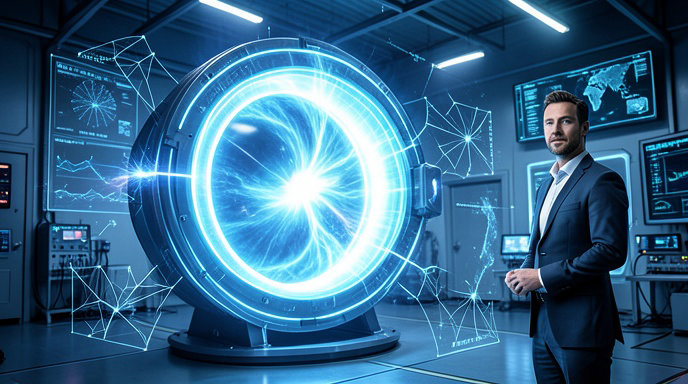
TL;DR
- Spotify co-founder Daniel Ek is backing Europa Fusion, an early-stage startup applying artificial intelligence to the search for commercially viable fusion power.
- The company’s strategy appears to combine computational design, machine-learning optimization and experimental validation rather than relying on a single untested breakthrough.
- Fusion remains a formidable engineering challenge: producing net energy is only the beginning, with materials, fuel handling, maintenance, cost and grid integration still unresolved.
A New Bet on Fusion’s Long Game
Daniel Ek, best known as the co-founder and former chief executive of Spotify, is putting money behind a very different kind of technology: fusion energy.
Through his investment activities, Ek is backing Europa Fusion, a young fusion company founded by an artificial-intelligence researcher. The investment places the startup within a growing group of companies attempting to commercialize fusion, a field that has attracted billions of dollars from venture capitalists, governments and major technology entrepreneurs.
Europa Fusion is still an early-stage company, and publicly available information about its financing, hardware roadmap and technical milestones remains limited. What is clear is the broad ambition: use modern AI techniques to reduce the time and cost required to design, simulate and operate fusion systems.
That proposition reflects a change in the fusion industry. For decades, progress depended largely on increasingly large experiments, extensive numerical simulations and painstaking trial and error. AI could give researchers a way to search through an enormous number of possible designs more quickly, identify promising operating conditions and learn from experiments as they unfold.
But faster discovery is not the same as a working power plant. Europa Fusion’s challenge will be converting computational insight into machinery that can survive extreme temperatures, intense radiation and continuous operation.
Why Ek Is Looking Beyond Consumer Technology
Ek’s interest in Europa Fusion is consistent with the investment philosophy associated with Prima Materia, the investment firm he established to support ambitious companies tackling large-scale problems.
Fusion has many of the characteristics that attract technology investors. It promises a potentially abundant source of low-carbon electricity, is supported by decades of scientific research and now benefits from improvements in computing, robotics, materials science and machine learning.
The technology also has a characteristic that makes it both attractive and risky: progress can be transformational, but timelines are difficult to predict. A successful fusion company could help reshape the global energy system. An unsuccessful one may spend years and substantial capital before proving that its chosen design cannot be commercialized.
For investors, the appeal is therefore not simply the prospect of selling electricity. It is the possibility of supporting a platform technology that combines advanced physics with software, automation and high-performance engineering.
Europa Fusion’s AI-First Approach
Fusion research involves navigating a vast design space. Engineers must choose the geometry of a reactor, the configuration of its magnets or lasers, the materials used in its walls, the fuel cycle and the methods used to extract heat and convert it into electricity.
Each decision affects many others. A configuration that improves plasma stability may make manufacturing more difficult. A material that withstands heat may be expensive or difficult to produce at scale. A design that performs well in a simulation may behave differently once exposed to turbulence, imperfections and changing operating conditions.
AI can help by exploring these trade-offs more efficiently than conventional methods.
Machine-learning systems can be trained on experimental and simulated data to predict plasma behavior, identify unstable conditions and recommend operating parameters. Optimization algorithms can search for reactor designs that meet multiple constraints at once. Digital twins can allow researchers to test control strategies virtually before applying them to costly physical equipment.
The most useful role for AI may be in real-time control. Fusion plasmas are hot, dynamic and difficult to maintain. A system capable of detecting small changes and adjusting magnets, heating systems or fuel injection could help keep the plasma stable for longer periods.
AI could also support maintenance. Fusion machines will need to identify damage, monitor components and predict failures in environments where direct human intervention may be impossible or dangerous.
The important distinction is that AI does not replace the underlying physics. It helps researchers search, predict and control. The reactor must still obey the laws of physics, and every promising computer-generated idea must eventually be demonstrated in hardware.
The Fusion Approaches Being Pursued
The fusion sector is not pursuing a single design. The most established approach is magnetic confinement, in which powerful magnetic fields hold a superheated plasma away from the reactor walls. Tokamaks and stellarators are the two best-known magnetic configurations.
Tokamaks use a doughnut-shaped chamber and a combination of magnetic fields to confine the plasma. Stellarators use more complex three-dimensional magnetic geometry and are designed to maintain confinement without relying on a large plasma current.
Other companies are pursuing inertial confinement, which uses powerful lasers or particle beams to compress tiny fuel capsules. Still others are investigating pulsed-power systems, magnetized target fusion and alternative reactor geometries.
Public descriptions of Europa Fusion’s specific configuration have been limited. That makes it difficult to assess the company against established technical benchmarks or determine how its approach differs from those of better-known fusion developers.
The company’s AI focus may not necessarily mean that it is building a completely novel reactor. It could instead be applying machine learning to the design and control of an existing fusion architecture. In practice, software and automation may prove valuable across several competing approaches.
From Scientific Breakthrough to Power Plant
Fusion research often focuses on a headline achievement: producing more energy from a fusion reaction than was delivered directly to the fuel. That milestone is important, but it does not amount to a commercial power station.
A viable plant must produce substantially more energy than the entire facility consumes. It must operate repeatedly or continuously, capture the energy as heat, convert that heat into electricity and do so at a cost that can compete with other low-carbon sources.
The engineering requirements are severe.
A commercial deuterium-tritium reactor would need to manage tritium, a radioactive form of hydrogen that is scarce in nature. Many proposed designs aim to breed tritium inside the reactor using lithium-containing materials, but that process must be demonstrated reliably and at an industrial scale.
The reactor’s internal components must withstand high heat and bombardment by energetic neutrons. These conditions can damage structural materials, activate components and make maintenance difficult. Replacing worn parts may require remote-operated robots and lengthy shutdowns.
The plant must also have an efficient method of removing heat. A design that achieves impressive plasma performance but cannot transfer heat safely and economically will not become a power station.
Finally, the entire system must be manufactured, regulated, financed and operated. Those challenges are outside the scope of many early laboratory demonstrations, but they will determine whether fusion can become a practical energy source.
Why AI Cannot Eliminate the Hard Parts
The excitement around AI can create the impression that software will compress decades of fusion development into a few years. That is unlikely.
Machine-learning models depend on data, and fusion data is expensive to generate. Experiments are difficult to repeat, facilities are limited and operating conditions can change in ways that are not fully captured by existing models.
AI systems can also struggle when they encounter conditions outside their training data. A model that performs well on simulations may fail when confronted with unanticipated plasma behavior, manufacturing defects or sensor problems.
For that reason, fusion companies are likely to use AI alongside conventional physics models rather than as a replacement for them. The strongest systems will combine physical constraints, experimental measurements and machine-learning predictions.
Validation will remain essential. A model may suggest a promising reactor shape or control strategy, but investors, regulators and engineers will need evidence that it works under realistic conditions and can be reproduced.
The Investment Case—and Its Risks
Fusion is becoming more attractive to investors partly because recent advances have changed perceptions of what is technically possible. Improvements in superconducting magnets, computing, lasers, manufacturing and plasma control have opened new design possibilities.
Private companies can also move faster than large public research programs in some areas. They may be able to focus on a narrower technical target, recruit talent from multiple disciplines and make rapid decisions about hardware development.
The risks, however, are substantial. Fusion projects are capital-intensive, and the time between a laboratory result and commercial revenue can be measured in years or decades. A company may achieve a scientific milestone without demonstrating an economically competitive system.
There is also a risk of technological crowding. Dozens of fusion companies are pursuing different concepts, but only a small number are likely to receive enough funding to build full-scale demonstration plants. Some approaches may be scientifically sound yet commercially disadvantaged by cost, complexity or supply-chain limitations.
For Ek, the investment represents a bet on both the science and the teams capable of turning it into a product. The AI component may improve the odds of finding and optimizing a design, but it does not remove the need for patient capital.
What to Watch Next
The most important evidence from Europa Fusion will come from technical milestones rather than the association with a high-profile investor.
Key indicators will include details of the company’s reactor concept, the research team’s relevant experience, the data and simulation methods being used, and whether the startup has access to experimental facilities or plans to build its own.
The company’s progress should also be measured against concrete engineering targets. These include plasma temperature and confinement time, energy gain, component lifetime, fuel-cycle performance and the ability to repeat experiments reliably.
A credible commercialization plan will need to explain how Europa Fusion intends to move from models to prototypes, from prototypes to a pilot plant and from a pilot plant to a grid-connected facility.
The broader fusion market will provide an important comparison. Several competitors are already developing magnets, plasma systems, power-conversion equipment and reactor components. Europa Fusion will need to show that its AI-driven approach produces results that are not merely interesting, but faster, cheaper or more reliable than conventional methods.
A High-Stakes Experiment in Deep Tech
Daniel Ek’s backing gives Europa Fusion visibility at a moment when fusion is moving from government laboratories into the private sector. It also highlights the growing overlap between artificial intelligence and physical science.
The company’s premise is compelling: if AI can help researchers navigate fusion’s enormous design and control problem, it could accelerate a technology whose development has historically been constrained by expensive experiments and slow iteration.
But fusion will ultimately be judged in metal, magnets, plasma and power systems—not in software demonstrations. The startup must prove that its algorithms can guide machines capable of operating under extreme conditions, producing energy repeatedly and doing so at a cost that society can afford.
That makes Europa Fusion’s race an unusually demanding one. AI may help the company search more intelligently. Ek’s investment may give it the resources and attention to search for longer. The decisive question is whether those advantages can produce a practical fusion plant rather than another promising simulation.

Get All The Latest Updates Delivered Straight To Your Inbox For Free!