
Nimble’s Eco-Friendly Trackable Wallets and Luggage Tags Challenge Apple and Google
TL;DR
- Nimble is entering the item-tracking market with eco-conscious wallets, keychains, luggage tags, and passport covers designed to work with major tracking networks.
- The products target consumers who want AirTag- or Find My Device-style location features without relying entirely on conventional plastic accessories.
- Nimble’s sustainability pitch arrives as Apple and Google expand their tracking platforms and the market faces continuing privacy and interoperability concerns.
A new contest is emerging around the humble wallet, keychain, and luggage tag. Apple and Google have built increasingly capable networks for locating misplaced belongings, but accessory companies are now competing to determine how those tracking systems are integrated into everyday products.
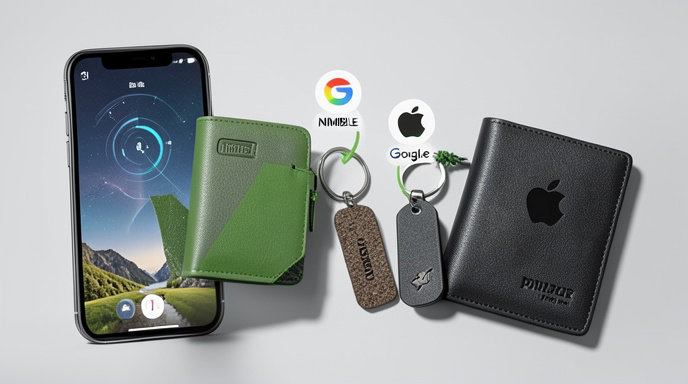
Nimble, known for accessories made with recycled and lower-impact materials, is moving into that category with a collection of trackable products. The range includes wallets, keychains, luggage tags, and passport covers, positioning the company at the intersection of sustainable hardware and the rapidly expanding item-tracking market.
The products are designed to appeal to people who want the convenience of digital tracking without adding another disposable-looking gadget to their pockets or luggage. Rather than treating a tracker as an afterthought, Nimble’s approach places tracking functionality inside accessories intended for daily use.
A Sustainable Alternative to Conventional Trackers
Most personal-item tracking products are small electronic tags housed in plastic enclosures. They are easy to attach to bags, keys, and luggage, but their environmental cost can be difficult to ignore. Electronics, batteries, adhesives, and mixed materials can complicate repair and recycling, while the accessory market often encourages consumers to purchase multiple cases and holders for the same tracker.
Nimble’s differentiation is its focus on materials and product life cycle. The company has built its brand around recycled materials, reduced packaging, and designs intended to limit the use of newly produced plastics. Applying that philosophy to trackable accessories gives Nimble a way to compete beyond specifications such as Bluetooth range or speaker volume.
The environmental claims still need to be judged across the entire life cycle of each product. A sustainable material does not automatically make an electronic accessory low-impact if the device is difficult to repair, contains a non-replaceable battery, or is discarded when its tracking component fails. Durability, battery replacement, recycling options, and long-term software support will be important measures of Nimble’s credibility.
Trackable Wallets Put Convenience First
Wallets are among the most obvious applications for item tracking. They are frequently misplaced, difficult to call from another device, and costly to replace when they contain identification, payment cards, and cash.
Nimble’s trackable wallet concept aims to build that protection directly into the wallet rather than requiring users to insert a separate tracker. Depending on the specific model and tracking ecosystem, users can use a companion smartphone network to view a wallet’s last known location or trigger an audible alert when it is nearby.
Integrating the electronics into the wallet may also create a cleaner design than attaching a separate tag. The trade-off is that users cannot simply remove the tracking unit and transfer it to another accessory. That makes construction quality and battery longevity especially important.
A wallet that becomes unusable when its tracking hardware runs out of power would undermine the sustainability message. Consumers will likely want clear information about whether the battery can be replaced, how the electronics can be separated from the material, and what happens at the end of the product’s life.
Luggage Tags and Passport Covers Extend the Use Case
Travel accessories broaden Nimble’s pitch beyond everyday carry. A trackable luggage tag could help travelers identify a suitcase at an airport, find a bag left in a hotel, or determine whether luggage has moved through a transportation hub.
A passport cover offers a similar benefit while protecting one of the most important items a traveler carries. Its tracking function could be useful at airports, hotels, and rental-car counters, where passports and travel documents are easy to misplace during busy transitions.
However, tracking a luggage tag or passport cover is not the same as providing real-time location monitoring. Most consumer item trackers depend on nearby smartphones or compatible network devices to update a product’s location. In a crowded airport, that network can be effective. In a remote area or a quiet room, location updates may be infrequent.
Travelers should also consider airline and airport rules. Trackers generally use low-power Bluetooth technology, but batteries and electronic devices remain subject to transportation policies. Clear guidance from Nimble on battery specifications and airline compatibility will be important for customers buying the products specifically for international travel.
Apple and Google Control the Most Important Piece
Nimble’s hardware may be visible to consumers, but Apple and Google control the software networks that make modern item tracking useful.
Apple’s Find My network uses nearby Apple devices to help locate compatible products, while Google’s Find My Device network uses participating Android devices. Both systems can provide location updates even when the tracked item is far from its owner’s phone, provided compatible devices detect the signal.
That network effect is a major advantage for Apple and Google. A tracker’s usefulness depends not only on the hardware but also on the number of phones operating in the surrounding area. Apple benefits from the large installed base of iPhones, while Google has the opportunity to reach a vast global population of Android devices.
For accessory makers, compatibility with these networks can reduce the need to build a separate app and tracking infrastructure. It can also make products easier for consumers to understand. Instead of learning an unfamiliar platform, buyers can manage a trackable wallet or luggage tag through tools already built into their phones.
The downside is dependence on platform owners. Apple and Google can change technical requirements, certification programs, operating-system support, or privacy policies. Accessory companies must also compete for visibility in ecosystems they do not control.
Privacy Remains a Central Concern
The growth of item tracking has brought greater attention to unwanted tracking. A device designed to help locate lost luggage can also be misused to monitor a person without consent.
Apple and Google have responded by adding alerts intended to notify people when an unknown tracker appears to be traveling with them. These protections have become an important part of the broader tracking conversation and are likely to influence how consumers evaluate Nimble’s products.
Nimble will need to communicate clearly about which tracking platform each product supports, how users can disable tracking, what alerts non-owners receive, and how location information is handled. Transparency will be particularly important for products such as passport covers and wallets, which are carried close to a person for long periods.
The balance is difficult. Strong anti-stalking protections can make trackers safer, but they may also limit some legitimate recovery scenarios. For example, a family member may carry an item belonging to someone else, or several people may share luggage. Product design and software behavior must account for those situations without weakening protections against abuse.
The Ecosystem Question
Nimble’s entry also highlights a key question for buyers: Should a trackable accessory work with Apple’s network, Google’s network, or both?
Cross-platform compatibility would make products more useful in households and workplaces where people use a mix of iPhones and Android phones. It could also reduce electronic waste by allowing a single accessory to remain useful when its owner switches platforms.
In practice, however, major tracking networks have historically been closely linked to their respective operating systems. Hardware compatibility, encryption, privacy controls, and network participation can all affect whether a product works equally well across platforms.
Consumers should therefore check compatibility before purchasing. A product that appears universally trackable may offer different features depending on the phone being used. Some functions could be limited to one operating system, while others may require a dedicated app or account.
Sustainability Versus Convenience
Nimble’s strategy reflects a broader shift in consumer electronics. Sustainability is increasingly being used as a product differentiator, but shoppers are becoming more skeptical of broad environmental claims.
The strongest case for Nimble will come from measurable details: the percentage of recycled content, packaging reductions, manufacturing standards, battery-replacement options, repairability, and end-of-life recycling. Product longevity may matter more than any single material choice.
A durable wallet that remains in use for years could have a lower environmental impact than a cheaper product replaced repeatedly. The same logic applies to luggage tags and passport covers, which are frequently exposed to abrasion, weather, baggage handling, and travel-related wear.
Nimble must also avoid creating a new form of accessory churn. If users need to replace a wallet whenever a battery expires or a tracking platform changes, the environmental advantages become less persuasive.
A Crowded and Expanding Market
Nimble is entering a market that includes dedicated tracker makers, phone manufacturers, luggage companies, and accessory brands. Trackers have become increasingly common as consumers look for ways to protect keys, bags, bicycles, luggage, and other valuables.
The category is attractive because it combines relatively simple hardware with powerful platform effects. Once a consumer begins using one tracking network, they may prefer products that work with the same system. That can encourage purchases of additional tags and compatible accessories.
Nimble’s challenge is to convince consumers that an integrated, sustainable accessory is worth choosing over a conventional wallet or luggage tag paired with a separately purchased tracker. The company’s products will need to match established alternatives on reliability while offering a clear design and environmental advantage.
The pricing will also be significant. Sustainable materials and integrated electronics can raise manufacturing costs. If Nimble’s products are substantially more expensive than conventional accessories, the company will need to demonstrate that durability, functionality, and environmental benefits justify the premium.
What to Watch Next
The early reception of Nimble’s trackable products will likely depend on more than their appearance. Reviews will need to test location accuracy, alert speed, battery life, Bluetooth performance, water resistance, and the quality of the physical construction.
Buyers will also want answers about repair and disposal. Can the tracking component be replaced? Is the wallet still usable when the electronics are removed? Does Nimble offer a take-back program? Are spare parts available? These questions are especially relevant because the company is presenting sustainability as a central part of its identity.
Platform support will be another important factor. Apple and Google are continuing to develop their item-finding systems, and changes to network availability or interoperability could influence which accessories remain useful over time.
Nimble’s move is therefore more than the launch of a few connected travel products. It is a test of whether environmental design can become a meaningful competitive advantage in a category increasingly shaped by large technology platforms.
If Nimble can combine dependable tracking, thoughtful privacy protections, durable construction, and verifiable sustainability claims, its wallets and luggage accessories could offer a credible alternative to the standard tracker-plus-holder model. If not, the products may be remembered as conventional accessories with an environmental message attached.
For now, the company’s entry adds welcome competition to a market dominated by Apple and Google’s networks. The next phase will show whether consumers value a tracker not only for where it can find their belongings, but also for how responsibly it is made.

Get All The Latest Updates Delivered Straight To Your Inbox For Free!