
Superhot Rock Geothermal: The Breakthrough Power Source for Data Centers
TL;DR
- Superhot-rock geothermal aims to tap extremely hot formations deep underground, potentially turning geothermal power into a resource available far beyond conventional volcanic regions.
- Startups including Fervo Energy, Quaise Energy and Sage Geosystems are combining oil-and-gas drilling techniques with engineered reservoirs or novel drilling systems to pursue firm, low-carbon electricity.
- The opportunity is large enough to attract data-center developers, but drilling cost, well durability, reservoir control, financing and project timelines remain major barriers to terawatt-scale deployment.
The race to power artificial-intelligence infrastructure is reviving interest in one of the oldest clean-energy technologies: geothermal power.
Unlike wind and solar, geothermal plants can operate around the clock. They do not depend on weather, require relatively little land and can provide the steady electricity that high-density data centers need. The problem is that conventional geothermal resources are concentrated in geologically active regions, where naturally permeable hot rock and underground fluids are already available.
Superhot-rock geothermal seeks to change that equation.
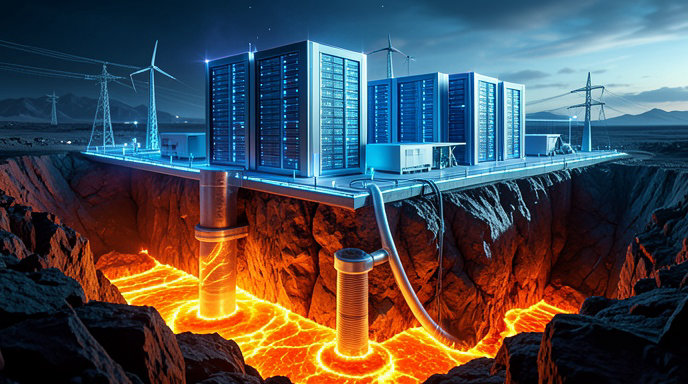
The concept is to drill deep enough to reach rock at temperatures generally above 374 degrees Celsius, the approximate point at which water becomes “supercritical” under pressure. Supercritical water can carry substantially more energy than ordinary hot water or steam. If engineers can safely create and control underground reservoirs in these formations, a single well system could produce far more power than a conventional geothermal installation.
The technology is still at the demonstration stage. But rising electricity demand from AI data centers, together with improvements in horizontal drilling and reservoir engineering, has turned superhot rock into one of the most closely watched areas of next-generation energy.
Why Superhot Rock Matters for AI
AI data centers place unusual demands on power grids. A large facility can consume hundreds of megawatts, while clusters of advanced accelerators can create additional requirements for cooling, backup systems and power-quality management.
That demand is arriving faster than many utilities can build new transmission lines or generation capacity. Solar and wind projects can be deployed comparatively quickly, but they require storage or backup generation to provide power during periods of low sunlight or weak wind. Natural-gas plants can offer reliability, but they add fuel-price exposure and carbon emissions.
Geothermal offers a different combination: firm output, a small physical footprint and potentially low operating emissions.
For data-center operators, that makes geothermal attractive as a source of so-called 24/7 carbon-free energy. A plant located near a computing campus could reduce dependence on congested transmission networks and provide a predictable supply contract over decades.
The largest opportunity would come if geothermal could be developed in regions without conventional geothermal conditions. Superhot-rock systems could theoretically be built in many parts of the United States and other countries, including areas close to existing power markets and data-center hubs.
That geographic flexibility is central to the industry’s pitch. The goal is not merely to improve geothermal power in Iceland, Indonesia or the western United States. It is to make deep heat a broadly accessible energy resource.
The New Geothermal Playbook
Next-generation companies are pursuing several related but distinct approaches.
Fervo Energy is developing enhanced geothermal systems, or EGS. The company drills deep wells into hot rock and uses hydraulic stimulation to create a network of fractures through which water can circulate. The heated water is then brought back to the surface to generate electricity.
Fervo’s work has been closely watched because it adapts drilling methods from the oil and gas industry. In Nevada, the company reported successful results from a pilot project that demonstrated high-temperature drilling, long horizontal well sections and sustained circulation between injection and production wells. The company has described its Cape Station project in Utah as a much larger commercial development, with an initial phase planned at roughly 70 megawatts and a longer-term target of about 400 megawatts.
Quaise Energy is taking a different route. Its technology is designed to replace conventional drill bits at extreme depths with millimeter-wave energy. The waves heat and vaporize rock, allowing drilling through formations that become difficult or expensive for mechanical tools. Quaise has tested its approach in laboratory and field environments, but it still faces the challenge of turning a promising drilling method into a reliable, high-rate commercial system.
Sage Geosystems is developing closed-loop and pressure-based geothermal systems. Its designs seek to use engineered underground reservoirs to store or circulate water, with some projects also targeting long-duration energy storage. The company has attracted attention for projects intended to demonstrate geothermal generation in regions that do not have naturally productive hydrothermal resources.
Other companies are exploring closed-loop geothermal systems, advanced well architectures and drilling technologies borrowed from petroleum, mining and space research. The approaches differ, but they share a goal: reduce dependence on naturally occurring geothermal reservoirs.
The Superhot-Rock Advantage
Temperature is the most important variable in geothermal economics.
A hotter reservoir can deliver more energy from a given amount of fluid. It can also support more compact power plants and potentially reduce the number of wells required for a given output. Supercritical fluids are especially attractive because their energy density can be much higher than that of conventional geothermal steam or hot water.
In theory, this could dramatically improve the economics of geothermal power. A small number of highly productive wells might produce the output of a much larger conventional field.
The resource base is also enormous. Heat exists almost everywhere below the Earth’s surface, and temperatures rise with depth. The challenge is not finding heat; it is reaching heat economically and creating an underground system that can circulate fluid without losing pressure or damaging the wells.
Industry advocates sometimes describe superhot rock as a resource capable of producing terawatts of power. That figure reflects the scale of the heat available in the Earth’s crust, not a near-term deployment forecast. Turning that theoretical resource into electricity would require millions of meters of drilling, extensive transmission and years of geological, regulatory and financial development.
The Drilling Problem
Drilling is the largest technical and economic obstacle.
Conventional oil and gas wells can already cost millions of dollars, and geothermal wells are often more demanding. They may encounter higher temperatures, corrosive fluids, hard crystalline rock and difficult pressure conditions. At superhot temperatures, drilling equipment, seals, electronics, cement and casing materials can fail faster than they do in petroleum operations.
Depth adds another challenge. The hottest resources may lie several kilometers underground, depending on local geology. Every additional kilometer increases drilling time, equipment wear and the complexity of well construction.
Directional drilling is particularly important for engineered geothermal systems. A productive project generally needs injection and production wells to intersect the same stimulated or permeable zone. Drilling long horizontal sections through hot, hard rock requires precise steering and durable tools.
The industry hopes that techniques developed for shale drilling can lower costs through repetition and standardization. But geothermal projects cannot assume that oil-and-gas learning curves will transfer automatically. Oil wells produce valuable hydrocarbons almost immediately after completion, whereas geothermal projects require large upfront investments before they generate revenue.
Reservoir Control and Induced Seismicity
Creating an engineered geothermal reservoir is not simply a matter of cracking rock and pumping water.
Operators must create enough permeability for fluid to circulate while maintaining pressure and avoiding leaks. If water escapes into surrounding formations, the system may lose productivity. If fractures connect unexpectedly with faults, the project could experience induced seismicity.
Earthquakes linked to fluid injection have affected some enhanced-geothermal and wastewater projects. Most induced events are small, but the possibility of larger seismic activity can create public opposition, regulatory delays and insurance complications.
Developers are working on better subsurface imaging, real-time pressure monitoring and staged stimulation methods. They also need clear protocols for reducing or stopping injection if seismic activity exceeds predetermined thresholds.
Superhot systems introduce additional complications. Extreme temperatures can alter rock chemistry, dissolve minerals and create scaling or corrosion in wells and surface equipment. Water chemistry must be managed carefully to preserve flow and protect turbines and heat exchangers.
Can the Economics Compete?
The commercial case for superhot rock depends on reducing the cost of drilling and increasing the amount of electricity produced per well.
A project can tolerate expensive wells if each well produces an exceptionally large and reliable amount of power. Conversely, even highly productive rock may not be economical if wells must be frequently repaired or replaced.
The cost of the power plant is only one part of the equation. Developers must pay for exploration, land, drilling, stimulation, gathering systems, turbines, grid interconnection, transmission and financing. They also face years of development risk before proving that a reservoir will perform as modeled.
Government support could be important during this phase. Loan guarantees, production incentives, tax credits and public research funding can reduce the risk of first-of-a-kind plants. The United States’ enhanced-geothermal incentives have helped improve the investment case, while federal research programs have supported drilling and subsurface technology.
Data-center buyers could also play a role by signing long-term power agreements. A contract with a creditworthy technology company or cloud provider can help a geothermal developer finance construction, particularly if the buyer values around-the-clock clean electricity more highly than intermittent renewable power.
Still, geothermal must compete with rapidly falling costs for solar, wind, batteries and natural-gas generation. Its strongest market may be locations where grid congestion, land constraints or carbon requirements make firm clean power especially valuable.
Why Data Centers Are Paying Attention
Large technology companies have already shown interest in geothermal as part of their clean-energy strategies. Google has supported advanced geothermal development, including a partnership with Fervo, and the broader sector is exploring ways to supply power directly to data-center campuses.
The attraction is not just carbon reduction. Data centers need dependable power with minimal interruption. A geothermal facility can potentially provide a stable output profile without the large batteries that would be required to firm a purely renewable supply.
Geothermal plants can also operate at high capacity factors and occupy less land than utility-scale solar installations producing the same annual energy. That matters in regions where land, transmission access and public acceptance are constrained.
However, geothermal projects generally take longer to develop than a data-center operator may prefer. A company can build computing capacity in stages over a few years, while a deep geothermal project may require extensive exploration, permitting and drilling before commercial operation.
This mismatch creates a potential business model: geothermal developers could build standardized plants in advance of demand, or data-center companies could make early commitments that help projects reach construction.
The Conventional Geothermal Leaders
Next-generation startups are entering a market with experienced incumbents.
Companies such as Ormat Technologies, Enel Green Power and Calpine have decades of experience developing and operating conventional geothermal assets. They understand resource assessment, plant construction, power marketing, maintenance and regulation.
Those companies benefit from proven reservoirs and established operating practices. Conventional geothermal plants can be highly reliable where the right geological conditions exist, and improvements in turbines, binary-cycle systems and reservoir management continue to raise performance.
Superhot-rock companies, by contrast, are still proving that engineered reservoirs can operate for years at commercial scale. Their potential advantage is a much larger geographic market and higher energy output per well. Their disadvantage is greater technical uncertainty.
The eventual industry may combine both models. Conventional operators could adopt advanced drilling and reservoir tools, while startups could partner with established power companies to gain access to financing, construction expertise and utility relationships.
A Race Against AI Demand
The timing of superhot geothermal development is being shaped by the speed of AI expansion.
Cloud providers and data-center developers are seeking large blocks of electricity in regions where grid capacity is already limited. In some markets, new generation and transmission projects face multi-year queues. A reliable geothermal plant could become valuable even if its cost is higher than that of ordinary renewable generation.
But AI demand also raises the standard for reliability. A data center cannot tolerate an energy source that is still undergoing frequent experimental interventions. Developers must demonstrate not only that a reservoir can produce power, but that it can do so continuously, predictably and with manageable maintenance.
The first commercial projects will therefore be important beyond their nameplate capacity. Investors and customers will be watching drilling rates, well costs, reservoir decline, uptime, water consumption and the frequency of workovers.
If those metrics improve quickly, geothermal could move from a specialized regional resource to a scalable source of firm clean power. If they do not, superhot rock may remain an intriguing but expensive technology for niche applications.
What Must Happen Next
Several milestones will determine whether the sector can scale.
First, developers need to complete larger commercial demonstrations that operate over multiple years rather than months. Long-term performance will reveal whether engineered reservoirs maintain permeability and whether superhot conditions cause unacceptable equipment degradation.
Second, drilling costs must fall. This could come from faster rigs, improved high-temperature tools, advanced materials, millimeter-wave drilling or better well designs. Reusing standardized designs across multiple projects will be essential.
Third, regulators and communities need confidence that induced seismicity, water use and subsurface impacts can be managed. Clear monitoring standards and transparent operating data will help.
Fourth, projects must secure customers willing to sign long-term contracts. Data-center companies may become early buyers, but utilities, manufacturers and other industrial users could provide additional demand.
Finally, the sector needs a supply chain. Scaling from demonstration plants to hundreds of gigawatts would require specialized rigs, casing, cement, turbines, control systems and trained workers. The equipment cannot be treated as custom hardware for every project.
The Outlook
Superhot-rock geothermal is not yet a proven replacement for conventional geothermal, natural gas or large-scale renewable power. It is a high-risk technology with an unusually large potential payoff.
If drilling and reservoir engineering improve as expected, deep hot rock could provide firm electricity in many regions that lack traditional geothermal resources. That would give data-center developers another way to secure reliable, low-carbon power while reducing pressure on already crowded grids.
The more realistic near-term vision is not an immediate terawatt buildout. It is a sequence of increasingly capable demonstrations: pilot wells, small commercial plants, standardized projects and eventually large fleets of systems built near major electricity markets.
The technology’s future will be decided underground, where engineers must convert heat into sustained fluid flow at a cost customers can afford. For data centers racing to meet the energy demands of AI, that challenge may be worth pursuing. If superhot rock works at commercial scale, geothermal could become less a regional specialty than a new foundation for the global power system.

Get All The Latest Updates Delivered Straight To Your Inbox For Free!