
Yale’s Jeffrey Sonnenfeld Warns Nvidia Could Undermine US Industrial Power
TL;DR
- Yale professor Jeffrey Sonnenfeld argues that Nvidia’s dominance could weaken, rather than strengthen, America’s broader industrial base.
- The company faces growing scrutiny over China-bound chips, Washington’s export-control decisions, shareholder litigation and possible director oversight liability.
- CEO Jensen Huang’s close engagement with the White House has increased Nvidia’s policy influence while intensifying debate over whether national-security safeguards are adequate.
Yale’s Jeffrey Sonnenfeld Warns Nvidia Could Undermine US Industrial Power
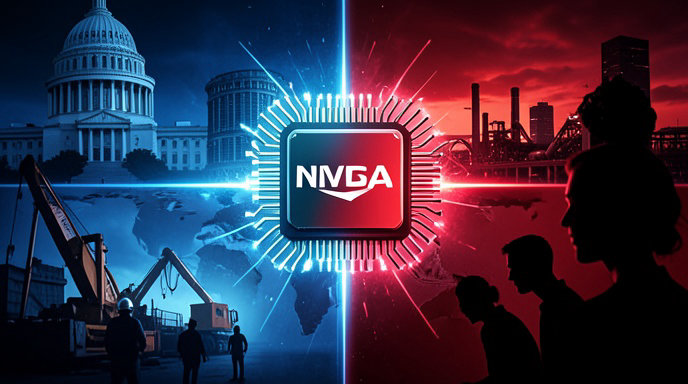
Jeffrey Sonnenfeld, the Yale School of Management professor known for his criticism of corporate governance and executive leadership, has raised a provocative question about Nvidia’s role in the American economy: Is the chip designer a national champion—or a company whose extraordinary power could ultimately undermine US industrial strength?
The debate comes as Nvidia sits at the center of Washington’s technology and national-security strategy. Its accelerators are essential to the artificial-intelligence boom, its market value has reached historic levels and its chief executive, Jensen Huang, has become a prominent participant in discussions with policymakers.
But Sonnenfeld’s criticism points beyond Nvidia’s share price or quarterly earnings. His concern is that the United States could mistake dominance in one highly valuable layer of the technology stack for a resilient industrial base. Nvidia designs leading AI processors, but much of the manufacturing, advanced packaging and supply-chain capacity required to produce them remains concentrated outside the United States.
The result, critics argue, is a company that symbolizes American technological leadership while also exposing the country to supply-chain dependence, geopolitical pressure and governance risks.
A national champion with an international supply chain
Nvidia’s success is built on a “fabless” model. The company designs chips and systems but relies on outside manufacturers, particularly Taiwan Semiconductor Manufacturing Co., for leading-edge production. Its products also depend on sophisticated memory, packaging, networking and equipment suppliers spread across Asia, Europe and North America.
That structure has allowed Nvidia to expand rapidly without owning the enormous fabrication plants required for cutting-edge semiconductor production. It has also helped the company concentrate resources on chip architecture, software and developer tools—areas where it has established a formidable competitive advantage.
Yet the model complicates the idea that Nvidia alone represents a revival of US industrial power. American policymakers may celebrate the company’s intellectual property and high-value jobs while still confronting a shortage of domestic capacity in wafer fabrication, advanced packaging and other critical manufacturing operations.
Sonnenfeld’s warning is therefore less about Nvidia’s technical achievements than about the policy narrative surrounding them. If the company is treated as proof that the United States has solved its semiconductor problem, Washington could underinvest in the less glamorous parts of the supply chain that determine whether chips can actually be produced at scale during a crisis.
The Nvidia paradox
Nvidia is simultaneously a major American asset and a source of strategic vulnerability.
Its GPUs and AI accelerators support cloud-computing companies, defense contractors, research institutions and start-ups. They are increasingly viewed as infrastructure for the next generation of software and military technology. The company’s CUDA software ecosystem has also made it difficult for customers to move quickly to competing hardware.
That concentration gives Nvidia unusual influence. Customers may depend on its products, investors may depend on its growth and policymakers may depend on its cooperation to maintain America’s lead in AI.
The same concentration can create fragility. If Nvidia’s supply chain is disrupted, if advanced chips are diverted to adversarial states or if export rules change abruptly, the consequences would extend well beyond one company. A market dominated by a single supplier can become a national-security risk when that supplier controls access to scarce computing capacity.
Concerns over Jensen Huang’s Washington role
Huang has become one of the most visible technology executives in Washington. His meetings with presidents and senior officials have helped make Nvidia a participant in debates over export controls, domestic manufacturing, AI regulation and the future of advanced computing.
Supporters say Huang provides policymakers with practical information about a rapidly changing industry. Nvidia’s position gives the company insight into the technical and commercial consequences of export restrictions that government officials may struggle to assess independently.
Critics see a different danger: policy becoming too closely aligned with the interests of the company best positioned to benefit from it.
The concern has intensified around Washington-backed efforts to preserve or restore Nvidia’s access to parts of the Chinese market. US officials have periodically tightened restrictions on the export of advanced AI chips to China, while companies have sought licenses, product redesigns or other arrangements that would allow them to continue selling less-powerful systems.
Those shifts have produced an uncomfortable political dynamic. Washington wants to prevent China from obtaining computing capabilities that could strengthen its military and surveillance systems. At the same time, US companies argue that a total withdrawal from the Chinese market would surrender commercial influence to foreign competitors and encourage Chinese customers to develop alternatives.
Huang has generally made the case that American companies need room to compete internationally. National-security officials, however, must decide whether maintaining Nvidia’s commercial position is worth the risk that advanced technology could reach actors the United States is trying to constrain.
The return of China-focused products
Nvidia has developed modified products intended to comply with US export restrictions while retaining commercial value in China. The most prominent examples have included reduced-performance versions of its data-center processors.
The policy challenge is that performance thresholds can become outdated quickly. A product that appears sufficiently limited when a rule is written may still provide substantial value when deployed in large clusters or combined with efficient software. Customers can also use multiple restricted systems together, complicating efforts to draw a clean line between permissible and prohibited computing power.
Any White House-supported return of Nvidia’s China-oriented products would therefore carry political and strategic costs. It could reassure investors and preserve a major US company’s market position, but it could also prompt accusations that commercial pressure has weakened national-security policy.
The issue is not limited to whether a particular chip crosses a technical threshold. It also involves the cumulative effect of access to large numbers of chips, networking equipment, software tools and technical support. Advanced AI capability is increasingly determined by the architecture of an entire computing cluster rather than by the specifications of one processor.
Geopolitical risks beyond China
China is the central focus of US export-control policy, but the risks extend to other adversarial or sanctioned countries. Chips can be transferred through intermediaries, resold on secondary markets, incorporated into data centers or acquired through cloud services.
Russia, Iran and North Korea face extensive restrictions, but enforcement remains difficult. Components can move through complex trading networks, while cloud computing can allow users to access advanced processing power without physically importing the underlying hardware.
This creates a problem for Nvidia and its directors. The company may sell to an apparently legitimate customer while having limited visibility into the ultimate user, the purpose of deployment or the later movement of equipment. Stronger due diligence can reduce the risk but also increases cost and may slow sales.
The potential consequences are substantial. Advanced AI systems could improve military planning, cyber operations, intelligence analysis, autonomous weapons and propaganda. Even when a chip is not designed specifically for military use, its computing capacity may have strategic value.
That dual-use character makes Nvidia’s products different from ordinary commercial hardware. The company is selling components that can power consumer applications and frontier research, but also systems relevant to national defense and strategic competition.
Director liability and governance questions
The growing scrutiny raises an important corporate-governance question: When does failure to manage export-control and national-security risks become a breach of directors’ duties?
Boards are generally expected to oversee significant legal and operational risks. In highly regulated industries, courts have increasingly examined whether directors created meaningful monitoring systems and responded appropriately to warning signs. A company operating at the intersection of semiconductors, AI and geopolitics faces an unusually broad set of potential red flags.
That does not mean Nvidia’s directors are automatically liable for every chip that reaches a restricted end user. Proving liability would typically require showing more than a bad outcome or an isolated compliance failure. Plaintiffs would likely need to establish that the board failed to make a good-faith effort to oversee a critical risk, ignored clear warnings or allowed inadequate controls to persist.
Nvidia could face scrutiny over questions such as:
- How does the board monitor export-control compliance?
- What information does management provide about distributors, resellers and ultimate users?
- Are compliance systems capable of tracking chips after shipment?
- How are product redesigns evaluated against changing national-security rules?
- Does the company treat geopolitical risk as a core strategic issue or primarily as a legal department concern?
Shareholder lawsuits could also focus on disclosure. Investors may argue that a company failed to describe material risks involving China sales, export restrictions, regulatory investigations or the possibility that products could be diverted to prohibited users. Whether such claims succeed would depend on the specific statements, disclosures and evidence involved.
Nvidia is not the only company exposed to these risks. Semiconductor manufacturers, equipment suppliers, cloud providers and AI developers all face similar questions. But Nvidia’s market position makes it a particularly visible test of how American corporate law handles national-security risk.
The lawsuit problem
Litigation surrounding Nvidia and the semiconductor industry can take several forms. Shareholders may bring securities claims after a stock-price decline, arguing that the company’s public statements failed to disclose material risks. Customers or business partners may pursue contract or commercial claims. Regulators may investigate export-control compliance, while governments may impose penalties or restrictions.
A lawsuit alone does not establish wrongdoing. Technology companies frequently face legal claims after regulatory changes or market reversals, and many are dismissed or settled without an admission of liability.
The broader significance lies in the costs of uncertainty. Even an ultimately unsuccessful case can require years of legal work, executive attention and document production. It can also intensify investor concerns about whether growth depended on assumptions that regulators were unwilling to accept.
For Nvidia, the central challenge is that export policy is not a stable commercial variable. A sale permitted under one administration or one set of rules may become restricted after a change in national-security assessments. Product plans, customer commitments and inventory decisions can all be affected.
That instability complicates the responsibilities of executives and directors. They must protect shareholder value while preparing for policy changes that may be difficult to predict and impossible for the company to control.
Can Nvidia strengthen US industrial power?
Nvidia can contribute to US industrial renewal, but its success is not sufficient by itself.
The company supports high-skilled employment, research and development, software ecosystems and demand for domestic data centers. It has also participated in efforts to expand US semiconductor production and has economic ties to a wider network of suppliers, infrastructure providers and AI developers.
However, the country’s industrial capacity depends on more than chip design. It requires reliable electricity, advanced packaging, machine tools, materials, skilled workers, construction capacity and geographically diversified production. It also requires businesses capable of manufacturing products that use advanced chips, not merely designing the processors that power them.
This is the heart of Sonnenfeld’s critique. Nvidia’s spectacular rise could obscure structural weaknesses elsewhere. A nation may lead in AI chip design while remaining dependent on foreign factories, imported equipment and overseas supply chains. Its companies may command enormous valuations without producing enough physical capacity to withstand a blockade, pandemic or military conflict.
The policy response should therefore avoid treating Nvidia as either an unquestioned national champion or a threat to be restrained. The company is both an important national asset and a source of concentrated risk.
What Washington must decide
The Nvidia debate reflects a larger unresolved question in US technology policy: Should Washington prioritize the global competitiveness of American companies, or limit that competitiveness when advanced products could strengthen geopolitical rivals?
There is no simple answer. Excessive restrictions could encourage foreign customers to abandon US suppliers and accelerate the development of competing ecosystems. Weak restrictions could allow adversarial governments to gain access to computing resources with serious military implications.
A durable policy would require clearer rules, faster licensing decisions and stronger enforcement across the entire technology chain. It would also require closer scrutiny of cloud access, resellers and intermediaries—not just the initial shipment of a physical chip.
For corporate boards, the lesson is equally important. National-security compliance can no longer be treated as a narrow regulatory function. It is a strategic issue involving product design, customer selection, supply-chain planning, public disclosures and long-term capital allocation.
Nvidia’s future will depend not only on whether it can maintain its technological lead, but also on whether it can demonstrate that its growth is compatible with American security and industrial resilience.
Sonnenfeld’s warning may ultimately prove either overly pessimistic or prescient. Nvidia has helped establish the United States as the leading center of the AI economy. But unless that advantage is translated into broader domestic manufacturing strength—and managed with credible safeguards against diversion—the company’s dominance could reveal the limits of American industrial power as much as its resurgence.

Get All The Latest Updates Delivered Straight To Your Inbox For Free!