
Detroit Startup Grounded Raises $5M to Customize Electric and Gas Vans for Small Businesses
TL;DR
- Detroit-based startup Grounded has secured $5 million in new funding to pivot from luxury camper van conversions to fleet upfitting for small businesses.
- The company will now customize both electric and gas-powered vans, positioning itself as a flexible intermediary as US EV adoption rates fluctuate.
- The funding will be used to scale production capacity and develop modular upfitting solutions that can serve mixed-fuel fleets.
From Glamping to Grit: Why Grounded Changed Course
Just a few years ago, Grounded was riding the wave of the pandemic-era outdoor boom, converting Mercedes-Benz Sprinter vans into $200,000+ luxury mobile suites for remote workers and weekend adventurers. But as interest rates climbed and the "van-life" trend cooled, the Detroit-based startup faced a harsh reality: the high-margin, low-volume business model was no longer sustainable.
Today, the company is announcing a strategic pivot and a fresh $5 million funding round to match. The new capital, led by a mix of automotive and climate-tech investors, will fuel Grounded's transition into a fleet customization specialist for small businesses—think plumbers, electricians, landscapers, and local delivery services. The shift is a bet that the real money in van customization isn't in Instagram-worthy interiors, but in the unglamorous, utilitarian work of keeping local commerce moving.
The EV Adoption Rollercoaster: A Market in Flux
The core of Grounded's new strategy hinges on a nuanced reading of the current US electric vehicle market. While EV passenger car sales have hit record highs, the commercial van segment tells a different story. Large corporate fleets like Amazon and FedEx are aggressively electrifying, but small businesses are hesitating.
Why? The upfront cost of an electric work van (like the Ford E-Transit or Rivian Commercial Van) remains significantly higher than its gas counterpart. Additionally, range anxiety is a real issue for tradespeople who may drive 200+ miles a day across a metro area, and charging infrastructure in older commercial districts is still spotty. The result is a bifurcated market: early adopters are going all-in on electric, while the vast majority of small fleet owners are sticking with reliable, cheaper gas-powered vans for the next 3-5 years.
Grounded's leadership sees this as the perfect opening. Instead of betting the company on a single powertrain, they are building a "powertrain-agnostic" upfitting platform.
The New Business Model: Modular Upfitting for Mixed Fleets
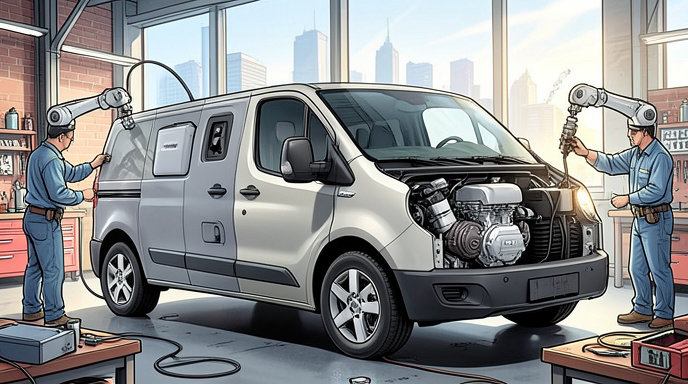
So, what does a Grounded upfit look like now? Gone are the walnut dashboards and induction cooktops. In their place are modular, heavy-duty systems: locking shelving units, integrated power take-offs (PTOs), inverter systems for running tools on-site, and reinforced flooring for hauling equipment.
The key differentiator is flexibility. Grounded is designing its upfits to be "EV-ready" even for gas vans. For instance, a gas-powered Ford Transit can be fitted with a battery pack and inverter that allows a plumber to run a pipe-threader without idling the engine. When that same business is ready to transition to an electric van in three years, Grounded can strip the interior and reinstall the same modular components into the new EV, with only minor wiring changes.
This approach de-risks the EV transition for small business owners. They don't have to commit to an expensive electric van today, but they also aren't locked into a gas-powered setup that will become obsolete. It's a bridge strategy that acknowledges the messy, uneven pace of the energy transition.
Why Detroit? The Manufacturing Advantage
Grounded's choice of headquarters is no accident. Being in Detroit gives the startup direct access to a deep pool of automotive electrical engineers and skilled fabricators who were laid off or underutilized by the Big Three. The company has also secured a partnership with a local automotive supplier to handle welding and sheet metal fabrication, allowing Grounded to scale production without building a massive factory from scratch.
This lean manufacturing approach is critical. The $5 million raise isn't for flashy R&D; it's for purchasing CNC routers, robotic welding arms, and expanding its assembly line to handle roughly 500 to 1,000 van conversions per year. The goal is to undercut the traditional upfitters—companies like Knapheide or Reading—which often have long lead times and outdated designs. Grounded aims to deliver a custom-fitted work van in under four weeks, versus the industry standard of eight to twelve.
The Competitive Landscape and The Road Ahead
Grounded isn't alone in this space. Companies like ARB and Ranger Design offer off-the-shelf shelving and racking. But Grounded is positioning itself as a premium, integrated solution—a "turnkey" partner that handles everything from the initial design consultation to the final electrical work.
The startup faces significant headwinds. The $5 million round is relatively small compared to the giants of the automotive supply chain. They also need to prove that their modular systems are durable enough for the daily abuse of construction sites.
However, the timing feels right. With the Biden administration's EPA regulations pushing for stricter emissions standards, and with many states offering rebates for commercial EV purchases, small businesses are starting to at least explore their options. Grounded's pitch is simple: "Let us build the van you need today, and we'll make sure it's ready for the van you'll want tomorrow." If they execute well, this Detroit startup could become the go-to middleman for the next decade of commercial fleet evolution.

Get All The Latest Updates Delivered Straight To Your Inbox For Free!