
Michael Polansky Is Training AI on Living Human Skin to Revolutionize Skincare
TL;DR
- Michael Polansky, Lady Gaga's fiancé and former right-hand to Sean Parker, has revealed his stealth AI biotech startup which has spent years in secret developing technology to keep living human skin tissue alive outside the body for weeks at a time.
- The company's platform uses that living skin as a training ground for AI models, testing thousands of compounds and biological responses in real-time to discover next-generation skincare ingredients far faster than traditional lab testing.
- After operating in stealth since 2020, Polansky says he is now going public to scale the science, attract top researchers, and bring the first AI-discovered compounds to market.
From Parker to Polansky: The Low-Profile Operator Steps Into the Spotlight
For years, Michael Polansky has been best known in two contexts: as the longtime partner and now fiancé of Lady Gaga, and as the former deputy to tech billionaire Sean Parker. As CEO of the Parker Group and co-founder of the Parker Institute for Cancer Immunotherapy, Polansky built a reputation as the quiet, Harvard-trained operator behind some of Silicon Valley's most ambitious philanthropic and biotech bets.
Now he is stepping out from behind the curtain with his own venture. After more than five years operating in complete stealth, Polansky has revealed he is the co-founder and driving force behind a San Francisco-based AI biotech startup focused entirely on human skin. While the company has avoided press and kept its team small, it has been quietly raising capital, filing patents, and building a lab that merges tissue engineering, automation, and machine learning.
Unlike a typical celebrity-backed beauty brand, this is not about marketing. Polansky describes it as a hard-science company first, with the goal of solving one of biology's most difficult challenges: how to study human skin without experimenting on humans.
The Breakthrough: Keeping Human Skin Alive for Weeks
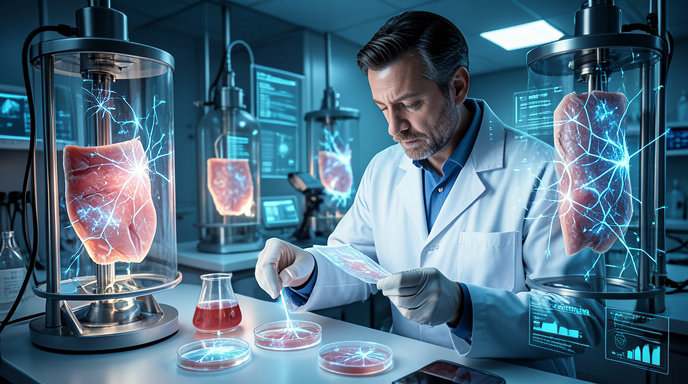
The core of the company's technology is a proprietary perfusion and bioreactor system that can sustain living human skin tissue ex vivo — outside the body — for weeks while keeping it biologically active.
Traditionally, skin samples used for research degrade within days, limiting what scientists can learn about long-term effects like aging, repair, inflammation, and response to new compounds. Animal testing and synthetic skin models offer only rough approximations, and human clinical trials are slow and expensive.
Polansky's startup claims to have solved the viability problem. By maintaining blood-flow-like nutrient delivery, oxygenation, and mechanical tension, their system keeps donated human skin tissue alive and functioning for up to four weeks. The tissue continues to produce collagen, react to UV exposure, heal from micro-wounds, and show inflammatory responses — just as it would on a person.
That creates a living, breathing testbed that can be monitored continuously with high-resolution imaging, genomics, and sensors.
An AI Trained on Living Biology, Not Just Data
That living testbed is where the AI comes in. Instead of training models on static datasets or published research papers, the company is training its AI directly on the biological responses of real human skin.
The platform runs automated, high-throughput experiments — applying thousands of potential skincare compounds, peptides, and molecules to living skin samples and recording the results in real time. Computer vision tracks changes at the cellular level, while transcriptomic and proteomic data feed into foundation models that learn how skin ages, repairs, and reacts.
According to Polansky, the AI has already identified several novel compound combinations that significantly boost barrier function and collagen production in lab tests, compounds that would have taken years to discover through conventional trial-and-error R&D. The goal is not just to make a better moisturizer, but to discover biologically active ingredients with pharmaceutical-grade efficacy that can be used for everything from anti-aging to eczema and wound healing.
In an interview, Polansky framed it as applying the logic of modern drug discovery to skincare: "Skincare is biology. For decades we've been guessing. If you can keep real human tissue alive and let AI learn from it at scale, you can finally move from guesswork to discovery."
Why Stealth Mode — And Why Reveal It Now
The startup was founded in 2020 and has operated under strict secrecy ever since, with Polansky funding much of the early work himself alongside Parker-affiliated investors. He said the decision to stay stealth was deliberate. Tissue viability is a notoriously hard problem, and the team wanted to prove the science before making any claims.
"We didn't want to be a hype company," Polansky said. "We needed to know the skin could actually stay alive, that the data was reproducible, and that the AI was finding things that actually work."
Now, with multiple patents granted, peer-reviewed validation underway, and its first AI-discovered compounds entering safety testing for future skincare products, the company is ready to scale. Polansky says going public now will help recruit leading AI researchers and dermatologists, establish partnerships with major skincare and biotech labs, and prepare for regulatory pathways.
While the company has not yet announced a brand name for its consumer products or a timeline for launch, Polansky confirmed the long-term plan is to both license its discovered compounds to established beauty conglomerates and develop its own line of clinically validated skincare.
Beyond Beauty: The Bigger Implications
While the initial application is skincare — a $180 billion global industry desperate for real innovation — the implications of the technology go far beyond cosmetics.
A reliable platform for sustaining and testing on living human tissue could reduce reliance on animal testing, accelerate dermatological drug development, and provide a new model for studying human biology with AI. Polansky, who helped Parker build one of the largest cancer immunotherapy networks in the country, sees skin as just the starting point.
For now, the man who has spent his career empowering other founders and artists is finally putting his own name on the door — and betting that the future of skincare won't be formulated in a marketing meeting, but learned by an AI watching living skin think, react, and heal in real time.

Get All The Latest Updates Delivered Straight To Your Inbox For Free!