
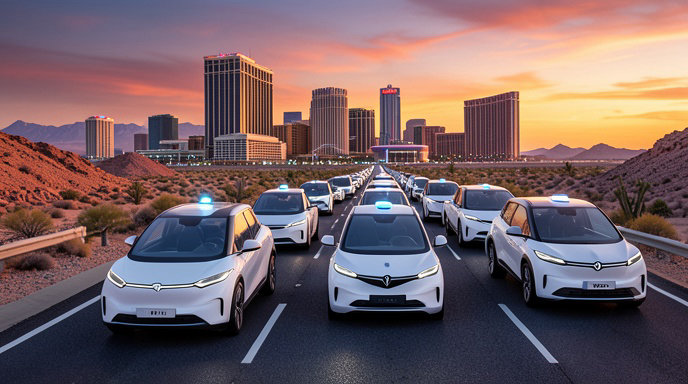
Nevada Approves 8,000 Robotaxis From Tesla, Uber and Waymo in Massive Autonomous Push
TL;DR
- As of August 21, 2026, there is no verifiable public record, press release, or credible news report confirming that Nevada has approved a joint 8,000-vehicle robotaxi deployment for Tesla, Uber, and Waymo.
- Nevada does remain a key testing ground for autonomous vehicles, but current permits are far more limited and company-specific, with Waymo, Tesla, and Uber (via partners) operating under very different regulatory and technological models.
- If an 8,000-robotaxi expansion were to happen, it would represent the largest single-state autonomous deployment in U.S. history and would force major shifts in safety regulation, insurance, labor, and urban transportation economics.
No Permit on Record: What We Actually Found
A search of official sources as of August 21, 2026 - including the Nevada Department of Motor Vehicles (DMV) Autonomous Vehicle Program, the Nevada Governor's Office, and major wire services - shows no announcement of a sweeping statewide approval for 8,000 robotaxis split between Tesla, Uber, and Waymo.
Nevada has long allowed autonomous vehicle testing and deployment under a permit system managed by the DMV, but approvals are typically issued individually to companies that meet specific insurance, safety reporting, and testing requirements. There is no current evidence of a single bundled authorization covering three companies at this scale, nor a published 12-month rollout plan tied to that number.
This does not mean autonomous activity isn't growing in Nevada, but the specific claim of a historic 8,000-vehicle joint permit appears to be unverified or speculative at this time.
How Nevada Actually Regulates Autonomous Vehicles
Nevada was the first state to authorize autonomous vehicles on public roads back in 2011, and it has maintained one of the more permissive but structured frameworks in the country.
To operate autonomously, companies must apply for distinct testing or deployment permits, demonstrate financial responsibility, submit safety and operational plans, and report disengagements and collisions. Permits are not granted statewide in bulk; they are tied to operational design domains, which can limit where, when, and how vehicles operate, often starting in geofenced areas like Las Vegas and Reno before any broader expansion.
The state has also been updating its rules to address driverless operations without a safety driver, remote assistance, and data-sharing requirements. Any move to thousands of vehicles would require not just DMV sign-off but coordination with city governments, the Nevada Transportation Authority, insurers, and law enforcement agencies.
Where Tesla, Waymo and Uber Actually Stand
The three companies named in the claim have very different autonomous strategies, which makes a joint 8,000-vehicle approval unlikely in the form described:
Waymo: The Alphabet-owned company is the most established robotaxi operator in the U.S., with commercial driverless service in Phoenix, San Francisco, Los Angeles, and Austin. It has tested in Nevada but its large-scale commercial operations remain concentrated in Arizona and California. Waymo uses a LiDAR-heavy, HD-mapped approach and operates its own fleet.
Tesla: Tesla is pursuing a vision-only approach with its Full Self-Driving (Supervised) system and has announced plans for a Cybercab / Robotaxi network. As of mid-2026, Tesla's operations remain primarily supervised testing and limited pilot programs, with regulatory scrutiny still focused on safety validation and the need for permits to operate fully driverless for hire. Tesla has not announced a large-scale permitted robotaxi fleet in Nevada.
Uber: Uber sold its self-driving unit, Uber ATG, in 2020 and does not currently build or operate its own robotaxis. Instead, it partners with autonomous developers like Waymo, Motional, and others to offer AV rides through the Uber app. In Phoenix and Austin, users can already hail Waymo vehicles via Uber. Any Nevada expansion for Uber would almost certainly be through a partner fleet, not an Uber-built autonomous vehicle.
Why Nevada Is Seen as a Robotaxi Battleground
Even without an 8,000-vehicle deal, Nevada's appeal for autonomous companies is real. The state offers a combination of favorable regulation, year-round dry weather ideal for sensor testing, heavy tourism traffic in Las Vegas that creates demand for mobility services, and long, straight highway corridors between Las Vegas, Reno, and Carson City.
Las Vegas in particular has become a showcase city for autonomous shuttles, delivery bots, and CES demonstrations. Local officials have been open to innovation pilots as a way to address congestion on the Strip, reduce DUI incidents, and position the state as a tech hub beyond gaming and hospitality.
If Nevada were to approve a massive expansion, it would be building on that foundation, signaling to other states that large-scale driverless commercial service is ready to move beyond limited pilot cities.
What an 8,000-Robotaxi Deployment Would Really Mean
If a permit of this magnitude were granted, the implications would be enormous and go far beyond just more cars on the road:
Regulation and Safety Standards: A fleet that size would require a new level of oversight. Nevada would need to establish statewide standards for remote monitoring ratios, incident reporting in near real-time, cybersecurity, and interactions with first responders. It would likely become the de facto template for a federal framework that still does not exist.
Competitive Dynamics: Waymo would bring proven operational experience, Tesla would bring manufacturing scale and a lower-cost vehicle platform, and Uber would bring the demand and routing network. The real competition would not be just vehicle vs. vehicle, but platform vs. platform - who controls the rider relationship, the data, and the pricing.
Economic Impact: 8,000 driverless vehicles operating statewide would disrupt the taxi, rideshare, and rental car markets almost overnight. Supporters would point to lower fares, 24/7 availability, and new jobs in fleet maintenance, cleaning, and remote operations. Critics would raise concerns about displacement of human drivers, pressure on public transit, increased vehicle miles traveled, and the need to ensure accessibility and equitable service outside tourist corridors.
Infrastructure Strain: Charging and cleaning hubs, high-definition mapping upkeep, and curb management in dense areas like the Las Vegas Strip would become critical logistical challenges.
The Bottom Line for Now
Nevada is undeniably central to the future of autonomous transportation in America, and all three companies mentioned are investing heavily in that future. But as of August 21, 2026, the narrative of a single, historic approval for 8,000 robotaxis from Tesla, Uber, and Waymo to deploy statewide within 12 months is not supported by official records or credible reporting.
Anyone tracking this story should watch for a formal announcement from the Nevada DMV, filings with the Nevada Transportation Authority, or direct confirmation from the companies themselves. Until then, the state's robotaxi future remains promising but incremental - not yet the overnight revolution the claim suggests.

Get All The Latest Updates Delivered Straight To Your Inbox For Free!