
Nvidia Partners With Cloverleaf in Billion-Dollar AI Data Center Bet
TL;DR
- Nvidia is anchoring a multi-billion dollar investment in data center developer Cloverleaf Infrastructure to accelerate the build-out of gigawatt-scale AI data center campuses in the U.S., with sites designed specifically for Nvidia's next-generation GPU platforms.
- The deal is a classic flywheel play: by funding the power- and land-constrained infrastructure layer, Nvidia creates guaranteed demand for its own chips while easing the biggest bottleneck to AI growth.
- The partnership signals a broader shift where chipmakers are becoming infrastructure financiers, positioning Nvidia to control more of the AI stack as rivals and hyperscalers race to secure long-term compute capacity.
The Deal at a Glance
Nvidia is moving further beyond silicon and into the concrete and power lines that make AI possible. The company has confirmed a major investment in Cloverleaf Infrastructure, a Houston-based data center developer specializing in large-scale, power-ready campuses for AI workloads.
While terms have not been fully disclosed, reports put the partnership in the billion-dollar range, with Nvidia acting as a lead strategic investor to help Cloverleaf scale its development pipeline. The funding will accelerate Cloverleaf's portfolio of purpose-built sites, which are expected to deliver over a gigawatt of capacity across key U.S. markets, including Texas.
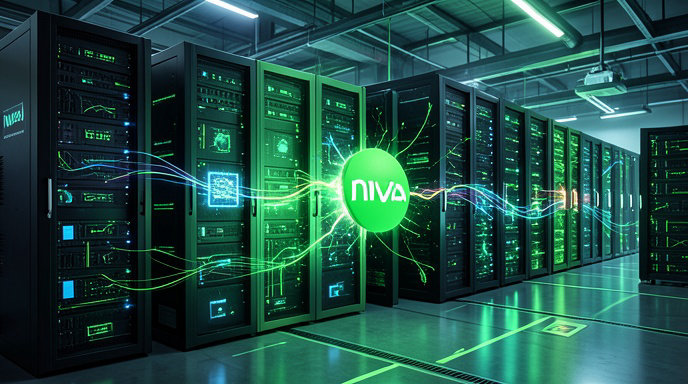
Crucially, these are not general-purpose data centers. Cloverleaf's campuses are being designed from the ground up for dense, liquid-cooled AI clusters running Nvidia's Blackwell and next-generation Vera Rubin architectures. Nvidia will not operate the facilities directly, but its investment gives it deep influence over design, deployment timelines, and technology stack.
Why Nvidia Is Funding Its Own Customers
At first glance, a chipmaker financing the data centers that buy its chips might seem circular. For Nvidia, it's strategic necessity.
The AI boom has flipped the industry's bottleneck. Demand for Nvidia GPUs remains insatiable, but customers — from hyperscalers to neoclouds like CoreWeave — cannot deploy them fast enough due to shortages in power, land, and permitting. Waiting three to five years for a new substation or grid interconnection is now a bigger constraint than chip supply.
By backing developers like Cloverleaf, Nvidia is essentially de-risking and pre-building its own market. Cloverleaf's model focuses on securing shovel-ready sites with dedicated power access, including behind-the-meter and bring-your-own-power solutions, long before a tenant is signed. That solves the two hardest problems in AI infrastructure today: where to put a 100,000+ GPU cluster and how to power it.
In return, Cloverleaf gets not just capital, but a powerful anchor partner that makes its sites instantly more attractive to hyperscalers, enterprises, and AI cloud providers who want guaranteed access to Nvidia's latest hardware and reference architectures.
The Flywheel Strategy Explained
This is Nvidia's flywheel in action, and Cloverleaf is just the latest turn of the wheel.
The logic is simple and self-reinforcing: Nvidia invests in infrastructure -> more power-ready data centers get built -> those data centers buy more Nvidia GPUs, networking, and software -> AI capabilities grow -> demand for compute increases -> need for more data centers. Each rotation accelerates the next.
Nvidia has executed this playbook before with investments in CoreWeave, Lambda, Crusoe, and other AI cloud platforms that are also massive consumers of its chips. What makes the Cloverleaf deal different is that it moves even further upstream — from funding GPU buyers to funding the land and energy developers who house them.
It also locks in Nvidia's full-stack vision. These new campuses are expected to be optimized for Nvidia's entire platform, including its Spectrum-X Ethernet, InfiniBand, NVLink, and DGX Cloud software, making it harder for competitors like AMD and Intel to displace it at the data center level.
What Cloverleaf Brings to the Table
Founded by energy and data center veterans and backed by private equity firm NGP, Cloverleaf Infrastructure has quietly become one of the most important players in the power-first data center boom. Unlike traditional developers who retrofit existing facilities, Cloverleaf focuses on greenfield mega-sites strategically located near abundant, low-cost power and fiber.
The company has been acquiring large land parcels with secured grid interconnections and developing its own power generation and substation infrastructure — a critical advantage as utilities struggle to keep up with AI-driven load growth. Its pipeline reportedly includes multiple sites capable of supporting 300 megawatts to over 1 gigawatt each, the scale required for frontier model training.
For Nvidia, partnering with a developer that already solved the power puzzle is far faster than building that expertise in-house. For Cloverleaf, Nvidia's backing provides validation, capital, and a direct line to the customers who will ultimately fill its buildings.
What It Means for the Future of AI Growth
The Nvidia-Cloverleaf partnership is more than a single deal — it's a blueprint for how the next phase of AI will be built.
As model sizes and inference demand explode, the race is no longer just about who has the best chip, but who can secure the physical capacity to run it. Hyperscalers like Microsoft, Amazon, and Google are spending tens of billions on data centers, but even they are constrained by power and construction timelines. By seeding independent developers, Nvidia ensures that capacity keeps growing outside the hyperscaler walled gardens, preserving a diverse customer base for its chips.
It also raises the stakes for competitors. If Nvidia controls both the chip supply and influences where those chips can be deployed most efficiently, rivals will need to offer not just competitive silicon, but competitive infrastructure solutions.
In the short term, expect Cloverleaf's first Nvidia-optimized campuses to come online in the next 18-24 months, helping to alleviate near-term capacity crunches. In the long term, this billion-dollar bet shows that Nvidia sees itself not just as a chip supplier, but as the architect of the entire AI economy — from the silicon to the substation.

Get All The Latest Updates Delivered Straight To Your Inbox For Free!