
Nvidia's $3.5B MediaTek Bet: How Nvidia Plans to Stay King of AI Chips as Big Tech Builds Its Own
TL;DR
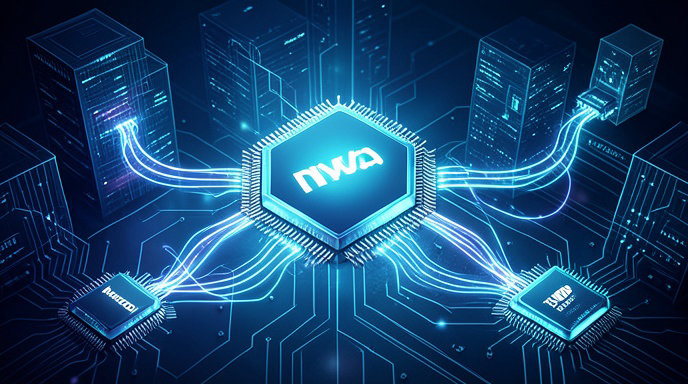
- Nvidia is reportedly investing $3.5 billion in Taiwan's MediaTek to co-develop next-generation AI chips for PCs, automotive, and edge devices, expanding its dominance beyond data center GPUs.
- The move is a direct defense against Big Tech's custom silicon push, as Google, Amazon, Microsoft, and Meta increasingly design their own AI chips to reduce reliance on Nvidia.
- By leveraging MediaTek's expertise in efficient ARM-based SoCs and its supply chain scale, Nvidia aims to own the full AI stack from cloud to edge and lock in the future of AI infrastructure.
Why Nvidia Needs MediaTek Right Now
For the last three years, Nvidia has been the undisputed king of AI. Its H100, H200, and new Blackwell GPUs power virtually every major AI model from OpenAI's GPT-4o to Google's Gemini and Meta's Llama. That dominance has made Nvidia a $3 trillion-plus company, but it has also made it a target.
Every major customer is now trying to become a competitor. Google has its sixth-generation TPUs, Amazon has Trainium and Inferentia, Microsoft unveiled its Maia 100 accelerator, and Meta is scaling its MTIA chips. The message is clear: Big Tech wants to control its own AI destiny and stop paying Nvidia's premium.
Nvidia's reported $3.5 billion bet on MediaTek is its answer. It is not just an investment; it is a strategic alliance designed to put Nvidia technology everywhere its customers are trying to replace it. While Nvidia owns the data center, MediaTek owns the edge. The Taiwanese fabless giant ships over 2 billion chips a year for smartphones, Chromebooks, smart TVs, routers, and cars. Nvidia can't build that scale alone.
An Alliance Years in the Making
This is not a cold partnership. Nvidia and MediaTek have been quietly collaborating for more than a year. In 2023 and 2024, the two companies announced joint automotive platforms, combining MediaTek's Dimensity Auto Cockpit SoCs with Nvidia's Drive Orin and RTX graphics for infotainment and driver assistance. Earlier this year, they co-developed a new ARM-based processor for AI PCs aimed at taking on Qualcomm's Snapdragon X Elite in the Windows on ARM ecosystem.
The new investment reportedly deepens that work dramatically. According to reports circulating in Taipei and on Wall Street, the deal gives Nvidia a significant equity stake in MediaTek and establishes a joint design center in Hsinchu, Taiwan's semiconductor hub, close to TSMC's fabs where both companies manufacture their chips.
The focus is on three key areas: a next-generation AI PC chip that pairs Nvidia's Blackwell GPU architecture with MediaTek's power-efficient CPU and 5G modem expertise, a new generation of automotive AI chips for software-defined vehicles, and ultra-efficient edge AI SoCs for enterprise and robotics.
Countering the Custom Silicon Rebellion
To understand why Nvidia is spending billions to defend its turf, look at the economics. Training a frontier AI model can cost hundreds of millions of dollars, and a huge portion of that cost is renting Nvidia GPUs from cloud providers. For hyperscalers like AWS and Google Cloud, building a viable in-house alternative, even if it is only 20-30% cheaper, saves billions annually.
But custom silicon has a weakness: it is narrow. Amazon's Trainium is great for AWS, but it doesn't help you run AI on a laptop, a car, or a factory robot. Nvidia's strategy has always been ubiquity through its CUDA software platform, which now has over 5 million developers. By partnering with MediaTek, Nvidia extends CUDA from the cloud to the absolute edge.
Imagine a future where an AI application is trained on Nvidia GPUs in the data center, but then runs seamlessly on a MediaTek-powered AI PC, a MediaTek-powered car, and a MediaTek-powered IoT device, all accelerated by Nvidia IP. That is a moat that a single-purpose TPU or Maia chip cannot cross. It locks developers into the Nvidia ecosystem end-to-end.
What This Means for the Future of AI Infrastructure
This bet signals a major shift in how AI infrastructure will be built. The era of AI being confined to massive data centers is ending. The next wave is hybrid AI, where inference happens everywhere, low-latency and offline.
For consumers, this could mean far more powerful AI PCs that can run large language models locally without the cloud, and cars that can process complex autonomous driving models in real-time. For enterprises, it means cheaper, more efficient AI deployment without being locked into a single cloud provider's custom chip.
For competitors, the pressure is on. Intel and AMD are racing to build their own AI PC chips, while Qualcomm is betting big on on-device AI. Nvidia and MediaTek together create a formidable rival with best-in-class graphics and best-in-class efficiency.
For TSMC, the world's most important chipmaker, the deal is a win. Both Nvidia and MediaTek are anchor customers for its 3nm and upcoming 2nm processes. A joint chip would guarantee massive, long-term volume for its most advanced nodes.
The Bottom Line: Defense as Offense
At first glance, Nvidia investing in another chipmaker might look defensive. In reality, it is the most offensive move it could make. Nvidia knows it cannot stop Google or Amazon from building their own chips. But it can make sure that Nvidia architecture is still the default everywhere else.
The $3.5 billion price tag is small compared to Nvidia's cash reserves and market cap, but the strategic payoff could be enormous. If the AI revolution truly moves from the cloud to every device, Nvidia is ensuring it still collects a toll at every step. The king of AI chips is not just defending its castle; it is building new ones on every corner of the board.

Get All The Latest Updates Delivered Straight To Your Inbox For Free!