
Oura Ring Lawsuit Claims Misleading Sleep Tracking Accuracy Exposed
TL;DR
- A new class-action lawsuit filed against Oura alleges its smart rings lack the sensor capability to accurately measure sleep stages and sleep quality, despite premium marketing claims of clinical-grade accuracy.
- The complaint centers on the gap between Oura's marketing and the technical reality of its sensors, arguing that heart rate, movement, and temperature data from a finger-worn PPG sensor cannot reliably replicate polysomnography used in sleep labs.
- The outcome could force major changes in how wearable companies advertise sleep-tracking accuracy and may entitle consumers to compensation if the court finds Oura engaged in deceptive marketing.
The Lawsuit at a Glance
Oura, the Finnish company behind the popular Oura Ring Gen 3 and Oura Ring 4, is facing a federal class-action lawsuit in the United States that directly challenges one of its most marketed features: sleep tracking. Filed in mid-August 2026 in the U.S. District Court for the Northern District of California, the complaint accuses Oura Health Oy of misleading consumers by advertising its rings as capable of providing highly accurate sleep stage analysis and overall sleep quality scores.
The plaintiffs argue that consumers paid a premium price, between $299 and $499 plus a $6.99 monthly membership for full data access, based on the belief that the ring could accurately track light sleep, deep sleep, and REM sleep. The lawsuit seeks class-action status to represent all U.S. purchasers, along with monetary damages, restitution, and an injunction to stop what it calls false and deceptive advertising.
At the heart of the case is not whether the Oura Ring tracks anything at all, but whether it can do what its marketing implies it does with the precision consumers were led to expect.
What the Plaintiffs Are Alleging
The lawsuit makes several specific accusations. First, it claims Oura's marketing creates a false impression of medical or near-medical accuracy. Advertisements, product pages, and app store descriptions have used phrases like "accurate sleep staging," "lab-accurate insights," and "know your sleep quality" which the plaintiffs argue suggests a level of scientific validation the device does not have.
Second, the complaint alleges the hardware itself is fundamentally incapable of the task. Unlike polysomnography, the gold standard for sleep analysis which measures brain waves via EEG, eye movement, and muscle activity, the Oura Ring relies on surrogate signals. The plaintiffs, citing opinions from sleep researchers, contend that no algorithm can reliably infer true sleep stages from those surrogate signals alone, especially on a night-by-night basis for an individual user.
Finally, the suit alleges unjust enrichment and violations of California's consumer protection laws, including the False Advertising Law and Unfair Competition Law. The core argument is that if consumers had known the sleep data was an estimate with significant margins of error, they would not have purchased the ring or would have paid substantially less for it.
How Oura's Sleep Tracking Actually Works
To understand the dispute, it helps to understand what is inside the ring. The Oura Ring does not measure brain activity. Instead, it uses a combination of sensors on the finger to make an educated guess about what stage of sleep you are in.
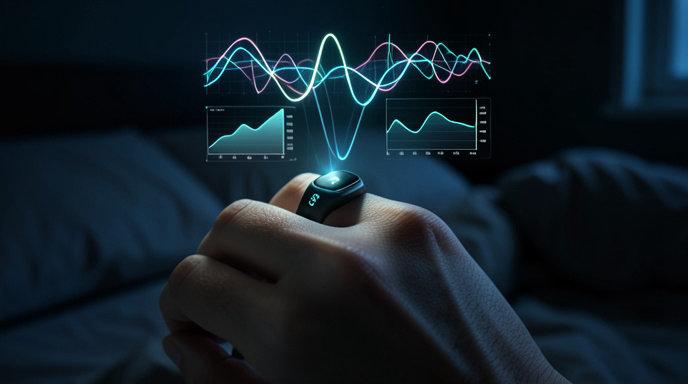
The primary sensors are photoplethysmography sensors, which use green and infrared LEDs to detect blood volume changes and estimate heart rate and heart rate variability. A highly sensitive 3D accelerometer tracks movement and restlessness throughout the night. An NTC temperature sensor monitors nightly skin temperature deviations, and newer models add blood oxygen sensing.
All of this data is fed into Oura's proprietary algorithm. For example, low movement combined with a steady, low heart rate and high heart rate variability is typically scored as deep sleep. Elevated heart rate variability and irregular heart rate with little movement is often classified as REM sleep. Light sleep and wakefulness are inferred from more frequent movement and intermediate heart rate patterns.
Oura has published validation studies comparing its Gen 3 ring to polysomnography, reporting overall sleep-wake agreement of around 85-90% but significantly lower accuracy for distinguishing between individual sleep stages, particularly deep sleep. The company has always stated in its support documentation that the ring provides estimates and is not a medical device, a disclaimer the lawsuit argues is buried and contradicted by its main advertising.
Marketing vs. Scientific Reality
This disconnect between marketing language and scientific nuance is common across the entire wearable industry, but the Oura lawsuit puts it under a microscope. Independent validation studies from universities and sleep labs over the past two years have consistently shown that while consumer wearables including Oura, Whoop, and Apple Watch are reasonably good at detecting total sleep time and sleep vs. wake, their accuracy for the four-stage sleep classification is far more limited.
Studies have shown accuracy for stage-specific detection can drop to 50-65%, with a tendency to overestimate REM and deep sleep and underestimate wakefulness after sleep onset. Performance also varies significantly between individuals, with factors like skin tone, finger size, tattoos, and sleep disorders like sleep apnea further reducing accuracy.
The plaintiffs argue that Oura failed to clearly disclose these limitations at the point of sale. Instead, they point to sleek app interfaces that present nightly sleep scores, detailed hypnograms, and stage breakdowns down to the minute without prominent error bars or confidence intervals, reinforcing the idea of precision.
Oura has not yet filed a formal response to the new complaint, but in previous statements regarding accuracy questions, the company has defended its technology, pointing to its peer-reviewed research, continuous algorithm improvements, and its use by researchers at institutions like UCSF and Stanford. The company maintains its sleep staging is among the most accurate in the consumer wearable category and that it is transparent about the nature of its estimates.
What This Means for Consumers and the Wearable Industry
If the lawsuit is certified as a class action and survives a motion to dismiss, the implications could be significant. For consumers, a successful claim could result in refunds, partial reimbursements, or extended membership credits. More immediately, it serves as a reminder that no consumer wearable currently on the market can diagnose sleep disorders or perfectly replicate a sleep lab. Sleep scores should be viewed as directional trends over weeks and months, not precise nightly medical data.
For the industry, the case could set a new precedent for advertising standards. The Federal Trade Commission has already increased scrutiny of health claims made by wearable and wellness tech companies. A ruling against Oura could force all major players to add clearer disclaimers, change how they visualize sleep data, and avoid terms like "accurate" or "clinical-grade" without FDA clearance.
Many legal analysts expect Oura to seek a settlement rather than go to trial, as similar class actions against Fitbit and other wearable makers in recent years have settled out of court. However, if Oura chooses to fight, the case will likely hinge on a battle of experts over whether its marketing was aspirational puffery or materially deceptive.
What's Next
The court will first decide whether the case meets the requirements for class-action certification. Oura will have 30 to 60 days to file its answer or a motion to dismiss. In the meantime, the lawsuit is already prompting renewed discussion among sleep scientists about the need for a standardized accuracy rating system for consumer sleep trackers, similar to nutrition labels.
For now, Oura Rings remain on sale and the Oura App continues to function as normal. No recall has been issued and no court has found the company liable for any wrongdoing. Consumers who are concerned about their sleep data should focus on long-term trends rather than single-night scores and consult a healthcare professional for any suspected sleep disorders.

Get All The Latest Updates Delivered Straight To Your Inbox For Free!