
Saudi Aramco Backs Mitti Labs to Transform Asia’s Rice Farming with Water-Smart Tech
TL;DR
- Saudi Aramco’s venture capital arm has invested in Mitti Labs, a climate-tech startup focused on reducing water usage and methane emissions in Asian rice paddies, with initial deployments in India.
- Mitti Labs combines satellite monitoring, soil sensors, and regenerative farming practices (like Alternate Wetting and Drying) to cut water consumption by up to 30% while generating verifiable carbon credits for farmers.
- The funding will accelerate expansion into the Philippines and Indonesia, targeting a combined rice-growing region that feeds billions, with a goal of locking carbon in agricultural soil at scale.
The New Oil: Why a Fossil Giant Is Betting on Rice
When Saudi Aramco—the world’s most valuable oil company—writes a check to a startup that helps rice farmers use less water, it signals a profound shift in how Big Energy views climate risk. The investment, announced this week, places Aramco’s venture arm (Wa’ed) alongside existing backers in Mitti Labs, a Boston- and Bengaluru-based agtech firm. The thesis is simple but radical: rice paddies are a methane bomb, and fixing them is both an environmental imperative and a multi-billion-dollar data opportunity.
Rice is the staple food for over 3 billion people, but it is also a climate villain. Flooded paddies breed anaerobic bacteria that release methane—a greenhouse gas 80 times more potent than CO2 over a 20-year period. Rice cultivation accounts for roughly 12% of global methane emissions. Mitti Labs’ pitch is that it can slash those emissions while simultaneously helping farmers cope with worsening droughts and depleted aquifers.
The Tech Stack: Satellites, Sensors, and a Smarter Flood
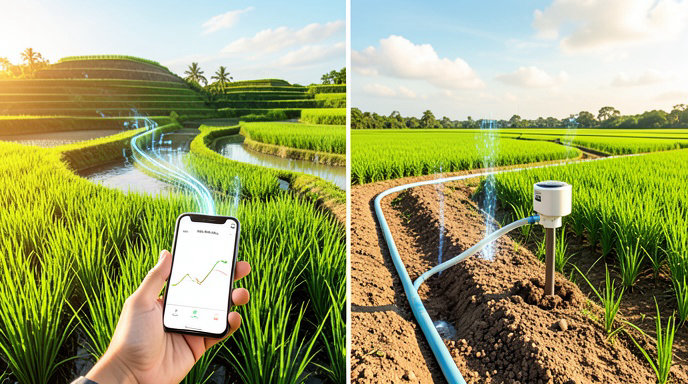
The core innovation is not a new rice seed or a chemical additive. It is a precision water-management system built on a three-layer tech stack. First, Mitti Labs deploys low-cost soil moisture sensors across partner farms. Second, it layers high-resolution satellite imagery (from partners like Planet Labs) to track canopy temperature, field wetness, and crop health at scale. Third, its proprietary AI models process this data to tell farmers exactly when to flood and drain their paddies—a practice known as Alternate Wetting and Drying (AWD).
Traditional AWD has existed for decades, but adoption has been slow because it requires daily field checks and manual judgment. Mitti Labs automates the decision-making. The system sends SMS alerts in local languages (Hindi, Bahasa, Tagalog) telling farmers to drain a field two days earlier than usual, or to hold water for another week. The result: water usage drops by 25–30% per cycle, and methane emissions fall by up to 50% because the soil is exposed to oxygen intermittently.
The Money Trail: Carbon Credits and Data as a Crop
Here is where the Aramco investment gets interesting. Mitti Labs monetizes the environmental gains through two revenue streams. The first is carbon credits. By measuring methane reduction with satellite-verified data, Mitti Labs generates high-integrity credits that it sells on voluntary markets—often to multinational corporations with net-zero commitments. Farmers receive a direct share of the credit revenue, which can add $30–$60 per hectare per season, a meaningful boost for smallholders.
The second stream is agricultural data. Mitti Labs is building a proprietary dataset of soil health, water usage, and yield patterns across millions of hectares. This data is gold for agribusinesses, fertilizer companies, and insurance firms. For Aramco, the strategic angle is less about rice and more about carbon accounting. The company has pledged to achieve net-zero emissions from its operations by 2050, and it is aggressively investing in nature-based solutions and carbon capture. Backing Mitti Labs gives Aramco a beachhead in the global carbon-credit supply chain, particularly in Asia where verification standards are often weak.
India First: The Pilot Hotspots
Mitti Labs is already operational in the Indian states of Punjab, Haryana, and Telangana—regions where groundwater levels are collapsing due to intensive rice cultivation. In Punjab alone, farmers pump water from depths exceeding 100 meters. The startup has onboarded over 15,000 smallholder farms, covering roughly 40,000 acres. Early results show yield neutrality (no loss in production) while cutting water use by a third. The company is also working with the International Rice Research Institute (IRRI) to validate methane reduction methodologies.
The India expansion is deliberately grassroots. Mitti Labs employs local "agri-entrepreneurs" who rent out the sensor kits and train farmers. The business model is not charity; it is a service fee plus a revenue share on carbon sales. This has attracted attention from state governments, which see a tool to enforce groundwater regulations without resorting to punitive fines.
Scaling to the Archipelago: Philippines and Indonesia
The new Aramco funding—amount undisclosed but described as "seven figures"—will fund expansion into Southeast Asia. The Philippines and Indonesia present a different challenge: smaller landholdings, more fragmented supply chains, and higher rainfall variability due to El Niño. In Indonesia, Mitti Labs will partner with local cooperatives in Java and Sulawesi, targeting the country’s 10 million rice farmers. The Philippines launch will focus on the Central Luzon rice bowl, where irrigation infrastructure is aging.
The company’s CEO, Dr. Ruchika Singh, told reporters that the Southeast Asian expansion is not just about replication. "The soil types, the monsoon patterns, and the farmer incentives are completely different. We are building a modular platform that adapts, not a one-size-fits-all solution." This includes integrating with existing government subsidy programs and working with millers who pay premiums for "low-carbon rice."
Why This Matters for Food Security and Climate Resilience
The stakes extend beyond emissions accounting. By 2050, Asia will need to produce 60% more rice to feed its population, but it will do so with 20% less water availability per capita. Mitti Labs’ approach is a rare win-win: it reduces the agricultural sector’s water stress while building resilience against climate shocks. During the 2023 El Niño, pilot farms in Telangana maintained yields while neighboring conventional farms saw 15% losses.
Moreover, the carbon revenue creates a new income stream for farmers who are often one bad monsoon away from bankruptcy. This financial buffer allows them to invest in better seeds or equipment, creating a virtuous cycle. For Aramco, the investment is a hedge: as the world decarbonizes, the company wants to own a slice of the "carbon farming" economy that will inevitably grow.
The Skeptic’s Corner: Verification and Scale
Not everyone is convinced. Critics point out that carbon credits from soil-based projects have a history of over-crediting. Measuring methane reduction across thousands of tiny, muddy paddies is notoriously difficult. Mitti Labs counters that its satellite-plus-sensor approach is more rigorous than the baseline methods, which often rely on static emission factors. The company is pursuing Verra and Gold Standard certification, and it publishes its monitoring data for third-party audits.
Scale is the other hurdle. The startup has ambitious plans to reach 1 million hectares by 2028, but that requires onboarding hundreds of thousands of farmers, each with unique land tenure and irrigation access. The Aramco backing provides patient capital, but it also raises questions about mission alignment. Some environmental groups have criticized Aramco for "greenwashing" its fossil fuel core. Mitti Labs’ response is pragmatic: "We don’t care where the money comes from. We care that it helps farmers and the planet. If an oil company wants to pay for that, we say welcome."
The Road Ahead: A Blueprint for AgTech 2.0
The Mitti Labs-Aramco partnership is a bellwether for a new wave of agtech investment. Unlike the first wave, which focused on drone sprayers and fancy apps, this second wave is about ecological infrastructure—turning farms into carbon sinks and water banks. The technology is less flashy but more systemic. It also requires deep collaboration with governments, NGOs, and commodity buyers.
For rice farmers in Asia, the immediate benefit is lower input costs and higher resilience. For the climate, the benefit is measurable methane reductions in a sector that has been largely ignored. And for Saudi Aramco, the benefit is a strategic foothold in the transition to a low-carbon economy—one flooded paddy at a time. The next 18 months will be critical as the company scales into Indonesia and the Philippines, but if the model holds, it could become the gold standard for climate-smart agriculture in the world’s most populous region.

Get All The Latest Updates Delivered Straight To Your Inbox For Free!