
Tesla Recalls 3 Million Cars in China Over Hidden Door Handles in Major Safety Crackdown
TL;DR
- China has ordered Tesla to recall more than 3 million vehicles and eight other automakers to issue fixes after regulators ruled that flush electronic door handles with hidden manual releases pose a critical safety risk.
- As an immediate remedy, affected cars must be retrofitted with prominent warning labels and instructions showing the location of the mechanical emergency release, while a new national standard will require clearly visible and operable manual handles on all new vehicles starting in 2027.
- The crackdown is sending shockwaves through the global EV industry, forcing a rethink of minimalist, button-only door designs pioneered by Tesla and now widely copied.
The Recall Heard Around the EV World
In one of the largest automotive safety actions in China's history, Tesla is recalling over 3 million vehicles sold in the country. The mandate from China's State Administration for Market Regulation (SAMR) targets Model 3 and Model Y vehicles produced domestically at Giga Shanghai and imported units, spanning model years from 2019 to the present.
Tesla is not alone. Eight other major automakers — including domestic giants like BYD, NIO, XPeng, Li Auto, Geely, and Xiaomi Auto — have been ordered to take corrective action on models that use similar retractable or flush-mounted electronic door handles. While Tesla's recall is by far the largest in scale, the directive applies industry-wide and marks the most aggressive government intervention yet against the trend of fully electronic doors.
All nine automakers have accepted the recall plan and will implement fixes free of charge to owners, either through over-the-air updates combined with physical modifications or through dealer service visits.
Why Hidden Handles Are a Safety Hazard
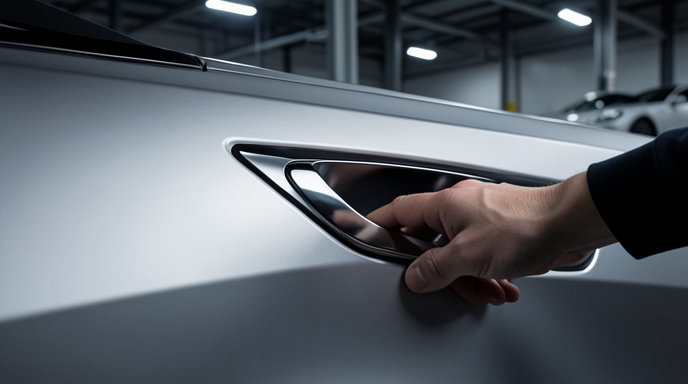
The sleek, flush door handle has become a signature of modern EV design. Popularized by Tesla, the handles sit flat against the bodywork to improve aerodynamics and create a minimalist look. They extend electronically when the key fob approaches or when pressed, and the doors themselves unlatch with an electronic button rather than a traditional mechanical lever.
Regulators and safety advocates say that design becomes dangerous in an emergency. In a severe crash, fire, or 12V battery failure, the electronic system can lose power, leaving occupants and rescuers unable to open the doors from the inside or outside. The mechanical backup release — which is required by law — is often hidden in obscure locations, such as inside the door pocket, under a speaker grille, or beneath a removable rubber mat, with no clear labeling.
Chinese investigators cited multiple incidents where passengers, including children in rear seats, were unable to exit vehicles after collisions, and where first responders struggled to access occupants. Similar concerns have been raised in the United States and Europe, where the U.S. National Highway Traffic Safety Administration (NHTSA) has opened preliminary investigations into electronic door failures.
China's Fix: Warning Labels Now, Redesign Next
The recall will be carried out in two phases.
Phase one is an immediate interim remedy. Tesla and the other automakers must add highly visible warning labels and permanent markings indicating the location and operation of the manual emergency door release for every door. For many Tesla owners, this means a service center will install a small, illuminated icon and text label near the hidden manual pull-cable in the front doors and rear doors, along with an updated on-screen tutorial that plays automatically after the recall update. Owners will also receive a physical owner-notification letter with diagrams.
This labeling fix is designed to be implemented quickly, within the next few months, without requiring a full hardware redesign.
Phase two is a fundamental change to how cars are built for China. The Ministry of Industry and Information Technology (MIIT) has unveiled a new revision to the national safety standard GB 11568 that will take effect on January 1, 2027. Under the new rule, all new vehicles must have interior door handles that are mechanically operable, clearly visible, and accessible without the use of tools or hidden covers, and must be operable even when the vehicle has no electrical power. Exterior handles must also have a mechanical failsafe that can be operated by rescuers.
In practice, this means the era of completely flush, button-only doors in China is over. Future models will need a distinct, tactile mechanical lever or a clearly marked pull-handle that works independently of electronics.
What This Means for the Future of EV Design
China is the world's largest auto market and the global leader in EV adoption, so its regulations have outsized influence on what automakers design for the rest of the world. Most manufacturers do not want to build one door system for China and a completely different one for Europe and the U.S.
The move is already forcing a design rethink. While flush handles offer a small aerodynamic benefit — typically adding a few kilometers of range — critics argue the safety trade-off was never worth it. Automakers had chased Tesla's minimalist aesthetic to signal that their cars were high-tech, but that minimalism came at the cost of intuitive, life-saving physical controls.
Expect the next generation of EVs, even outside China, to feature hybrid designs: handles that may still sit flush for aerodynamics but will incorporate a prominent, always-available mechanical release with clear tactile feedback. Xiaomi's SU7 and newer BYD models, for example, are already showing prototypes with more conventional handles in response to the draft regulation.
For Tesla, which has built its entire design language around clean surfaces and electronic controls, the recall represents a significant philosophical challenge. The company has said it will comply fully and will push the required software and labeling updates via its service network in the coming weeks.
Ultimately, the crackdown signals a broader regulatory shift: as EVs go mainstream, governments are no longer willing to let futuristic design trump basic, proven safety principles. The physical door handle, once thought to be obsolete, is making a comeback.

Get All The Latest Updates Delivered Straight To Your Inbox For Free!