
SpaceX to Build $100B Second Starbase in Louisiana With First Starship Flight Targeted for 2029
TL;DR
- As of August 26, 2026, no official announcement from SpaceX, the State of Louisiana, or federal regulators has confirmed a $100 billion second Starbase in Louisiana, though unverified reports describe a proposed facility with construction starting in 2027 and a first Starship launch targeted for 2029.
- The reported plan describes a massive expansion beyond SpaceX's Boca Chica, Texas Starbase, positioned to increase Starship launch cadence, support Artemis and Mars ambitions, and leverage Louisiana's Gulf Coast infrastructure.
- If confirmed, a project of this scale would carry major economic, logistical, and environmental implications for Louisiana and U.S. spaceflight, but key details including funding, location, and regulatory approval remain unverified.
A Second Starbase on the Gulf Coast?
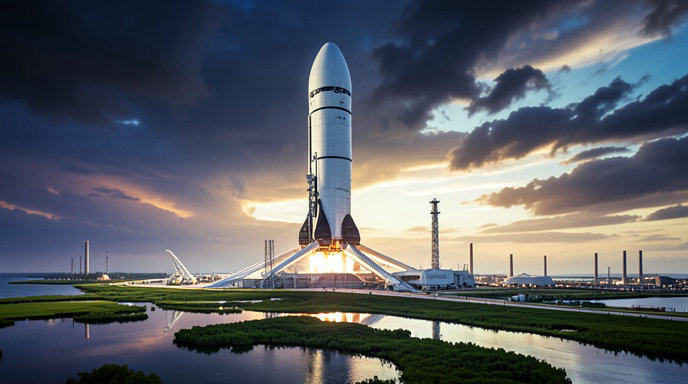
Reports circulating about SpaceX's next giant leap describe a second Starbase, this time on Louisiana's Gulf Coast, with a staggering $100 billion price tag. While SpaceX has not officially confirmed the project as of August 26, 2026, the details being discussed point to a facility modeled on Starbase in Boca Chica, Texas, but built for a significantly higher launch rate and next-generation Starship operations.
According to the proposal as described, construction would begin in 2027, with the first Starship flight from the new site targeted for 2029. That timeline would align with SpaceX's broader goals for increasing Starship flight frequency, supporting NASA's Artemis lunar program, and laying groundwork for future Mars missions. No filings with the Federal Aviation Administration, U.S. Army Corps of Engineers, or Louisiana economic development agencies have been publicly identified to corroborate the timeline.
Why Louisiana
Louisiana's inclusion in the reported plan has drawn attention due to its strategic and industrial advantages. The state's Gulf Coast location offers direct access to equatorial launch trajectories over water, similar to Texas and Florida, while its existing aerospace and maritime industrial base could support large-scale manufacturing and transport.
The region is already home to NASA's Michoud Assembly Facility in New Orleans, where core stages for the Space Launch System are built, and has a deepwater port network capable of handling oversized hardware via barge. Proximity to SpaceX's current Starbase and its growing operations at Kennedy Space Center in Florida would also create a Gulf Coast launch corridor, potentially streamlining logistics, propellant supply, and recovery operations for Super Heavy boosters and Starships.
The $100 Billion Question
A $100 billion investment would dwarf any private spaceport development to date and would represent one of the largest private infrastructure projects in U.S. history. For context, SpaceX's entire Starship development program to date is estimated in the single-digit billions, with its Texas Starbase built incrementally over several years.
An investment at this scale, if accurate, would suggest far more than a launch pad. The reports describe a fully integrated complex including Starship and Super Heavy manufacturing facilities, Raptor engine production and testing, a massive launch and catch tower infrastructure, tank farms for liquid methane and liquid oxygen, and a dedicated port for offshore launch and recovery platforms. It would also imply long-term workforce housing, power generation, and transportation upgrades.
Analysts note that funding on this level would likely require a mix of private capital, long-term government contracts, and significant state and federal incentives, none of which have been publicly disclosed or confirmed as of late August 2026.
Construction Timeline and 2029 Launch Target
The reported two-year construction window from 2027 to 2029 is considered extremely ambitious for a project of this magnitude. Even with SpaceX's rapid iterative construction approach demonstrated in Texas, a greenfield spaceport of this complexity would typically require extensive environmental review under the National Environmental Policy Act, FAA launch site licensing, coastal zone management approvals, and wetlands permitting — processes that often take multiple years on the Gulf Coast.
Targeting a first Starship flight in 2029 would mean SpaceX aims to replicate and scale the development model it pioneered at Boca Chica, where build, test, and fly cycles proceeded in parallel with regulatory review. Achieving that cadence in Louisiana would depend on early site preparation, parallel infrastructure development, and a streamlined approval process that has not yet been publicly documented.
Economic and Strategic Implications for Louisiana and U.S. Spaceflight
If the project moves forward as described, the impact on Louisiana could be transformative. A second Starbase would potentially bring tens of thousands of direct construction and operations jobs, plus a wider ecosystem of suppliers, contractors, and service industries. State officials have long sought to diversify the economy beyond energy and expand its commercial space footprint centered around Michoud.
For SpaceX and U.S. spaceflight more broadly, a second Gulf Coast Starbase would address a critical bottleneck: launch capacity. SpaceX currently juggles Falcon and Starship operations between Texas and Florida, with range congestion and environmental constraints limiting flight rate. A dedicated, high-cadence Starship port in Louisiana could enable the dozens to hundreds of launches per year that SpaceX says are needed for orbital refueling, lunar landings, and Mars settlement architecture, while also providing redundancy if weather or technical issues ground one site.
It would also intensify domestic competition in the heavy-lift launch market and reinforce U.S. leadership as NASA, SpaceX, and other providers push toward a permanent lunar presence.
What Still Needs to Be Confirmed
Despite the scale of the claims, major questions remain unanswered as of August 26, 2026. SpaceX has not issued a press release, filing, or public statement confirming a Louisiana Starbase, a $100 billion budget, or the 2027-2029 timeline. No specific parish or site location, land acquisition records, or formal incentive packages from Louisiana Economic Development have been verified.
Environmental considerations will also be central. Any Gulf Coast spaceport would face scrutiny over impacts to wetlands, wildlife, fisheries, and hurricane resilience, as well as community impact and infrastructure strain. The FAA's environmental assessment process for the Texas Starbase resulted in years of review and mitigation requirements, a precedent that would likely apply to any Louisiana site.
For now, the reported $100 billion Louisiana Starbase remains an ambitious but unverified proposal. Until official documentation, regulatory filings, or direct confirmation from SpaceX and state authorities emerge, the plan should be treated as speculative.

Get All The Latest Updates Delivered Straight To Your Inbox For Free!