
Google Signs Its Biggest Rice-Methane Carbon Credit Deal With Mitti Labs to Green 100,000 Hectares in India
TL;DR
- Google has signed a four-year agreement with Indian startup Mitti Labs to generate carbon credits from methane-cutting rice farming across 100,000 hectares in three states.
- The project will train smallholder farmers in Punjab, Haryana, and Uttar Pradesh to shift from flooded paddies to Alternate Wetting and Drying and Direct Seeded Rice techniques.
- The deal is Google's largest rice-methane carbon removal purchase to date and a major test for high-integrity agricultural credits in voluntary carbon markets.
A Search Giant Bets On Paddies
Google is going deep into India's rice belt to tackle one of climate's most overlooked super-pollutants: methane from paddy fields.
Under a new four-year agreement, Google will buy carbon credits generated by Mitti Labs, a Delhi and New York-based climate-tech startup, across 100,000 hectares of rice farmland in Punjab, Haryana, and Uttar Pradesh. The project is expected to cut tens of thousands of tonnes of methane emissions while supporting incomes for tens of thousands of smallholder farmers.
For Google, which has pledged to reach net-zero across its operations and value chain by 2030 and to catalyze high-quality carbon removal, it is the company's biggest bet yet on rice-methane abatement. For Mitti Labs, founded in 2023 by Harvard graduates Nathan Torrens, Xavier Johnson, and Devendra Singh, it is a breakout moment that vaults a little-known agritech startup onto the global carbon market stage.
Why Paddy Methane Matters So Much
Rice feeds more than half the world, but the way it is traditionally grown carries a heavy climate cost.
Most Indian rice is grown in continuously flooded paddies. Standing water creates oxygen-free conditions in the soil, allowing microbes to produce methane as they decompose organic matter. That methane bubbles up through the water and rice stalks into the atmosphere.
The numbers are stark. Rice cultivation is responsible for roughly 8% to 12% of global human-caused methane emissions, and India is the world's second-largest rice producer with over 45 million hectares under cultivation. Methane is more than 80 times more potent than carbon dioxide over a 20-year period, meaning cuts today can slow warming fast.
That is why tech buyers like Google, Microsoft, and Stripe are now looking beyond forestry and direct air capture to agricultural methane — a source that is huge, measurable, and until recently, largely untapped for carbon finance.
How Mitti Labs Actually Cuts Methane
Mitti Labs does not ask farmers to stop growing rice. It changes how they grow it.
The core of the program is a bundle of proven agronomy practices, led by Alternate Wetting and Drying, known as AWD, and Direct Seeded Rice, or DSR.
In conventional farming, fields stay flooded for weeks. With AWD, farmers use simple perforated tubes sunk into the soil to monitor water levels, allowing fields to dry out periodically before re-flooding. This breaks the anaerobic cycle that creates methane, cutting emissions by 30% to 50% without hurting yields, while using about 30% less water.
With DSR, farmers sow seeds directly into the soil instead of transplanting seedlings into flooded nurseries. That shortens the flooding period, saves labor and water, and further reduces methane and pumping costs.
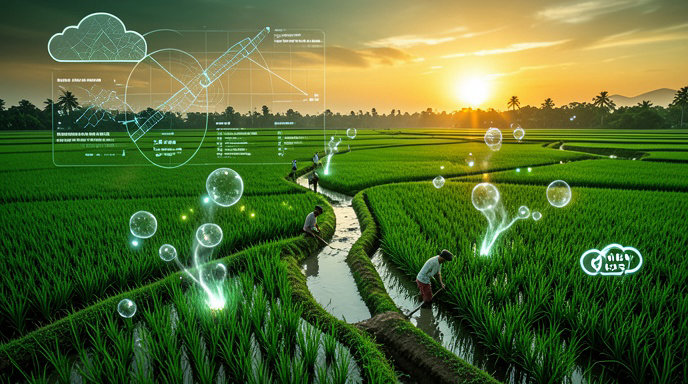
Mitti Labs handles the hard parts: farmer enrollment and training, agronomist support via field teams and a mobile app, satellite imagery and IoT water sensors for monitoring, and third-party measurement, reporting, and verification to generate credits that meet high-integrity standards.
Inside The 100,000-Hectare, Four-Year Deal
The scale is what makes this deal landmark.
Spanning 100,000 hectares — roughly the size of Berlin or nearly 250,000 acres — the project will roll out across key basmati and non-basmati belts in Punjab, Haryana, and Uttar Pradesh over four years. Mitti Labs estimates the effort will engage more than 50,000 to 75,000 smallholder farmers, most farming 1 to 3 hectares each.
Google will purchase the verified methane-reduction credits generated through 2030, providing long-term revenue certainty. While neither side has disclosed price per tonne, long-term agricultural methane credits of this quality typically command a significant premium over conventional offsets, reflecting the cost of field operations and digital MRV.
Importantly, this is not a one-off offset purchase. Google has framed the deal as part of its beyond-value-chain mitigation portfolio and its work to scale emerging carbon removal and reduction pathways that need early buyers to mature.
What Is In It For Indian Farmers
For farmers, the pitch is not just carbon — it is cash, water, and resilience.
Mitti Labs shares a majority of carbon revenue back with farmers via direct payments, alongside agronomic benefits: lower diesel and electricity costs from less pumping, lower labor costs from direct seeding, and more resilient soils. In water-stressed states like Punjab and Haryana, where groundwater tables are falling by nearly a meter per year in places, using less water is itself a lifeline.
Early pilot data from Mitti Labs in Haryana and Punjab showed yield parity or slight gains alongside 25% to 40% water savings, critical as monsoons become more erratic. The startup also employs local youth as field coordinators, creating rural climate jobs.
Challenges remain — changing century-old flooding habits requires trust, timely advisories, and reliable payments — but a four-year Google-backed offtake gives farmers and lenders confidence the program will stick around.
What It Signals For Carbon Markets
Voluntary carbon markets have been rocked in recent years by questions over credibility, particularly around avoided deforestation credits. Buyers have shifted sharply toward high-durability, science-backed removals and reductions with digital verification.
Rice methane fits that new mold. Emissions cuts can be directly measured via water regime data, satellite monitoring, and IPCC-approved methane models, and they deliver sustainable development co-benefits that rating agencies now prize.
Google's move follows a string of Big Tech bets on next-generation credits, from enhanced rock weathering to biochar in India. By anchoring a 100,000-hectare rice project, Google is effectively signaling that AWD-based methane credits can scale to hundreds of millions of hectares across Asia — if MRV costs fall and methodologies standardize.
Analysts say the deal could unlock copycat agreements in Vietnam, Bangladesh, Thailand, and the Philippines, where rice methane is also dominant.
The Road Ahead
Execution will be everything. Mitti Labs must now scale from thousands to tens of thousands of farmers, maintain rigorous verification across fragmented plots, and navigate state agricultural policies and subsidy regimes around water and power.
Google, meanwhile, says it will publish learnings on project performance and share data to help improve global rice methane methodologies.
If it works, the model is powerful: a U.S. tech giant's climate budget funding cleaner air, saved groundwater, and extra income for Indian farmers — one paddy at a time. In a carbon market hungry for trust, that 100,000-hectare stretch of rice fields may become one of the most watched climate experiments on Earth.

Get All The Latest Updates Delivered Straight To Your Inbox For Free!