
The Exploration Company Raises $450M to Challenge SpaceX With Reusable Spacecraft
TL;DR
- The Exploration Company has closed a $450 million Series C, described as the largest Series C ever raised by a European space company, to scale production of its reusable Nyx capsule.
- The funding will expand manufacturing in France, Germany and Italy, accelerate development of the Huracan engine, and push Nyx Earth toward a first orbital cargo flight to the ISS in 2028.
- With ESA backing and commercial station contracts in sight, TEC is positioning Nyx as Europe's independent alternative to SpaceX Dragon for cargo and eventually crew transport.
Europe Finally Has a SpaceX Contender
For years, Europe has watched the commercial space race from the sidelines while SpaceX dominated launches, cargo runs, and crew flights. That dynamic may be starting to shift.
Munich and Bordeaux-based The Exploration Company, known as TEC, announced this week it has secured $450 million in Series C financing. The company says it is the largest-ever Series C by a European space company, more than doubling its total capital raised to over $600 million and valuing it among the continent's most valuable space startups.
The round was backed by a mix of existing European venture firms, new global growth investors, and sovereign-linked funds, underscoring how strategically important independent space access has become for Europe. TEC says demand was heavily oversubscribed amid growing concern that Europe lacks its own reusable crew and cargo vehicle.
From Startup to Industrial Scale
Founded in 2021 by former Airbus and ArianeGroup engineers Helene Huby, Sebastien Reichstat and Pierre Ory, TEC moved fast with a SpaceX-style iterative approach rare in European aerospace.
After flying two small-scale demonstrators, Bikini in 2024 and Mission Possible in 2025 on a SpaceX Falcon 9, the company is now shifting from prototyping to industrialization.
The new capital will be used to scale headcount from around 350 today to more than 1,000 in the next three years, and to build out its factories in Bordeaux, France, Munich, Germany, and Turin, Italy. The goal is a production line capable of building dozens of Nyx capsules per year, rather than one-off vehicles.
Chief executive Helene Huby has framed the raise not as a moonshot bet, but as a manufacturing play: Europe needs a high-cadence, low-cost capsule factory just as Airbus scaled commercial aircraft decades ago.
What Nyx Actually Is
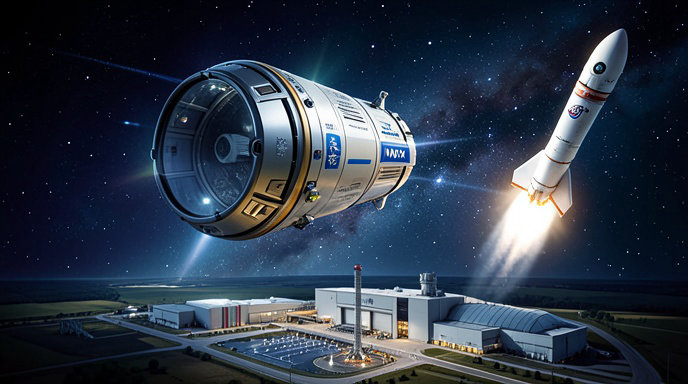
At the center of TEC's ambitions is Nyx, a modular, reusable and refuellable conical capsule designed to ferry cargo - and eventually astronauts - to low Earth orbit and beyond.
The initial version, Nyx Earth, is designed to carry up to 3,000 kilograms of pressurized and unpressurized cargo to space stations like the International Space Station and upcoming commercial stations including Starlab and Axiom Station. Unlike traditional expendable European vehicles, Nyx is designed to be recovered after re-entry, refurbished, and reflown multiple times.
Later variants include Nyx Moon, a larger version aimed at lunar orbit missions under NASA's Artemis program and ESA's exploration roadmap, and a crewed Nyx Earth capable of carrying up to five astronauts.
TEC is also developing its own Huracan engine burning bio-methane and liquid oxygen for Nyx's service module, a key step toward full reusability and deep-space refueling.
Reusable by Design, Built to Compete on Price
Reusability is where TEC plans to take on SpaceX directly.
While SpaceX's Dragon capsule proved that commercial reuse could slash costs for NASA, Europe has never had an equivalent system. Ariane 6 is expendable, and the Automated Transfer Vehicle retired in 2015.
TEC says Nyx will be reusable for up to five missions, with parachute-assisted splashdown and a capsule architecture built for rapid turnaround. By standardizing avionics, propulsion and thermal protection across Earth and Moon versions, the company believes it can offer flights at Dragon-like prices while maintaining European supply chains.
The company has already signed early cargo agreements and letters of intent with ESA, CNES, and commercial station developers desperate for a second, non-American ride to orbit after Russian Soyuz and Northrop Grumman Cygnus constraints.
Why Timing Matters for Europe
The $450 million raise lands at a pivotal moment for European space sovereignty.
ESA has been pushing its LEO Cargo Return Service and Commercial Cargo programs to foster private cargo return capability by 2028, with TEC and Thales Alenia Space as leading contenders. The war in Ukraine, delays to Ariane 6, and reliance on SpaceX for Galileo launches have intensified political pressure to fund homegrown alternatives.
Brussels and national governments in France, Germany and Italy have increasingly framed independent crew and cargo access as critical infrastructure, not just science. TEC's ability to attract large private capital plus public contracts mirrors the NASA COTS model that seeded SpaceX in 2006.
If TEC hits its 2028 target for a full-scale Nyx Earth demonstration flight to the ISS, it would become the first European company to privately develop an orbital re-entry vehicle at that scale.
The Road to 2028 and Beyond
The challenges ahead are immense. Building a human-rated, reusable spacecraft is one of the hardest engineering feats in tech, and TEC will need to prove reliable re-entry, life support, and cost-effective refurbishment.
The next milestones to watch are qualification of the Huracan engine in 2026-2027, a Nyx Earth orbital test without crew, and ESA's decision on operational cargo contracts worth hundreds of millions of euros.
TEC is also openly eyeing crewed flights by the early 2030s and lunar logistics missions, putting it on a collision course not just with SpaceX, but with Blue Origin, Sierra Space's Dream Chaser, and state-backed programs in China and India.
Still, with $450 million in fresh capital, a growing order book, and political tailwinds, The Exploration Company has done something no European startup has done before: raise SpaceX-scale money to build SpaceX-scale hardware in Europe.
Whether Nyx can actually rival Dragon will come down to execution. But for the first time, Europe has a credible challenger on the launch pad.

Get All The Latest Updates Delivered Straight To Your Inbox For Free!