
Tesla Secures $30B Credit to Supercharge Cybercab and Optimus Scale-Up
TL;DR
- Tesla has secured $30 billion in new revolving credit facilities to fund high-volume manufacturing for Cybercab and Optimus without straining its cash reserves.
- The financing backs a planned surge to around $25 billion in capex as Tesla builds out Cybercab lines at Giga Texas and scales Optimus pilot production.
- The move signals Tesla is shifting from prototype phase to mass commercialization of autonomy and robotics, with robotaxi service and factory humanoids as its next growth engines.
Tesla is done talking about prototypes. It is now buying the financial firepower to build them by the millions.
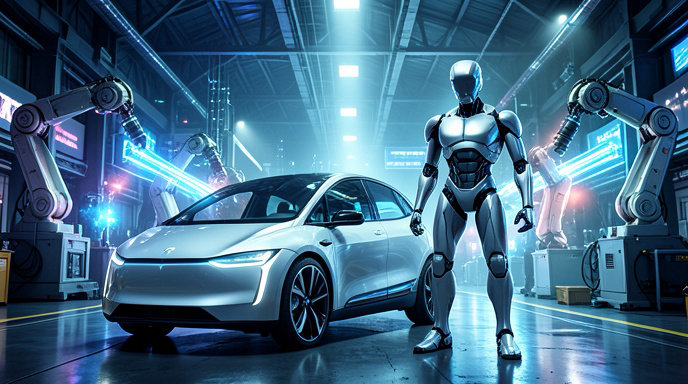
The electric vehicle maker has locked in $30 billion in new credit facilities, a massive liquidity buffer explicitly tied to accelerating production of two of its most ambitious bets yet: the Cybercab robotaxi and the Optimus humanoid robot. The timing is no accident. With both programs approaching critical manufacturing milestones, Tesla is stockpiling capital now to ensure money is never the bottleneck.
Why Tesla Is Stockpiling Capital Now
At first glance, Tesla does not look like a company desperate for cash. It closed the last quarter with tens of billions in cash and investments and remains one of the most profitable automakers in the world by gross margin per vehicle.
But scale-up is a different game. Building dedicated Cybercab production lines, tooling new unboxed manufacturing processes, securing AI chips, batteries, and actuators, and standing up Optimus assembly all require enormous upfront spending long before revenue arrives.
Revolving credit facilities give Tesla flexibility. Unlike a bond raise or equity sale, Tesla does not have to draw the money immediately or dilute shareholders. It can tap the $30 billion as needed, repay it, and borrow again. In volatile rate environments, locking in commitments now also protects Tesla from future tightening in credit markets.
In short, Tesla is building a war chest for autonomy while its balance sheet is strong, rather than waiting until it is stretched.
The $25 Billion Capex Push Explained
Central to the story is Tesla's planned jump in capital expenditures to around $25 billion. Management has signaled capex will rise sharply as Cybercab industrialization, AI infrastructure, and Optimus manufacturing converge.
For Cybercab, that means funding the highly automated line at Giga Texas designed around Tesla's unboxed vehicle process. The goal is to slash assembly footprint and cost per vehicle by building the steering-wheel-less, pedal-less robotaxi in modular sections in parallel. New paint, casting, body, and final assembly tooling alone runs into the billions.
For Optimus, capex is going toward in-house actuator production, dexterous hand assembly, battery packs, and testing lines. Tesla has said it plans to first deploy Optimus in its own factories before selling externally, which requires retooling material handling, training infrastructure, and safety validation systems.
The $30 billion credit backstop essentially covers more than a year of that elevated capex, giving Tesla room to keep investing even if automotive margins compress or robotaxi rollout is slower than hoped.
Cybercab: From Unveiling to High Volume
Cybercab is the linchpin of Tesla's autonomy strategy. Unveiled as a purpose-built, two-seat robotaxi with no steering wheel or pedals, wireless inductive charging, and a low-cost design optimized for ride-hailing, it is meant to power Tesla's Robotaxi network.
Tesla has been piloting unsupervised rides in Austin and the Bay Area using Model Y vehicles, but Cybercab is where unit economics get transformative. The company has targeted production starting in 2026 at Giga Texas, with eventual volume in the millions per year.
That ramp is capital intensive. Beyond the factory, Tesla must fund charging depots, cleaning and servicing hubs, spare parts networks, and its Dojo and Cortex AI compute clusters to train and validate Full Self-Driving for driverless operation. The new credit lines ensure Tesla can parallel-track vehicle production and network infrastructure without pausing one for the other.
Optimus: Tesla's Second Billion-Unit Bet
If Cybercab is Tesla's near-term autonomy play, Optimus is its long-term moonshot turning into a real product line.
Tesla has moved Optimus from lab demos to pilot production, with Gen 2 and Gen 3 prototypes showing major gains in walking stability, hand dexterity with 22 degrees of freedom, and AI-driven task learning using the same neural net approach as its vehicles. CEO Elon Musk has repeatedly claimed Optimus could eventually dwarf the car business, envisioning demand in the billions of units for factory, logistics, and home use.
Scaling humanoids, however, is brutally expensive. Actuators, sensors, planetary roller screws, custom chips, and batteries all need new supply chains. Tesla is investing to bring much of that in-house to control cost and quality, mirroring its vertical integration in cars and batteries.
The $30 billion facility lets Tesla fund that supply chain build-out, expand its Fremont and Texas bot pilot lines, and absorb early low yields without cutting back on automotive or energy programs.
What It Signals For Autonomy and Robotics
Wall Street is reading the financing as a declaration of intent. Tesla is no longer hedging between being an automaker and an AI-robotics company. It is financing itself like the latter.
By securing debt capacity ahead of revenue, Tesla is signaling confidence that Cybercab and Optimus will pass technical and regulatory hurdles and that the constraint will be manufacturing capacity, not demand. It also puts pressure on rivals like Waymo, Zoox, Hyundai, and Chinese humanoid startups, who must now compete with a Tesla that can outspend them on factories and compute.
Risks remain. Unsupervised Full Self-Driving still faces regulatory scrutiny state by state, Cybercab's unboxed process is unproven at scale, and Optimus must prove reliability in real factory shifts. If timelines slip, Tesla will carry higher interest commitments and capex depreciation.
But Tesla's message is clear: the era of demos is over. With $30 billion in fresh credit and $25 billion in capex aimed at robots on wheels and robots on legs, Tesla is betting the company on mass-produced autonomy.

Get All The Latest Updates Delivered Straight To Your Inbox For Free!