
5 PearX Startups That Stole the Show From Spatial Models to Local AI Chips
TL;DR
- Pear's Fall 2026 PearX Demo Day leaned hard into full-stack AI, with spatial world models and on-device inference chips dominating VC chatter over traditional SaaS and copilots.
- The five standouts that drew the most partner meetings were building foundational tech for robotics, local AI compute, autonomous engineering, voice infrastructure, and AI-native ERP.
- Investors say the shift signals Pear's bet that the next breakout wave won't be chatbots, but the physical and silicon layers that let AI operate in the real world.
Pear Takes Over Palo Alto Again
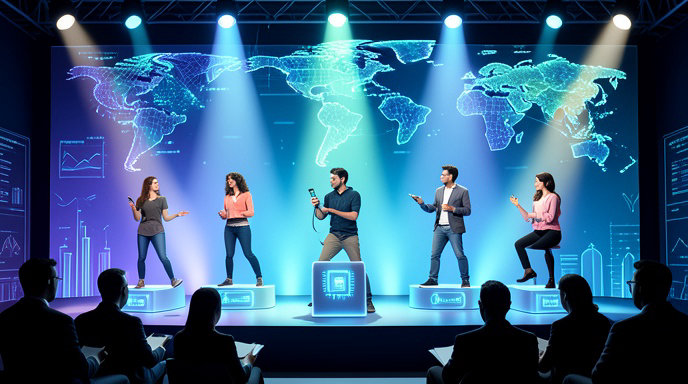
TechCrunch joined a packed room in Palo Alto last week for Pear VC's latest PearX Demo Day, the twice-yearly showcase for the early-stage accelerator that helped launch DoorDash, Guardant Health, and Branch.
This cohort was noticeably leaner and more technical than last year's. Of the 30-plus teams that pitched, almost two-thirds described themselves as AI infrastructure or applied AI, with very few pure consumer plays. The hallway buzz after the pitches wasn't about another coding copilot — it was about robots that understand space and chips that let large models run without the cloud.
Here's the breakdown of the five startups that had VCs lining up for follow-ups.
1. Fieldform: The Spatial Model for the Real World
The clear crowd favorite was Fieldform, a San Francisco-based team building what it calls a large spatial model for robotics and construction.
Instead of training language models on text, Fieldform trains on 3D scans, LiDAR, video walkthroughs, and CAD files to let machines reason about physical space. Its demo showed a robot dog navigating a messy construction site, identifying exposed wiring and unfinished drywall, then generating a work order automatically.
Why investors are excited: Every robotics founder complains about lack of real-world 3D data. Fieldform is positioning itself as the World Labs for industry — selling an API that gives any robot or AR headset instant spatial understanding. Pear partner Mar Hershenson reportedly called it one of the strongest technical demos in PearX history.
What's next: The company says it already has paid pilots with two national construction firms and a warehouse robotics company, and is raising a $12 million seed to expand its data engine.
2. Memcore: Breakthrough Chips for Local AI
If Fieldform was the software star, Memcore was the hardware moonshot.
The Mountain View startup is developing a low-power inference chip designed to run 7B to 30B parameter models entirely on-device, with no cloud connection. In a live on-stage demo, the team ran real-time transcription, translation, and a voice assistant on a prototype board drawing less than 5 watts — roughly what a Chromebook uses at idle.
Why investors are excited: With Apple, Samsung, and Meta all pushing on-device AI, VCs see a massive opening for an Arm-style challenger focused purely on local LLM inference. Memcore claims 10x better tokens-per-watt than Nvidia's Jetson edge line by using compute-in-memory architecture.
What's next: Tape-out with TSMC is planned for early 2027, and the founders — two former Apple silicon engineers and a Stanford PhD — are in talks with PC and drone makers for design wins.
3. Patchwork: The AI Reliability Engineer
Patchwork wants to kill the 2 a.m. pager duty call.
The startup builds autonomous SRE agents that live inside a company's cloud infrastructure, detect anomalies, and actually fix them — rolling back bad deploys, scaling databases, and filing post-mortems. In its demo, Patchwork caught a cascading Kubernetes failure in a simulated production environment and resolved it in 47 seconds.
Why investors are excited: Unlike Devin-style coding agents, Patchwork sells directly on downtime avoided, a metric every CTO understands. Design partners reportedly cut incident time by 60% during the PearX program.
What's next: The team just launched paid GA on AWS and GCP and is raising an $8 million seed led by an existing PearX backer, according to sources on the show floor.
4. Hello Caller: Voice AI That Doesn't Sound Like AI
Voice agents were everywhere at Demo Day, but Hello Caller stood out for one reason: it sounded human.
The startup offers ultra-low-latency voice infrastructure for home services, clinics, and auto shops, with interruption handling and background noise cancellation that actually works. Its live call to book a plumber got laughs — and then silence — when the audience realized there was no human on the other end.
Why investors are excited: Unit economics. Hello Caller charges per resolved call, not per minute, and claims 94% resolution without human handoff. In boring, high-volume verticals like HVAC and dental offices, that's an instant ROI pitch.
What's next: The company says it's already handling over 500,000 calls per month and is profitable on a per-customer basis. Expect a Series A announcement within months.
5. Ledgerly: The AI-Native ERP for Modern SMBs
The sleeper hit of the day was Ledgerly, building what it calls an AI-native NetSuite for startups and mid-market companies.
Instead of bolting AI onto old accounting software, Ledgerly starts with bank feeds, contracts, Slack messages, and invoices to auto-reconcile books, flag burn anomalies, and draft board decks. Its founder closed the pitch with a line that drew applause: Stop paying humans to do copy-paste into QuickBooks.
Why investors are excited: ERP is deeply unsexy and enormously sticky. VCs who missed out on Ramp and Brex see Ledgerly as the next systems-of-record play, with AI as the wedge to rip out decade-old incumbents.
What's next: Ledgerly announced $3.2 million in Pear-led pre-seed funding on stage and a waitlist of 1,000 companies.
What It All Means
The throughline across all five? PearX is betting the post-chatbot era is about AI that acts in the physical economy — whether that's navigating a job site, running on a chip in your pocket, answering phones, or closing the books.
Not every bet will pay off, especially in capital-intensive areas like chips and world models. But if VC buzz on Sand Hill Road is any indicator, spatial computing and local AI just had their breakout Demo Day moment.

Get All The Latest Updates Delivered Straight To Your Inbox For Free!