
Ambrosia Energy Plans 10 GWh Texas Battery Factory to Power Off-Grid Data Centers
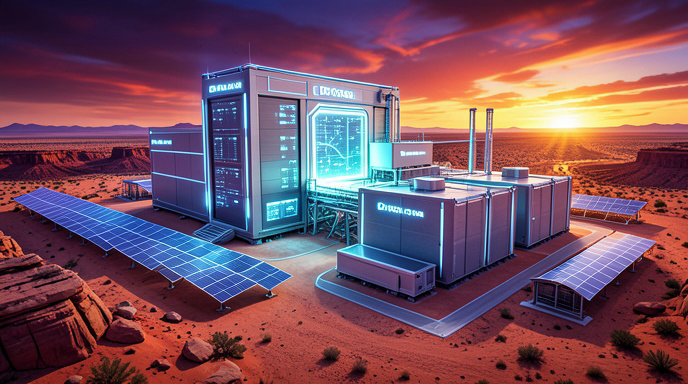
TL;DR
- Ambrosia Energy is planning a 10 GWh battery factory in Texas aimed specifically at powering off-grid data centers for AI workloads.
- The facility will produce long-duration batteries designed to pair directly with large-scale solar farms to deliver 24/7 clean power.
- If completed, the project could reshape sustainable AI infrastructure by bypassing grid constraints and cutting diesel backup reliance.
A Texas-Sized Bet on Off-Grid AI
Ambrosia Energy is making one of the boldest moves yet in the race to power artificial intelligence without breaking the grid. The company has unveiled plans for a massive 10 GWh battery factory in Texas, a facility purpose-built to supply energy storage for off-grid data centers.
The announcement lands at a moment of intense pressure on the U.S. power system. AI data center demand is surging, interconnection queues are stretching for years, and developers in Texas, Arizona, and Nevada are increasingly looking to islanded, behind-the-meter power plants to get online faster.
Ambrosia’s answer is to co-locate compute with clean generation — and use industrial-scale batteries to make that power reliable around the clock.
Inside the 10 GWh Factory Plan
While final site selection details are still emerging, Ambrosia says the Texas facility is envisioned as a gigafactory-scale plant with 10 GWh of annual production capacity at full build-out.
That scale would place it among the largest dedicated stationary storage factories in the United States. For context, 10 GWh is enough to deliver 1 gigawatt of power for 10 hours — sufficient to bridge overnight gaps for multiple hyperscale solar-powered data center campuses.
The company is targeting a phased construction approach, with initial production lines ramping up first followed by full vertical integration, including module assembly, power electronics integration, and containerized system testing on-site. The project is expected to create hundreds of manufacturing and engineering jobs, aligning with Texas’ push to become a hub for both advanced manufacturing and data center development.
Battery Tech Built for Solar + Data Centers
Unlike EV batteries optimized for energy density and weight, Ambrosia’s focus is squarely on stationary storage: safety, cycle life, cost per kilowatt-hour, and the ability to discharge for extended periods.
The batteries in development are designed to pair directly with solar panels to deliver round-the-clock clean power. The architecture combines high-capacity lithium-based cells with advanced thermal management and software-driven dispatch tailored to data center loads.
Key design priorities include:
- Long-duration discharge to cover nights and cloudy periods without diesel generators
- High cycle stability to handle daily solar charging and discharging for 15-20 years
- Modular, containerized units that can be dropped alongside solar farms and data halls
- Grid-forming inverters and AI-driven energy management to smooth out solar variability and protect sensitive servers from power fluctuations
This solar-plus-storage approach is central to Ambrosia’s pitch: instead of waiting for new transmission lines, data center operators can build their own microgrid power plant.
What It Means for Sustainable AI Infrastructure
The bigger story is not just batteries — it’s a new model for sustainable AI infrastructure.
Traditional data centers draw continuous power from the grid, often backed by natural gas and diesel generators for outages. Off-grid, solar-plus-storage campuses flip that model, offering a way to scale compute capacity in sunny, land-rich regions like West Texas without adding strain to ERCOT.
If Ambrosia delivers on its 10 GWh vision, it could:
- Accelerate deployment timelines by avoiding multi-year grid interconnection delays
- Slash carbon emissions from AI training and inference by replacing fossil backup with stored solar
- Lower long-term energy costs as battery and solar prices continue to fall
- Strengthen U.S. energy independence by onshoring battery manufacturing for critical digital infrastructure
Challenges remain, including financing a gigafactory, securing raw materials, navigating permitting, and proving long-duration performance at data-center scale. Competition is also fierce, with established battery giants and data center developers racing to lock in their own clean power solutions.
Still, Ambrosia Energy’s Texas plan signals where the industry is headed: the future of AI may not be powered by the grid at all, but by sun, storage, and silicon built side-by-side in the desert.

Get All The Latest Updates Delivered Straight To Your Inbox For Free!