
California Robotaxi Law Fines Operators for Blocking First Responders
TL;DR
- California's new first-responder safety law lets the DMV fine robotaxi companies up to tens of thousands of dollars per incident when an autonomous vehicle blocks, delays, or interferes with police, fire, or EMS operations.
- Operators like Waymo, Cruise, and Zoox must now provide 24/7 live emergency contacts, equip cars to pull over automatically for sirens and road closures, and file detailed incident reports within hours.
- The law takes effect January 1 and gives the state power to suspend testing and deployment permits for repeat offenders, raising compliance costs as robotaxi fleets expand in San Francisco, Los Angeles, and beyond.
What The New Law Actually Requires
California is putting robotaxi operators on notice: if your driverless car gets in the way of a fire truck, ambulance, or police cruiser, you will pay for it.
The legislation, signed in late September by Gov. Gavin Newsom as part of a broader autonomous vehicle safety package, creates the state's first dedicated penalty system for AV interference with emergency response. Under the rules, which will be enforced jointly by the Department of Motor Vehicles and the California Public Utilities Commission, companies can face fines starting at $5,000 for a first documented obstruction and rising to $25,000 or more per incident for repeated or egregious violations.
But it goes far beyond fines. Operators must now maintain a dedicated, around-the-clock emergency communications line that first responders can reach in under 30 seconds. When a call comes in, companies must be able to remotely locate, unlock, immobilize, or move the vehicle in real time.
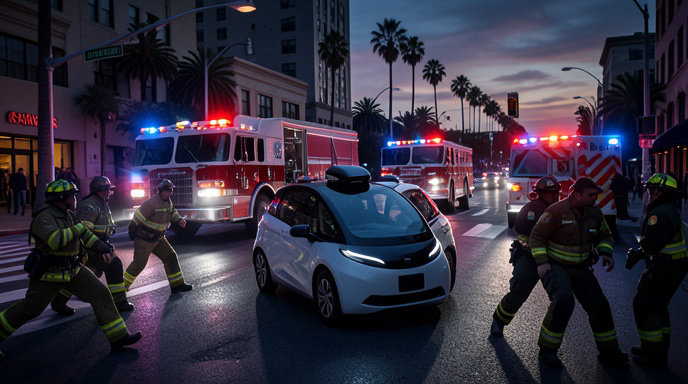
The law also mandates technical upgrades. Autonomous vehicles operating for hire must be able to detect active emergency scenes, flashing lights, sirens, road flares, and temporary closures, and then pull over, yield, or reroute without human intervention. If the car cannot proceed safely, it must clear the travel lane rather than stop in place - a direct response to high-profile cases of robotaxis freezing in intersections.
Finally, any interference event must be reported to the DMV within 24 hours, with full sensor video, GPS logs, and remote-assistance records preserved for at least a year. Three major violations in 12 months can trigger a temporary suspension of a company's driverless deployment permit in the affected city.
Why Lawmakers Pushed It Through Now
The bill sailed through Sacramento with bipartisan support after two years of mounting complaints from city fire departments, police unions, and mayors.
San Francisco Fire Chief Dean Crispen and Los Angeles County officials testified to dozens of incidents since 2023 where Waymo and former Cruise vehicles stopped in the middle of active fire scenes, parked on top of fire hoses, blocked ambulances trying to reach hospitals, or drove through yellow crime-scene tape while officers were investigating.
In one widely cited San Francisco case, a driverless car stalled between a fire engine and a burning building, delaying crews by several minutes. In Los Angeles, first responders reported having to smash a window to move a robotaxi that would not respond to verbal commands.
Lawmakers said existing rules were toothless. Previously, the DMV could investigate AV collisions, but there was no specific fine for non-crash interference, and cities had no authority to ticket a car with no driver. Emergency responders had no reliable way to contact operators in the moment, often waiting on hold with customer support lines while an incident unfolded.
Supporters framed the law as a compromise. It does not ban driverless operations or give cities veto power over expansion - something the industry fiercely opposed - but it gives the state clear enforcement tools and gives first responders a seat at the table in future permit reviews.
How This Hits Waymo, Cruise, And Zoox
For Waymo, the market leader with more than 100,000 paid rides per week in San Francisco, Los Angeles, and the Bay Area, the impact is operational rather than existential. The company already has a first-responder hotline and training program with local fire departments, and it says its latest software is better at recognizing emergency vehicles. Still, it will need to expand its fleet response teams, upgrade its remote assistance staffing to meet the 30-second rule, and overhaul its incident reporting systems to meet the 24-hour deadline.
Cruise faces higher stakes. The GM-backed company is in the middle of a cautious comeback in California after its statewide suspension in 2023 following a pedestrian dragging incident in San Francisco. With plans to relaunch paid service in Phoenix, Houston, and parts of the Bay Area, any permit suspension under the new law would be a major setback. Cruise has publicly supported the bill and says it is building new emergency pull-over and two-way voice features into its vehicles.
Amazon's Zoox, which just began public operations in Las Vegas and Foster City with its purpose-built, steering-wheel-free shuttle, and smaller players like May Mobility and Motional, will also be covered. Industry groups warn compliance will raise costs, especially the requirements for continuous human monitoring, data storage, and city-by-city coordination drills with police and fire agencies.
What Happens Next
The law takes effect January 1, 2027, giving the DMV three months to finalize the fine schedule, reporting portal, and technical standards for emergency detection.
Expect a flurry of activity before then. The DMV is required to hold public workshops with first responders and AV companies this fall, and Waymo and Cruise have already pledged to participate in joint training exercises in San Francisco and Santa Monica.
Civil liberties and labor groups say they will be watching enforcement closely, pushing for public disclosure of all interference reports. The AV industry, meanwhile, is lobbying for a clear appeals process to avoid fines for edge cases where yielding was technically impossible.
One thing is clear: as robotaxis go from novelty to everyday infrastructure in California, the era of a driverless car blocking a fire truck with no consequences is over.

Get All The Latest Updates Delivered Straight To Your Inbox For Free!