
Trump Rebrands AI as Super Intelligence as Zuckerberg, Musk, Bezos Sign Safety Pledge
TL;DR
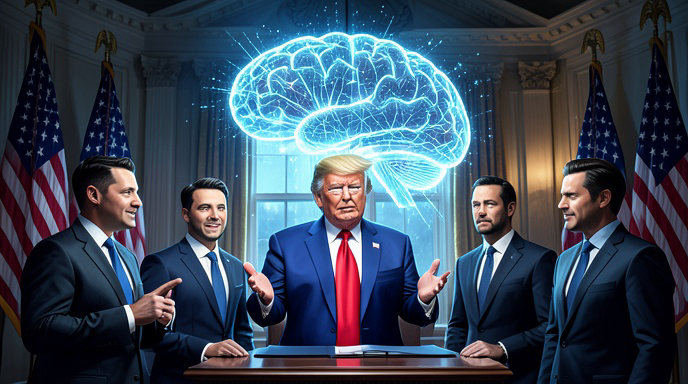
- The White House hosted Zuckerberg, Musk, Bezos, Amodei and other tech leaders this week to sign what President Trump described as a morally binding AI safety pledge focused on transparency and child protection.
- Trump signed an executive order directing federal agencies to reframe advanced AI as superintelligence, signaling a shift toward an America-first race for superintelligent systems.
- Meta and OpenAI used the moment to unveil friendlier, more personal AI products as both companies pour hundreds of billions into data centers and talent.
A High-Powered Room in Washington
Washington has seen plenty of tech summits, but few with this much star power in one room. This week President Donald Trump convened chief executives from across the AI stack at the White House, including Meta CEO Mark Zuckerberg, Tesla and xAI chief Elon Musk, Amazon founder Jeff Bezos, and Anthropic CEO Dario Amodei.
Also in attendance were OpenAI CEO Sam Altman, Microsoft CEO Satya Nadella, Google CEO Sundar Pichai, and Nvidia CEO Jensen Huang. The meeting, framed by the administration as a unity moment for American technology, blended policy talk, dealmaking, and showmanship.
Trump told the assembled leaders the United States must lead the world in what he repeatedly called superintelligence, not just artificial intelligence. The CEOs, in turn, used their speaking turns to praise U.S. energy expansion, announce new investments, and commit to keeping frontier development inside the country.
What Is the Morally Binding Pledge
The centerpiece of the event was a voluntary AI safety pledge that Trump dubbed morally binding.
Unlike a formal regulation or treaty, the document carries no legal penalties. Instead, signatories agreed to a set of shared principles: test frontier models for safety before public release, share information about serious risks with the government, strengthen cybersecurity around model weights, improve transparency around data use, and add stronger protections for children.
The White House said the pledge is meant to build public trust without slowing innovation. Critics were quick to note the lack of enforcement mechanisms, calling it more of a handshake than a safeguard. Supporters countered that getting direct rivals like Musk, Zuckerberg, and Amodei to sign the same safety language is itself significant.
Amodei, who has long warned about catastrophic AI risks, reportedly pushed for stronger evaluation standards. Zuckerberg and Altman emphasized openness and broad access. Musk, now both an xAI founder and a White House ally, framed safety as inseparable from American competitiveness against China.
From Artificial Intelligence to Superintelligence
Alongside the pledge, Trump signed an executive order that officially directs the federal government to rebrand its AI efforts around the term superintelligence.
The order instructs agencies to update strategy documents and research programs to prioritize the pursuit of superintelligent systems, streamline permitting for data centers and energy projects that support AI training, and cut what the administration calls ideological bias in government-procured models.
In remarks before signing, Trump said artificial intelligence sounds dated, while superintelligence captures the scale of what is coming. Administration officials said the language change is designed to reset Washington thinking from regulating chatbots to winning what they see as an inevitable race to systems smarter than humans.
Policy experts say the practical impact will depend on follow-through. The order does not create new funding on its own, but it gives agencies a mandate to fast-track infrastructure and favor American-made models in federal contracts.
Meta and OpenAI Put a Friendlier Face on AI
If the White House provided the policy drama, Meta and OpenAI provided the product gloss.
Meta this week has been showcasing its next generation of personal AI, including new Ray-Ban smart glasses with a conversational assistant, celebrity-voiced personalities, and deeper integration of Meta AI across Instagram, WhatsApp, and Facebook. Zuckerberg has pitched the vision as personal superintelligence for everyone, an assistant that knows you, helps you create, and is always present.
OpenAI, meanwhile, has leaned into warmth and companionship. The company has highlighted voice mode, memory, and more personable behavior for ChatGPT, positioning it less as a productivity tool and more as a helpful friend, tutor, and creative partner. Altman has spoken openly about AI becoming emotionally resonant, even as researchers warn about attachment and over-reliance, especially among teens.
Both approaches mark a clear shift. After years of anxiety about job loss, misinformation, and rogue models, the two most consumer-facing labs are racing to make superintelligence feel approachable, stylish, and indispensable.
The Money Behind the Charm Offensive
The friendly branding belies staggering spending.
Meta has told investors it could spend upwards of $600 billion on AI infrastructure through 2028, including massive new data center campuses in Louisiana, Texas, and Wyoming, plus an aggressive hiring spree for its Superintelligence Labs unit. The company has offered nine-figure packages to poach top researchers from OpenAI, Anthropic, and Google DeepMind.
OpenAI is spending at a similar scale. With its Stargate partnership with Oracle and SoftBank, the company is building out gigawatt-scale data centers across the U.S., burning billions per quarter as it races toward more capable models. Altman has argued that only massive compute will unlock the safety and economic benefits promised at the White House.
Amazon, Microsoft, Google, and xAI are all committing tens of billions more. Nvidia, whose chips power nearly all of it, sits at the center of the boom. Bezos used his White House remarks to reaffirm Amazon's long-term AI and space infrastructure bets, while Musk touted xAI's new Colossus supercomputer in Memphis.
What Happens Next
The White House says the pledge is just the start, with detailed safety testing guidelines, an AI literacy initiative, and new energy deals for data centers expected in the coming months.
For now, the message from Washington is clear: America will chase superintelligence first and sort out the rules as it goes. Whether a morally binding promise signed by billionaire rivals will be enough to keep that race safe remains the open question hanging over Silicon Valley.

Get All The Latest Updates Delivered Straight To Your Inbox For Free!