
Danu Robotics: Amy Ma’s Six-Year Mission to Transform Recycling with AI
TL;DR
- Danu Robotics founder Amy Ma has spent six years developing AI-powered robots designed to identify and sort recyclable waste more accurately.
- The company’s approach combines computer vision, machine learning and robotic handling to tackle contamination and inconsistent sorting in recycling facilities.
- Danu’s technology could help waste operators recover more valuable materials, reduce reliance on manual sorting and make automated recycling more adaptable.
A Long-Term Bet on Smarter Recycling
Recycling has a deceptively difficult automation problem. A conveyor belt may carry paper, cardboard, plastic containers, metal cans, food packaging and general waste at high speed, often in dirty, damaged or partially obscured forms. For a human worker, distinguishing those items is challenging enough. For a machine, it requires a combination of visual recognition, rapid decision-making and precise physical movement.
That challenge has driven Amy Ma, founder of Danu Robotics, for the past six years. Her mission is to build a robot that can make recycling plants more intelligent and efficient by identifying materials in real time and separating them with greater consistency.
Danu Robotics is part of a growing wave of companies applying artificial intelligence to waste management. Its technology is intended not simply to automate repetitive picking, but to improve the quality of the decisions made on recycling lines.
Why Recycling Needs Better Sorting
The economics and environmental benefits of recycling depend heavily on the quality of the material recovered. When different materials are mixed together, or when food and other waste contaminate recyclable items, the resulting bales can become harder to sell or process. In some cases, contamination can cause entire loads to be rejected.
Most recycling facilities already use a combination of screens, magnets, air jets, optical sorters and human workers. These systems are effective at separating certain categories of material, but they are less capable when objects are irregular, overlapping, damaged or difficult to identify.
Plastic packaging illustrates the problem. Two containers may look similar but belong to different material categories. A wrapper may be recyclable in one local system but not another. A piece of cardboard may be technically recyclable but too contaminated to recover. The more accurately a facility can distinguish these objects, the more useful material it can extract from the waste stream.
Danu’s central proposition is that AI-equipped robots can add a more flexible layer of intelligence to this process.
From Computer Vision to Robotic Action
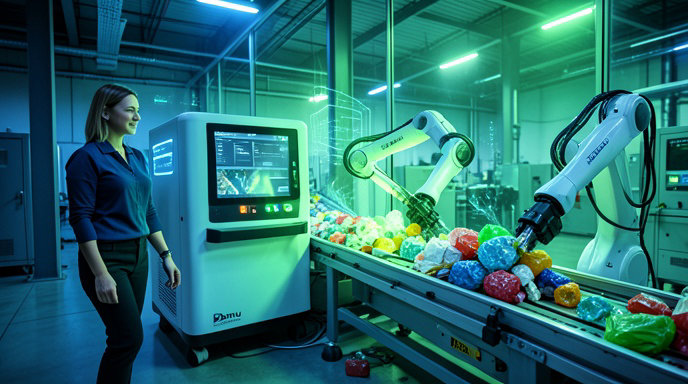
The system developed by Danu Robotics is designed to use computer vision and machine-learning models to recognize objects as they move along a conveyor. Once the software identifies a target item, a robotic mechanism can pick it and place it into the appropriate stream.
That process involves several demanding tasks. The robot must interpret images under changing lighting conditions, recognize items that are partly hidden, estimate where an object is located and act quickly enough to keep up with the conveyor. It must also cope with objects that are crushed, wet, dirty or visually similar to other materials.
In practical terms, the technology must connect perception with movement. A system that can identify a bottle but cannot reliably grasp it at speed offers limited value. Likewise, a fast robot that makes frequent classification errors may increase rather than reduce contamination.
The six-year development effort reflects the difficulty of combining those capabilities in an industrial environment. Laboratory demonstrations are relatively controlled. Recycling plants are not. Equipment must operate around dust, noise, vibration and constantly changing waste streams, while minimizing downtime and maintenance requirements.
The Role of AI in Reducing Contamination
AI can potentially improve recycling in two important ways: by recognizing more items and by making more consistent decisions.
Human sorters bring valuable judgment and flexibility to recycling lines, but the work is physically demanding and repetitive. Concentration can decline over long shifts, and facilities may struggle to recruit and retain enough workers. An automated system can monitor every item continuously and apply the same classification rules throughout a shift.
Machine-learning models can also be updated as they encounter new packaging formats and unfamiliar objects. This adaptability is important because the waste stream changes over time. Brands redesign packaging, new materials enter the market and local recycling rules evolve.
The goal is not necessarily to remove people from the process altogether. In many facilities, robotics is more likely to supplement human workers by handling high-volume, repetitive picking while people focus on quality control, maintenance, exception handling and tasks requiring broader judgment.
A More Flexible Alternative to Conventional Automation
Traditional recycling equipment often performs a specific separation task exceptionally well. Magnets can remove ferrous metals, while optical systems can identify certain material types based on their optical properties. But these technologies can be less flexible when facilities need to distinguish among a wider range of individual objects.
An AI-powered robotic sorter can potentially be trained to recognize specific products, packaging categories or quality requirements. That could make it useful in facilities where the composition of incoming waste changes frequently.
Flexibility may become increasingly important as recycling operators face pressure to recover more material from existing waste streams. Rather than relying only on additional mechanical equipment, operators could use software-driven systems that improve through new training data and updated recognition models.
The commercial test, however, is whether that flexibility produces a measurable return. A robot must sort enough material, with sufficient accuracy, at a cost that makes sense for facility operators. It also needs to be reliable in conditions that are considerably harsher than those found in many conventional industrial settings.
The Founder’s Six-Year Challenge
Ma’s work highlights a broader reality about robotics startups: building a successful machine requires far more than developing a capable algorithm.
A recycling robot must combine hardware engineering, machine learning, industrial design, safety systems and business integration. It must fit into existing conveyor infrastructure, work alongside staff and avoid disrupting operations. Every additional component introduces potential maintenance needs and operational risks.
The six-year timeline also points to the importance of real-world testing. Computer vision systems improve when they are exposed to large and varied datasets, but recycling data is particularly messy. Objects can appear in countless orientations and conditions, and a model trained on clean images may struggle when confronted with real waste.
For Danu, the development process has therefore involved translating AI research into a machine capable of working at industrial speed. That means refining not only the recognition models but also the robot’s gripping, placement and control systems.
Potential Benefits for Waste Operators
If deployed successfully, Danu’s technology could offer several benefits to recycling facilities.
Improved accuracy could reduce the amount of unwanted material in recovered bales. Higher-quality output may make those materials more attractive to reprocessors and help prevent recyclable items from being sent to landfill or incineration.
Robotics could also help address labor shortages. Sorting work is often physically strenuous, and automated systems could reduce the amount of repetitive picking required from human employees. Workers could instead be assigned to supervision, maintenance, quality assurance and other higher-value roles.
Another potential advantage is operational consistency. A robotic system can gather detailed data about what it sees and sorts, giving operators a clearer picture of the facility’s material flows. That information could help managers identify contamination sources, adjust equipment or measure the performance of individual sorting lines.
The Environmental Impact Is Not Automatic
AI-powered sorting is not a solution to every problem in recycling. Better sorting can improve recovery, but it does not guarantee that a material will be economically recyclable or that sufficient processing capacity exists downstream.
The environmental value of automation depends on the entire chain. Recovered materials must be transported, processed and converted into products that displace the use of virgin resources. If markets for a particular material are weak, even highly accurate sorting may not lead to meaningful recovery.
Energy consumption, equipment manufacturing and maintenance must also be considered. The strongest environmental case for robotic sorting will come when higher recovery rates and better material quality outweigh those costs.
Danu’s technology is therefore best understood as one component of a broader recycling system rather than a standalone fix. Policy, packaging design, collection systems, domestic reprocessing capacity and consumer behavior will remain equally important.
Competing in a Crowded Robotics Market
Danu Robotics is entering a sector that includes established automation companies, specialist recycling-equipment manufacturers and other startups using AI to sort waste. The competitive landscape is developing quickly as rising disposal costs, labor shortages and sustainability targets encourage investment.
To stand out, Danu will need to demonstrate more than accurate object recognition. Its robots must be easy to install, simple to maintain and compatible with the varied equipment already used by recycling operators. Customers will also want evidence that the machines can maintain performance over long periods and justify their cost through higher recovery or lower labor requirements.
Data may become a significant competitive advantage. A company that deploys robots across multiple facilities can gather information about different waste streams and use that data to improve its models. At the same time, each deployment presents new technical challenges, making implementation experience as important as the underlying AI.
What Comes Next for Danu Robotics
The next stage for Danu will likely center on proving that its technology can move from promising engineering project to dependable commercial product. That will require sustained operation in live recycling environments, transparent performance measurements and partnerships with waste-management companies.
Key questions include how many items the system can process, how accurately it identifies different materials, how well it handles contamination and how much maintenance it requires. Operators will also assess whether the robots can be integrated without extensive reconstruction of existing facilities.
As AI models become more capable and robotic hardware becomes less expensive, systems like Danu’s could become more common across waste-management operations. Future versions may identify a broader range of materials, track quality in real time and coordinate several robots working on the same line.
Ma’s six-year effort reflects the patience required to build technology for an industry where reliability matters as much as innovation. Recycling facilities cannot afford equipment that works only in demonstrations. They need machines that can operate continuously, adapt to unpredictable inputs and deliver measurable improvements.
If Danu Robotics can meet those demands, its work could help shift recycling automation from rigid mechanical separation toward a more intelligent, data-driven model. The result would not eliminate the complexity of waste management, but it could give operators a better tool for recovering more value from the material society throws away.

Get All The Latest Updates Delivered Straight To Your Inbox For Free!