
Etched Eyes $40B+ Valuation as AI Chip Funding Frenzy Explodes
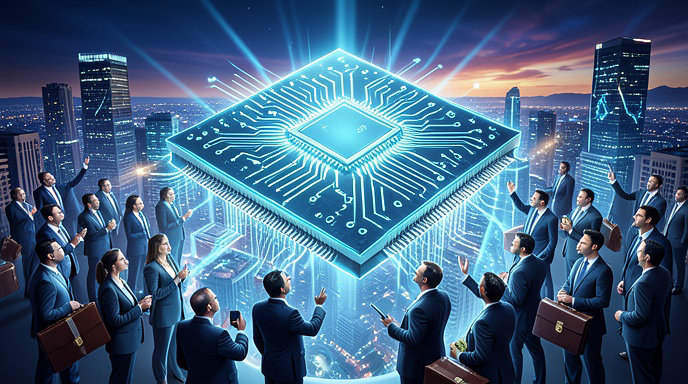
TL;DR
- Etched is reportedly fielding new investor offers at a $40B-plus valuation, roughly double its valuation from just months ago, according to people familiar with the talks.
- The frenzy is driven by early demand for its Sohu transformer-only AI chip, which promises far faster and cheaper inference than Nvidia GPUs, plus a massive backlog of customer interest.
- If completed, the round would make Etched one of the most valuable AI hardware startups in the world and intensify the race to break Nvidia's dominance.
A Doubling In Just Months
Etched, the two-year-old AI chip startup betting everything on transformers, is suddenly at the center of Silicon Valley's latest funding frenzy.
As of early October 2026, the company is reportedly fielding inbound investment offers that would value it at more than $40 billion, just months after its last major raise. That previous round, closed this summer, had already priced Etched at around $18 billion to $20 billion — itself a massive jump from its $2 billion-plus valuation in 2025.
The talks are said to be early and no deal has been finalized, but the fact that investors are willing to double the price in a matter of months tells you everything about the current mood around AI infrastructure.
Founded in 2022 by Harvard dropouts Gavin Uberti and Chris Zhu, Etched has taken an all-or-nothing approach that most chipmakers avoided. Instead of building a general-purpose GPU to take on Nvidia directly, it built Sohu, an application-specific integrated circuit designed to run only one thing: transformer models.
Why Investors Are Rushing In
The pitch is simple and audacious. Etched claims Sohu can run large language model inference more than 20 times faster than Nvidia's H100 at one-tenth the cost per token, by stripping out all the programmability needed for training, image processing, or other workloads.
For investors, three factors are driving the rush:
First, inference is exploding. As AI shifts from training giant models to serving billions of daily queries, cloud providers are desperate for cheaper, more power-efficient chips. Etched argues its single-purpose design is perfect for that moment.
Second, scarcity. Unlike Nvidia's GPUs, which remain supply-constrained and expensive to run at scale, Sohu is built on TSMC's 4nm process and targeted specifically at data centers looking to slash energy bills.
Third, traction. The company has said it has billions of dollars in prospective customer reservations and has begun shipping early Sohu systems to select partners for testing. Backers including Two Sigma Ventures, Peter Thiel, Jane Street, Lightspeed, and others see that pipeline as validation that the risky bet could pay off.
The Last Raise Was Already Huge
Etched's rise has been unusually fast even by AI standards.
After raising $120 million in June 2024, the startup reportedly raised several hundred million dollars in late 2025 and then again in mid-2026 at a valuation just under $20 billion. That summer round was described as heavily oversubscribed, with existing investors scrambling to maintain their stakes.
Now, sources say new crossover funds, sovereign wealth funds, and major cloud-adjacent strategics are circling, hoping to get in before commercial-scale deployments begin in 2027. At $40 billion-plus, Etched would leapfrog most other AI chip challengers and sit just behind Cerebras and ahead of Groq, Lightmatter, and SambaNova in private-market value.
It would also put the company, which has yet to post significant revenue, in the same valuation league as some public semiconductor companies.
What It Means For The War Against Nvidia
Nvidia remains the undisputed king of AI hardware, controlling an estimated 85 to 90 percent of the AI accelerator market and posting record data center revenue quarter after quarter. Its CUDA software moat, relentless release cycle from Hopper to Blackwell to Rubin, and deep ties to hyperscalers make it brutally hard to displace.
But Wall Street and Silicon Valley are now betting that the market is big enough for a second winner focused purely on inference.
Etched is not alone. Groq, with its language processing units, Cerebras with its wafer-scale engine, and photonic startups like Lightmatter have all raised billions in the past year. What sets Etched apart is its extreme specialization — a gamble that transformers will remain the dominant AI architecture for years to come.
Skeptics warn that single-purpose chips are vulnerable if model architectures shift, and that scaling manufacturing, software stacks, and customer support to compete with Nvidia will cost billions more. Etched will need this new capital to fund TSMC wafer commitments, expand its San Jose and New York teams, and build out its compiler and serving software.
What Happens Next
For now, Etched has declined to comment on the reported talks, which is standard for a company in the middle of a fundraise.
People close to the company say no terms have been agreed and the final valuation could change, or the company could opt to wait. But bankers say the inbound interest alone signals a broader shift: after two years dominated by foundation model funding, mega-investors are now pouring money back into picks-and-shovels AI hardware.
If Etched closes at $40 billion, expect even more capital to flood into alternative chips — and even more pressure on Nvidia to prove its general-purpose GPUs can stay cheaper and faster than a swarm of hungry specialists.

Get All The Latest Updates Delivered Straight To Your Inbox For Free!