
Industrial Next Wants Factory Robots to Switch Tasks in Minutes, Not Weeks
TL;DR
- Industrial Next is building software and gripping systems that let factory robots switch between delicate, complex tasks in minutes instead of weeks of reprogramming and retooling.
- The startup is targeting labor-intensive jobs like assembly, kitting, and machine tending that have resisted automation due to high-mix, low-volume production.
- Rapid retooling could unlock truly flexible factories, helping manufacturers cope with labor shortages and reshoring without massive downtime.
The Bottleneck No One Talks About
Industrial robots are fast, precise, and tireless. So why do most factories still rely on people for so much delicate work?
The answer is changeover. A traditional robot arm can do one task brilliantly for years — pick up the same part, place it in the same spot, repeat. But ask it to handle a new product, a different shape, or a more fragile component, and production grinds to a halt. Engineers spend days or weeks reprogramming paths, swapping grippers, tuning force settings, and testing for errors.
For industries like electronics, medical devices, consumer goods, and automotive suppliers, where product runs are getting shorter and variety is exploding, that bottleneck is crippling. Industrial Next was founded to eliminate it.
Teaching Robots To Be Generalists
Instead of building a new robot from scratch, Industrial Next focuses on the layer that makes existing arms useful: perception, grasping, and task planning.
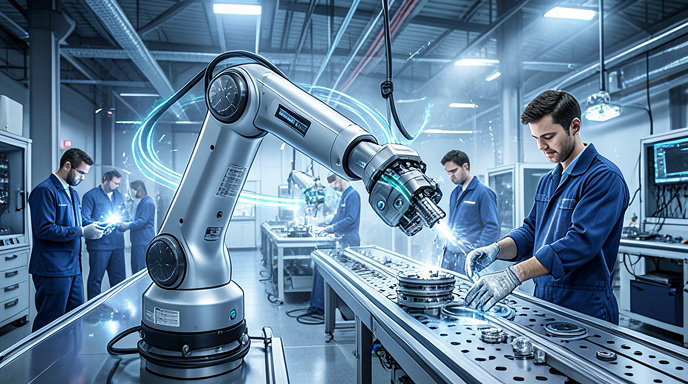
The company's approach combines AI-powered vision, compliant gripper hardware, and no-code task software. A robot equipped with its system can identify mixed parts in a bin, figure out how to pick up a soft wire harness versus a rigid metal bracket, and adjust its force on the fly to avoid damage.
Crucially, operators can teach a new task by demonstration rather than code. Show the robot what to do once or twice, adjust parameters on a tablet, and it generalizes to variations. What used to take an integrator weeks of custom work can now be done in minutes on the factory floor.
Automating The Jobs Humans Don't Want To Do
Industrial Next isn't going after simple pallet-moving. It's targeting the messy middle of manufacturing — jobs that are repetitive and ergonomically brutal, but too dexterous for old-school automation.
Think: routing cables through a chassis, inserting flexible gaskets, sorting unsorted kits of screws and connectors, tending CNC machines with oily, oddly-shaped parts, and packing fragile items for final assembly. These are roles that manufacturers struggle to fill and retain, especially on night shifts.
By automating them, the startup argues factories don't eliminate workers, they reassign them. One operator can supervise a cell of three or four robots that are constantly switching jobs, rather than standing at a single station all day.
What Rapid Retooling Means For Flexible Factories
The bigger vision is the lot-size-of-one factory. Today, only large automakers and electronics giants can justify heavy automation because they run millions of identical units. Small and mid-sized manufacturers running hundreds or thousands of variants are stuck with manual labor.
If changeover drops from weeks to minutes, the math flips. A contract manufacturer in Ohio or Texas could take a morning order for medical pumps, switch to power tools after lunch, and run lighting fixtures overnight — all on the same cell.
That flexibility is becoming existential. With reshoring pressure, tariffs, supply chain volatility, and persistent skilled labor shortages in the U.S., manufacturers need automation that pays off in months, not five-year cycles.
Challenges Ahead
Industrial Next isn't alone. Giants like FANUC, ABB, and Universal Robots, plus well-funded startups in dexterous manipulation and humanoids, are all chasing flexible automation.
The hard part is reliability. A demo that works 95% of the time is exciting; a factory deployment that fails 5% of the time is a disaster. Delicate tasks magnify that — a crushed connector or dropped lens can scrap an entire high-value assembly.
To win, Industrial Next will need to prove uptime, ease of use by non-roboticists, and seamless integration with existing MES and quality systems. Early pilots with forward-leaning manufacturers will be critical to show it can survive dust, vibration, lighting changes, and real operator turnover.
The Future Of Production
If Industrial Next delivers, the factory robot stops being a single-purpose machine and starts acting more like a power tool — something you pick up, retask, and put back to work as needed.
That shift won't happen overnight, but the direction is clear. Manufacturing's next productivity leap won't come from faster robots, but from robots that waste less time waiting to be told what to do next.

Get All The Latest Updates Delivered Straight To Your Inbox For Free!