
Mecka AI Raises $60M From Sequoia to Pay People to Train Robots
TL;DR
- Mecka AI has raised $60M led by Sequoia to scale its paid human data-collection network for robotics, with participation from existing investors and angels in AI and robotics.
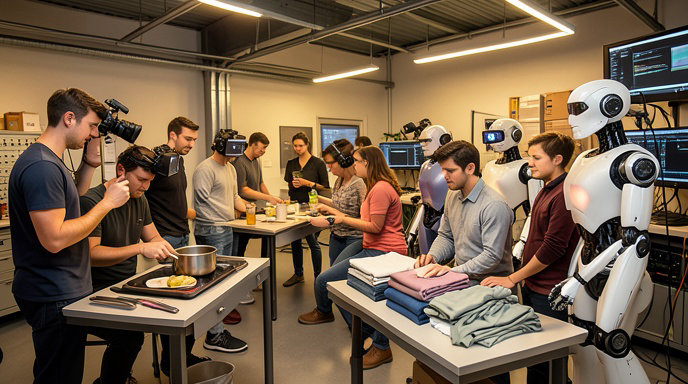
- The startup pays everyday people to record themselves doing household chores, warehouse tasks, and dexterous manipulation on camera and wearables, creating labeled real-world training data for robot foundation models.
- The round signals a heating robotics data race, as labs shift from simulation and YouTube scraping to high-quality, consent-based human demonstration data to unlock general-purpose robots.
Sequoia's $60M Bet on Human Data
Mecka AI announced this week it has raised $60 million in new funding led by Sequoia Capital to pay regular people to train the next generation of robots. The round, which closed in early October 2026, also includes follow-on from its seed investors and a handful of prominent robotics founders and AI researchers.
The company declined to disclose its exact valuation, but sources close to the deal describe it as a significant step-up that puts Mecka among the best-funded startups tackling the robotics data problem. Sequoia partner Alfred Lin will join the board as part of the financing.
In a statement, Sequoia said it backed Mecka because data, not hardware, is now the bottleneck for humanoids and mobile manipulators. While robot bodies have gotten cheaper and more capable, the AI brains to run them are starved for diverse, real-world examples of how humans grasp, fold, clean, cook, and tidy.
How It Works: Get Paid to Do Dishes on Camera
Mecka's model flips the usual gig economy script. Instead of driving or delivering, contributors get paid to record themselves doing everyday tasks.
Here's the pitch: download the Mecka app, accept a task like "unload dishwasher," "fold laundry with occlusions," or "pack a grocery bag with fragile items," then perform it while wearing a low-cost head-mounted camera or setting up two to three phone cameras provided by Mecka. Some higher-paying tasks involve sensor gloves, wrist trackers, or teleoperation rigs that capture hand pose, force, and gaze in addition to video.
Payouts range from around $20 for a quick 15-minute kitchen session to several hundred dollars for multi-hour, multi-angle collections or in-home sessions. Mecka says it has already paid out millions to tens of thousands of contributors across the U.S., with expansion to Europe and Asia planned with the new capital.
Once uploaded, videos go through Mecka's pipeline for quality checks, privacy blurring, object segmentation, and 3D hand and body tracking. The result is an episode library pairing RGB video, depth estimates, language instructions, and action labels that robotics labs can license to train vision-language-action models.
Co-founders describe it as Scale AI meets YouTube, but built specifically for embodiment - consented, directed, and dense with the physical interactions robots actually need to learn.
Why Robots Desperately Need Your Messy Kitchen
For years, robotics teams trained largely in simulation or on small, lab-collected datasets. That works for a robot that only picks one box in one warehouse, but it breaks down in messy human environments.
Real kitchens and living rooms are cluttered, lighting changes, objects deform, liquids slosh, and every person loads a dishwasher a little differently. Scraped internet video helps robots understand what tasks look like, but it rarely shows exactly how hands move in 3D, how much force to use, or what failure and recovery looks like.
Mecka argues only deliberate human demonstration data at internet scale can close that gap. By asking people to record the same task dozens of ways - different homes, different hands, different clutter, different cameras - it creates the variation robot policies need to generalize.
Early customers appear to agree. Mecka says its data is already being used by humanoid companies, warehouse automation firms, and foundation model labs to improve grasp success rates, long-horizon task completion, and language following. Internal benchmarks shared by the company claim models fine-tuned on Mecka episodes show double-digit gains on dexterous tasks like folding shirts and clearing tables compared to pre-training alone.
Inside the Robotics Data Race
Mecka's $60 million raise is the latest sign that robotics data has become its own arms race.
In the past 18 months, investors have poured billions into humanoids from Figure, Tesla, 1X, and Agility, plus generalist robot brain startups like Physical Intelligence, Skild AI, and Toyota Research Institute's large behavior models. All of them share the same hunger: millions of high-quality demonstrations.
That has spawned a new layer of startups focused purely on supply. Some lean on teleoperation farms where operators remotely pilot robots for hours. Others build simulation generators. Mecka is betting that real humans doing real tasks in real homes, paid fairly and with consent, will be cheaper, more scalable, and more diverse than building thousands of robots just to collect data.
Sequoia's lead is notable. The firm has been increasingly active in embodied AI and sees data infrastructure as a winner-pick even if it's unclear which humanoid wins. The funding will let Mecka scale from tens of thousands to what it calls millions of episodes, while building automated curation tools to filter for quality and avoid the junk-data problem that plagued early web-scale scraping.
Privacy and Pay: Can This Scale Fairly?
Paying people for video inside their homes inevitably raises questions about privacy, consent, and labor.
Mecka says all collection is opt-in, contributors review and approve clips before upload, and faces of bystanders, kids, documents, and screens are automatically blurred. Contributors retain the right to delete sessions, and the company says it does not sell raw identifiable video, only de-identified training datasets under commercial license.
On pay, critics of data gig work warn rates can race to the bottom. Mecka counters that its median hourly pay is well above minimum wage in the U.S. and that top collectors who take on complex manipulation tasks earn significantly more. With the new funding, it plans to launch contributor leaderboards, bonuses for rare tasks, and longer-term contracts for high-quality power users.
Regulators and AI ethics researchers will be watching closely as in-home collection scales, particularly around children in the background, rented housing, and cross-border data rules.
What's Next for Mecka
With $60 million fresh in the bank, Mecka plans to triple headcount, open new data operations hubs, and ship a self-serve platform where any robotics team can request custom tasks - for example, 10,000 examples of opening stubborn jars in dim kitchens - and get results in days.
Longer term, the ambition is bigger than a dataset vendor. Mecka wants to be the canonical human demonstration layer for embodied AI, continually capturing how the physical world changes with new products, packaging, appliances, and cultural habits, then feeding that stream directly into robot training runs.
If robots are finally about to leave the lab and enter homes, hospitals, and warehouses, someone has to show them how humans actually live. Mecka just got $60 million to pay us to do it.

Get All The Latest Updates Delivered Straight To Your Inbox For Free!