
OpenAI’s AI Math Proofs Face Scrutiny From Researchers
TL;DR
- OpenAI’s AI-generated mathematical proofs are drawing scrutiny because many appear incomplete, insufficiently justified, or difficult for experts to verify.
- Researchers say producing plausible mathematical text is far easier than delivering rigorous, publication-ready proofs that withstand independent checking.
- The debate highlights unresolved problems in AI reasoning, automated verification, and how scientific communities should evaluate machine-generated mathematics.
OpenAI’s AI Math Proofs Face Scrutiny From Researchers
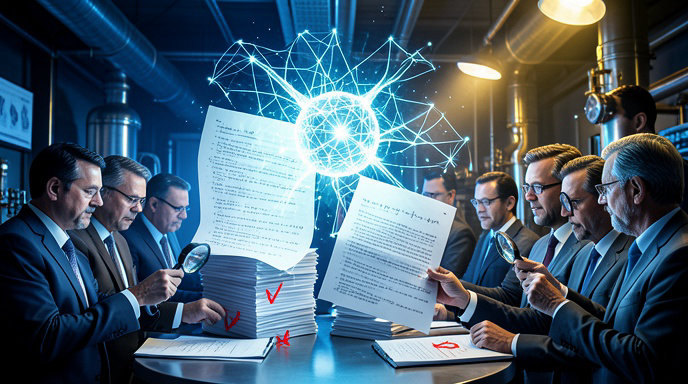
A wave of mathematical proofs produced with the help of OpenAI systems is being met with caution from researchers who say the work often falls short of the standards expected in professional mathematics.
The concern is not simply whether an AI model can produce an elegant argument or arrive at a correct-looking conclusion. In mathematics, every important step must be justified, definitions must be used consistently, hidden assumptions must be exposed, and the result must be reproducible by other experts. According to researchers familiar with the material, many of the proofs being circulated do not yet meet that bar.
The criticism arrives as AI companies increasingly present advanced mathematical reasoning as evidence that their systems are moving beyond fluent text generation. OpenAI and its competitors have invested heavily in models designed to solve difficult problems, generate formal arguments, and assist with research. But the latest debate suggests that impressive demonstrations may not always translate into dependable mathematical discoveries.
The Difference Between a Plausible Argument and a Proof
A mathematical proof is more than a convincing explanation. It is a chain of logically valid steps that establishes a claim under clearly stated premises.
Large language models are capable of generating arguments that resemble the style of research mathematics. They can introduce lemmas, refer to established techniques, and organize a solution into familiar sections. The problem is that a proof can sound authoritative while containing a subtle gap.
Common weaknesses include skipping a necessary case, applying a theorem outside its stated conditions, confusing an approximation with an exact result, or asserting that a difficult subproblem is “standard” without proving it. Such errors can be particularly difficult to detect when the surrounding argument is polished and uses technically sophisticated language.
Researchers consulted about OpenAI’s output reportedly found examples where the broad strategy appeared promising but key transitions were unsupported. In some cases, a model’s answer may point toward a legitimate approach without actually completing the argument. That distinction is crucial: in research mathematics, an incomplete proof is not a proof merely because the missing step appears likely to be true.
Verification Is the Central Challenge
Independent verification is one of the main obstacles facing AI-generated mathematics.
Human mathematicians often rely on informal exposition when communicating with colleagues. They may omit routine details because those steps are well understood by the intended audience. AI systems, however, can omit exactly the details that determine whether an argument is valid. A reader must then reconstruct the reasoning and determine whether the gap can be repaired.
Formal proof assistants offer one possible solution. Systems such as Lean, Coq, and Isabelle can check whether a proof follows from precisely defined axioms and previously established results. If an AI-generated proof has been translated into a suitable formal language and accepted by a proof assistant, confidence in its logical validity rises substantially.
But formalization is itself difficult. Mathematical research is often written in a flexible, informal language, while proof assistants require exact definitions and explicit operations. Converting an informal argument into machine-checkable form can take substantial effort, particularly when the argument involves new concepts or advanced areas of mathematics.
A proof that has not been formally verified must therefore be reviewed by specialists. That review can take days, months, or longer, depending on the problem’s complexity. AI may accelerate the production of candidate arguments, but it does not eliminate the need for expert checking.
Why Volume Can Be Misleading
The apparent abundance of AI-generated proofs may also distort expectations about progress.
A system can produce hundreds or thousands of candidate solutions quickly. Most may be obvious, flawed, redundant, or variations on known methods. Sorting useful work from incorrect output can become a new bottleneck, shifting the burden from generating ideas to evaluating them.
Researchers have long faced a similar problem with automated theorem provers and computer-assisted mathematics. Generating possible paths through a proof is relatively easy compared with identifying the path that is both valid and mathematically meaningful. An automated system may also spend considerable effort exploring technically correct but unproductive lines of reasoning.
The volume of output can create an impression of rapid discovery even when the number of verified advances remains small. For mathematicians, novelty and correctness matter more than the number of pages an AI system can produce.
The Problem of Hidden Assumptions
One recurring issue in machine-generated mathematics is the treatment of assumptions.
A model may silently rely on a function being continuous, a set being finite, a matrix being invertible, or a probability distribution satisfying conditions that were never stated. In less advanced problems, such assumptions may be easy to spot. In research-level work, they can invalidate an entire result.
AI systems also have difficulty maintaining consistency across long arguments. A variable may change meaning, a special case may be forgotten, or a definition introduced early in the proof may be used differently later. Because language models generate text sequentially, they do not automatically maintain the same kind of formal state that a proof assistant does.
Long-context capabilities can help a model keep track of more information, but they do not guarantee logical consistency. A system may remember an earlier definition while still applying it incorrectly.
What OpenAI’s Systems May Still Do Well
The criticism does not mean AI has no value in mathematics.
Researchers say language models can be useful for brainstorming, suggesting known techniques, translating between mathematical notation and prose, explaining difficult concepts, and identifying possible connections between fields. They may also help write code, search mathematical literature, or produce initial drafts that experts can refine.
In some cases, an AI system can generate a valuable insight even if its first proof is incomplete. A researcher may recognize that a proposed construction is promising and then supply the missing argument independently. That makes AI more comparable to a research assistant or idea-generation tool than an autonomous mathematician.
The strongest systems may become more reliable when paired with external tools. A model can propose a proof strategy, a symbolic mathematics system can test algebraic manipulations, and a formal verifier can check the final logical structure. Combining these components could reduce—but not eliminate—the risk of confident errors.
Publication Standards Are Higher Than Demonstration Standards
A public demonstration typically rewards speed, clarity, and a successful answer on a selected problem. Academic mathematics requires much more.
A publishable result must normally establish that the claim is correct, explain how it relates to prior work, identify the limits of the method, and provide enough detail for other researchers to reproduce and assess it. Peer review is designed to expose mistakes, but it is not an infallible certification process. Even human-authored papers sometimes contain errors that emerge only after publication.
AI-generated work faces additional questions. Who is responsible for a proof produced by a model? Can researchers explain the system’s reasoning, or only inspect its final text? How should a paper disclose the model’s contribution? And what level of machine verification should be required before an AI-assisted result is treated as a genuine advance?
These questions are becoming more urgent as laboratories promote mathematical reasoning as a benchmark for general intelligence.
A Test of AI Reasoning Claims
Mathematics is an unusually demanding test for AI because correctness is often unforgiving. A response can be eloquent, insightful, and almost entirely correct while still failing as a proof because of one invalid inference.
That makes mathematical performance a useful counterweight to demonstrations based primarily on language fluency. It also exposes a broader limitation of current AI systems: they are often better at producing the appearance of reasoning than at guaranteeing that every step is sound.
OpenAI’s mathematical systems may improve through better training data, reinforcement learning, tool use, and integration with formal proof environments. But researchers caution that benchmarks should distinguish between solving a known problem, proposing a plausible argument, and producing a verified original theorem.
Those are different achievements, and treating them as interchangeable can overstate what AI has accomplished.
The Road Ahead
The most credible future for AI in mathematics may be collaborative rather than autonomous. Models could search large bodies of existing work, suggest conjectures, fill routine proof steps, and help formalize ideas. Human mathematicians would remain responsible for defining the problem, assessing significance, checking the argument, and deciding whether the result is genuinely new.
For that partnership to work, AI developers will need to provide clearer evaluations and more transparent evidence. That could include independently checked proofs, formal verification where practical, detailed error rates, and tests designed to prevent systems from receiving credit for reproducing familiar solutions.
The current scrutiny is therefore less a verdict on whether AI belongs in mathematics than a warning about how its achievements should be measured. Generating a flood of proofs is relatively easy. Producing mathematics that experts can trust, verify, and publish remains a far higher standard.

Get All The Latest Updates Delivered Straight To Your Inbox For Free!