
Science Corp Implants PRIMA Vision Chip in First Stargardt Patient, Eyes Future BCI Breakthrough
TL;DR
- Science Corp CEO Max Hodak revealed at TechCrunch Disrupt 2026 that the company has implanted its PRIMA retinal implant in its first patient with Stargardt disease, expanding beyond age-related macular degeneration.
- The wireless photovoltaic PRIMA chip works with infrared-projecting smart glasses to stimulate remaining retinal cells, with clinical data showing many previously blind patients regaining ability to read letters and words.
- The milestone anchors Science Corp's broader strategy to prove clinical and commercial viability in vision restoration before advancing toward its next-generation Primo brain-computer interface for broader neurological conditions.
A Major First for Stargardt Disease
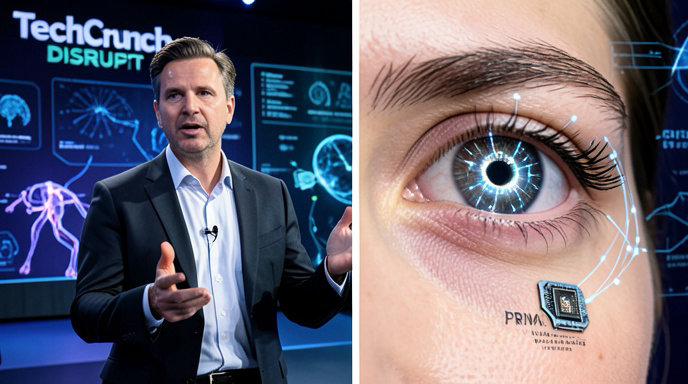
On stage at TechCrunch Disrupt 2026, Science Corporation founder and CEO Max Hodak announced a quiet but historic milestone: surgeons have implanted the company's PRIMA vision-restoring chip in its first patient with Stargardt disease.
Stargardt disease is the most common form of inherited juvenile macular degeneration, affecting roughly 1 in 8,000 to 10,000 people and causing progressive central vision loss, often beginning in childhood or young adulthood. Unlike age-related macular degeneration, where PRIMA has been studied for years, there are currently no FDA-approved treatments for Stargardt's dry form.
Hodak framed the implant as the start of a new expansion for the program. Science Corp acquired the PRIMA technology from Pixium Vision in 2023 after Pixium faced financial difficulties, and has since pushed it through advanced clinical testing in Europe and the U.S. The company confirmed earlier this year that it was broadening eligibility criteria to include Stargardt patients with advanced geographic atrophy-like lesions and severely reduced central vision.
While Hodak did not disclose the patient's identity, implant location, or early visual outcomes during the Disrupt talk, he described the surgery as successful, with the 2mm wireless chip placed under the retina as intended. Further follow-up will be needed to assess functional vision gains over the coming months as the patient undergoes rehabilitation and fitting with the external glasses system.
How PRIMA Actually Works
PRIMA is not a traditional camera eye or a brain implant. It is a subretinal photovoltaic prosthesis designed to replace lost photoreceptors in diseases where the light-sensing cells of the macula die off but the inner retinal wiring remains largely intact.
The system has three key parts:
First, a tiny 2 x 2 millimeter chip, just 30 microns thick, containing 378 photovoltaic pixels. Surgeons insert it beneath the retina in the area of damaged macula in a procedure that takes under two hours.
Second, a pair of augmented-reality glasses equipped with a mini camera and infrared projector. The camera captures the visual scene, processes it down to a simplified image, and beams it into the eye as pulses of near-infrared light.
Third, the chip itself converts that infrared light into electrical stimulation. Each pixel converts light to a tiny electric current that stimulates adjacent bipolar cells in the inner retina, which then relay signals naturally through the optic nerve to the brain. Because it is photovoltaic, the implant needs no batteries, wires, or connectors through the eye wall.
Patients perceive a form of artificial, pixelated central vision in black and white or grayscale that combines with any remaining natural peripheral vision. Training and software tuning are critical — users learn to scan with head movements and interpret the new phosphene patterns, often over several months.
What Clinical Trials Have Shown So Far
The Stargardt implant builds on several years of data in geographic atrophy secondary to dry age-related macular degeneration, a leading cause of irreversible blindness in older adults.
In the European PRIMAvera pivotal trial, results presented over the past two years showed that a majority of implanted patients with previously no readable central vision were able to read letters, numbers, and short words using the PRIMA system with zoom and contrast enhancement. Some patients achieved visual acuity in the range of 20/460 on average, with several reaching 20/200 or better — the threshold for legal blindness in the U.S. — when using the device.
Safety data has been closely watched. Reported serious adverse events have largely been related to the surgical procedure itself rather than the device, and the implant has shown good stability under the retina over long-term follow-up.
In the U.S., Science Corp is running a pivotal FDA trial to support eventual market approval. Hodak has previously said the company aims to file for regulatory approval in Europe and the U.S. in the coming years if pivotal data remains positive. Expanding to Stargardt could significantly broaden the addressable population and provide a pathway for younger patients with inherited disease who have lived decades with central blindness.
Why Science Corp Is Starting With Vision
Science Corporation, founded by Hodak after he left Neuralink in 2021, has long positioned itself as a Neuralink competitor with a more near-term, medical-device approach.
Speaking at Disrupt 2026, Hodak reiterated that vision was a deliberate first target: the eye and visual system are accessible, well-understood, and allow for measurable outcomes. Restoring sight, even partially, offers a clear risk-benefit case for regulators, surgeons, and patients, unlike more experimental cognitive or motor BCI applications.
Revenue from a commercial blindness prosthesis could also fund the company's far more ambitious brain work. Science Corp has raised hundreds of millions in funding to build out its Alameda, California manufacturing and R&D facilities, where it fabricates its own micro-LED displays, flexible electrodes, and implants.
The company is pursuing regulatory and reimbursement pathways as a traditional medtech company, a contrast to the hype-driven approach often seen in neurotech. Success with PRIMA would give it credibility, surgical networks, and real-world experience with chronic neural stimulation.
The Road to Primo and a Next-Gen BCI
The Stargardt milestone is only one half of Hodak's Disrupt message. The other is what comes next: Primo, Science Corp's next-generation brain-computer interface.
Primo is envisioned as a high-density, wireless cortical implant that uses optogenetics and micro-LED arrays to both read and write neural activity at far higher resolution than today's electrode-only systems. In animal studies previewed by the company, Science Corp has demonstrated thousands of channels of optical stimulation using genetically modified neurons that respond to light.
Hodak told the Disrupt audience that lessons from PRIMA — wireless power, hermetic packaging, surgical workflow, image processing, and long-term biocompatibility — feed directly into Primo. The eye, in effect, is a proving ground for the brain.
While Primo remains preclinical, Science Corp has signaled interest in initial applications such as vision restoration via direct cortical stimulation for patients whose optic nerve or retina is too damaged for PRIMA, followed by motor, communication, and eventually broader cognitive indications.
The timeline remains long and uncertain. Brain optogenetics in humans will require gene therapy approvals in addition to device approvals, and will face intense safety scrutiny. Competitors including Neuralink, Precision Neuroscience, Synchron, and Paradromics are already in human testing with electrical BCIs.
Still, by showing a working implant that has moved from lab to operating room to patients reading again, Science Corp hopes to stand apart. If the first Stargardt patient — and others to follow — can regain functional central vision, it would strengthen the case that bioelectronic medicine can scale from restoring a lost sense to ultimately expanding human capabilities.

Get All The Latest Updates Delivered Straight To Your Inbox For Free!