
Self-Driving Trucks Clear Major Roadblock and Accelerate Toward an AI-Powered Future
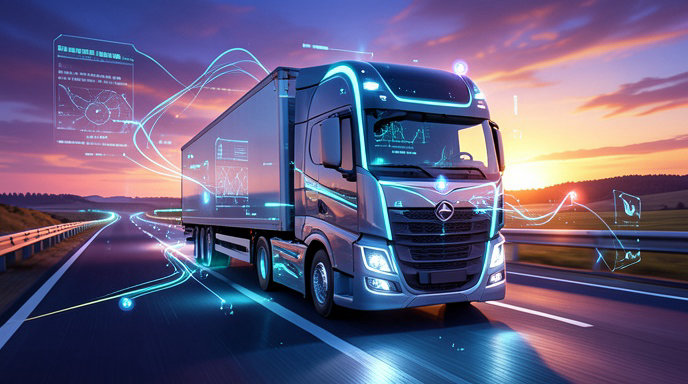
TL;DR
- Federal regulators have cleared a long-standing safety exemption process for driverless heavy-duty trucks, removing the requirement for human-placed warning devices and manual controls and unlocking true interstate driver-out operations.
- AI foundation models are now handling long-haul freight planning, predictive maintenance, and hub-to-hub autonomy, with Aurora, Kodiak, and Torc leading first commercial driverless routes in Texas and the Sun Belt.
- Commercial scale-up is next: analysts expect hundreds of driverless trucks on U.S. freight corridors by late 2027, shifting focus from testing to unit economics, insurance, and shipper adoption.
The Roadblock That Just Fell
For nearly five years, self-driving truck developers have been stuck in regulatory limbo. The technology was ready for driver-out highway runs, but federal motor carrier rules still assumed a human was always on board — to place warning triangles after a breakdown, to hold a steering wheel, to meet hours-of-service and inspection requirements.
That logjam just broke. In the latest TechCrunch Mobility briefing, the spotlight is on a new determination from the Federal Motor Carrier Safety Administration and the National Highway Traffic Safety Administration that creates a streamlined exemption pathway for Level 4 autonomous trucks operating without a driver.
In practice, it means companies like Aurora Innovation and Kodiak Robotics can now legally deploy cab-mounted warning beacons instead of driver-placed flares and triangles, and operate purpose-built trucks without traditional manual controls for interstate commerce. Combined with the U.S. Department of Transportation's broader Automated Vehicle framework for expediting crash-reporting reviews and expanding exemptions from 2,500 to 25,000 vehicles per manufacturer per year, the decision removes the case-by-case petition cycle that slowed every expansion.
It is the single biggest federal green light the industry has received, and it arrives just as states like Texas, Arizona, and New Mexico have solidified pro-deployment laws for freight corridors.
Why This Matters for Commercial Deployment
Until now, most "driverless" progress was qualified. Aurora launched its commercial driverless service between Dallas and Houston in April 2025, but had to navigate a patchwork of waivers and operate with tight operational design domain limits. Kodiak, Torc Robotics, and Volvo Autonomous Solutions were all running pilot hauls with safety drivers or limited driver-out tests.
With the exemption pathway cleared, those pilots can convert to paid, driver-out, 24/7 hub-to-hub operations. That changes the math entirely.
Long-haul trucking is built for autonomy: monotonous interstate miles, severe driver shortages of more than 60,000 drivers nationally, and razor-thin margins. Removing the driver from the 500+ mile Texas Triangle and I-10 and I-45 corridors allows trucks to run nearly continuously, stopping only for fuel, charging, and loading. Early operator data cited by TechCrunch suggests autonomous trucks can increase asset utilization by 2x to 3x compared to human-driven rigs, while cutting fuel use 10-15% through AI-optimized driving.
Shippers who were hesitant to sign multi-year contracts without regulatory certainty are now re-engaging.
How AI Is Reshaping Freight
This is no longer just about lidar and lane-keeping. The new wave of self-driving trucks is powered by generative AI and foundation models trained on millions of miles of freight data.
Aurora's Aurora Driver, Kodiak's Actuation and Waabi's Waabi World simulator all now use end-to-end AI stacks that reason about construction zones, erratic passenger cars, and severe weather in ways rule-based systems could not. Waabi in particular has pitched its neural simulator as a way to train for rare edge cases without driving billions of physical miles.
Off the truck, AI is rewiring the freight business itself. Uber Freight, Convoy successor platforms, and project44 are using AI brokers to match autonomous capacity with loads in real time, predict dwell times at hubs, and dynamically price driverless lanes. Predictive maintenance models flag brake, tire, and sensor failures before they strand a $300,000 rig on I-45. Autonomous transfer hubs — where human drivers handle complex first- and last-mile city driving and the AI takes the highway middle mile — are becoming the dominant operational model.
The Key Players Poised to Benefit
A clear hierarchy is emerging:
Aurora Innovation: The first mover with commercial driverless deliveries for Hirschbach and Uber Freight in Texas. With partnerships with PACCAR and Volvo Trucks, Aurora is best positioned to scale to hundreds of trucks by end of 2027.
Kodiak Robotics: Focused on rugged, serviceable autonomy and its AI-powered SensorPods. Its partnerships with Atlas Energy, J.B. Hunt, and Daimler Truck give it a foothold in energy and long-haul freight, plus a defense-adjacent business that diversifies revenue.
Torc Robotics and Daimler Truck: Torc's hub in Albuquerque and deep integration with Freightliner Cascadia platforms make it the OEM-integrated favorite for large fleets that want factory-built autonomy, not retrofits.
Volvo Autonomous Solutions and Waabi: Volvo's Texas hub-to-hub network paired with Waabi's asset-light driver-as-a-service model could be the sleeper hit for shippers wary of owning autonomous assets.
And behind them: chipmakers like NVIDIA, whose DRIVE Thor platform powers most of these stacks, and logistics giants like FedEx, Werner, and Schneider, which get first access to cheaper, always-available capacity.
What Comes Next for Autonomous Transportation
Clearing the federal roadblock does not mean smooth highway ahead. Three battles will define the next 18 months.
First, scale and safety proof. Developers must now log tens of millions of driverless miles without a high-profile crash. NHTSA will still require detailed crash reporting, and one serious incident on a crowded interstate could trigger a political backlash and renewed calls for human-driver mandates, especially in California and labor-aligned states.
Second, insurance and liability. Who pays when there is no driver? Carriers, OEMs, and tech developers are hammering out new liability-sharing frameworks with insurers like Aon and Liberty Mutual. Federal clarity helps, but state tort law remains messy.
Third, jobs and public trust. The Teamsters and other labor groups argue driverless trucks threaten hundreds of thousands of jobs. Proponents counter that autonomy will fill long-haul roles humans don't want while creating new hub, maintenance, and remote-assist jobs. Winning over the public — and state legislatures — will require transparent safety data.
If those hurdles are managed, analysts see the Sun Belt freight network going substantially autonomous for repeatable highway lanes by 2028-2029, with expansion to the Midwest and Southeast after that. Europe and China, led by Daimler, MAN, and Inceptio, are not far behind.
For the first time, self-driving trucks are no longer a science project waiting on Washington. Washington just moved, and the AI freight era is officially hauling.

Get All The Latest Updates Delivered Straight To Your Inbox For Free!