
Trump’s Science Prize Picks Raise Questions About Big Tech Donor Ties
TL;DR
- Reports that President Donald Trump honored prominent technology figures with top U.S. science awards have drawn scrutiny over their political giving and relationships with his administration.
- The controversy centers on whether donations and access influenced recognition—or merely reflect a broader effort to enlist private-sector innovators in Trump’s technology agenda.
- The dispute highlights the need for transparent selection standards separating scientific achievement from political loyalty, fundraising and presidential access.
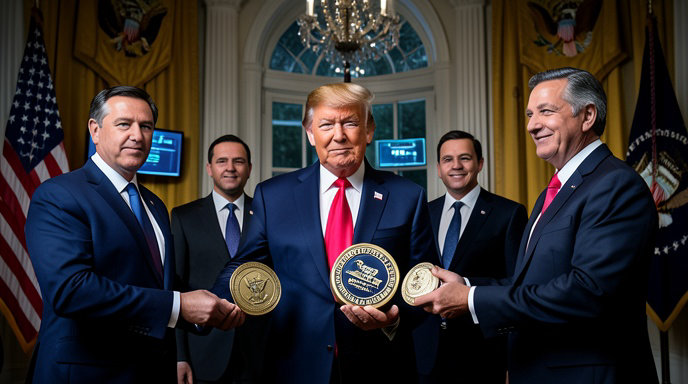
A set of science and technology honors presented by President Donald Trump is prompting fresh questions about the boundary between scientific recognition and political influence.
The debate intensified because some of the technology leaders associated with the honors have also donated to Trump-aligned political committees, attended high-profile events with the president or pursued close relationships with his administration. Supporters describe the awards as overdue recognition for major contributions to computing, engineering and innovation. Critics see a troubling overlap between presidential honors and the political networks helping finance Trump’s return to power and technology agenda.
The controversy does not establish that any recipient improperly influenced the selection process. It does, however, raise questions about how the administration evaluates candidates, how much public disclosure accompanies the decisions and whether the White House is using scientific prestige to reinforce relationships with powerful technology executives.
A prestigious award—and a political backdrop
The National Medal of Science and the National Medal of Technology and Innovation are among the federal government’s most prominent honors for scientific and technological achievement. The awards are intended to recognize sustained contributions that advance knowledge, industry and the public welfare.
Recipients are generally selected through formal processes involving advisory bodies, federal agencies and expert review. The final decision is made by the president, giving the White House an important role in shaping the public message surrounding each class of honorees.
That presidential role has become more politically consequential as technology companies have moved closer to Washington. Artificial intelligence, semiconductor manufacturing, space systems, social media, cybersecurity and advanced robotics are now central to national security and economic policy. Technology executives, in turn, have become major political donors and influential participants in policy debates.
Against that backdrop, even a scientifically defensible award can attract suspicion when a recipient has also supported the president’s political efforts.
Donations put the spotlight on selection decisions
The scrutiny surrounding the latest honors is focused less on whether the recipients are accomplished than on the appearance of overlapping interests.
Several technology leaders associated with Trump’s political orbit have contributed to presidential campaigns, inaugural committees, super PACs or other groups supporting his agenda. Others have used their companies’ platforms and personal influence to seek favorable treatment on regulation, artificial intelligence policy, government contracts, trade, immigration or antitrust enforcement.
Such activity is not automatically disqualifying. Private citizens and corporate executives have the right to participate in politics, and a political donation does not prove that an award was exchanged for support. But the combination of political giving and presidential recognition can create an appearance problem, particularly when the administration does not provide a detailed explanation of how each recipient was evaluated.
Ethics specialists often distinguish between an actual conflict of interest and an apparent conflict. An actual conflict involves a decision-maker’s personal interests affecting an official action. An apparent conflict arises when the surrounding facts could reasonably lead the public to question the decision, even if the process was proper.
Presidential awards are especially vulnerable to that perception because they are highly visible, difficult to challenge and closely identified with the president who presents them.
Silicon Valley’s changing relationship with Trump
The controversy reflects a broader shift in the relationship between Trump and the technology industry.
During Trump’s first term, many Silicon Valley leaders were openly critical of his policies and rhetoric. In recent years, however, some of the industry’s most powerful figures have moved toward cooperation, seeing the administration as a potential ally on issues including artificial-intelligence development, energy infrastructure, defense technology and limits on regulation.
Some executives have donated substantial sums to Trump-linked political operations. Others have appeared alongside him, advised his transition team or negotiated agreements involving investment and domestic manufacturing.
Trump, for his part, has sought to portray his administration as the champion of American technological dominance. His public appearances with business leaders have emphasized large investment announcements, new data centers, chip plants, energy projects and artificial-intelligence initiatives.
That partnership may produce practical benefits, including faster construction of infrastructure and stronger coordination between government and industry. It also creates incentives for companies and executives to cultivate personal access to the White House—making symbolic gestures such as awards politically significant.
The case for honoring technology pioneers
Supporters of the awards argue that political criticism should not obscure genuine scientific achievement.
Technology leaders can have an enormous effect on research and innovation even when their primary role is managerial or entrepreneurial. They may finance laboratories, create platforms used by researchers, commercialize foundational discoveries or build companies that expand the reach of advanced technologies.
In some cases, their contributions involve long-term investments whose benefits are difficult to measure using conventional academic metrics. Supporters say that recognizing such work acknowledges the broader ecosystem required to turn scientific ideas into products, industries and public capabilities.
They also note that presidential administrations of both parties have honored business leaders, inventors and philanthropists with political connections. A recipient’s political activity, they argue, should not erase decades of technical achievement or automatically disqualify someone from consideration.
From this perspective, the real test is whether the award’s standards were applied consistently and whether the recipients’ contributions meet the legal and professional criteria established for the honor.
Questions about transparency remain
The central unresolved issue is how the administration reached its decisions.
A credible process would identify the relevant selection body, explain the contribution for which each person was honored and disclose whether political relationships played any role. It would also make clear whether the recipients were nominated before their political activity, how competing candidates were evaluated and whether ethics officials reviewed potential conflicts.
Without that information, critics are left to infer motives from timing, public appearances and financial records.
The White House could reduce concerns by publishing detailed award citations, nomination timelines and selection procedures. Congress could also ask relevant agencies to explain how advisory recommendations were handled and whether established practices changed under the current administration.
Greater disclosure would not eliminate political disagreement, but it would allow the public to distinguish between legitimate recognition and favoritism.
A broader conflict-of-interest debate
The dispute is part of a larger argument over how public institutions should interact with wealthy technology leaders.
Government increasingly depends on private companies for expertise and infrastructure. At the same time, those companies are seeking government decisions that can determine their market position. The result is a relationship in which access benefits both sides: officials gain technical knowledge and investment commitments, while executives gain influence over policy and public recognition.
That arrangement can be productive, but it requires safeguards. Awards, contracts, regulatory decisions and policy appointments should not become informal rewards for financial support. Nor should political disagreement alone prevent qualified people from contributing to government or receiving recognition.
The difficult task is creating rules that protect merit while addressing the appearance of preferential treatment.
Why the stakes are higher for science honors
Scientific awards carry authority beyond the individual recipient. They signal which achievements the government believes deserve public trust and emulation.
If citizens conclude that honors are linked to campaign donations or presidential access, the damage could extend beyond one administration. Researchers and engineers may become less willing to view federal recognition as independent of politics. The public may also grow more skeptical of government-backed claims about innovation and scientific progress.
That risk is particularly serious at a time when debates over artificial intelligence, climate technology, biotechnology and space exploration already involve intense commercial and political competition.
The administration’s challenge is therefore not simply to defend the recipients. It must demonstrate that the awards were based on accomplishments that would have merited recognition regardless of the recipients’ political connections.
The line between influence and favoritism
Political influence is an unavoidable feature of modern technology policy. Industry leaders will continue to lobby, donate, advise officials and seek favorable conditions for their businesses.
The harder question is when influence becomes favoritism.
A donation alone is weak evidence. A donation followed by a private meeting is more suggestive but still inconclusive. A pattern involving financial support, unusual access, unexplained changes to selection procedures and a prestigious government benefit would warrant much closer examination.
That is why independent review and clear documentation matter. They help establish whether the award reflects a recipient’s public contributions or the administration’s private relationships.
For now, the controversy remains a test of credibility rather than a settled finding of misconduct. The technology leaders may well have earned their honors on the merits. But unless the selection process is explained in greater detail, the political context will continue to shape how those awards are understood.
Science recognition should celebrate discovery, engineering and public benefit. When it arrives alongside major political donations and close presidential ties, transparency is not an optional extra—it is part of the award’s legitimacy.

Get All The Latest Updates Delivered Straight To Your Inbox For Free!