
Volvo Expands Nvidia Partnership to Power Next-Gen Automated Driving Beyond EVs
TL;DR
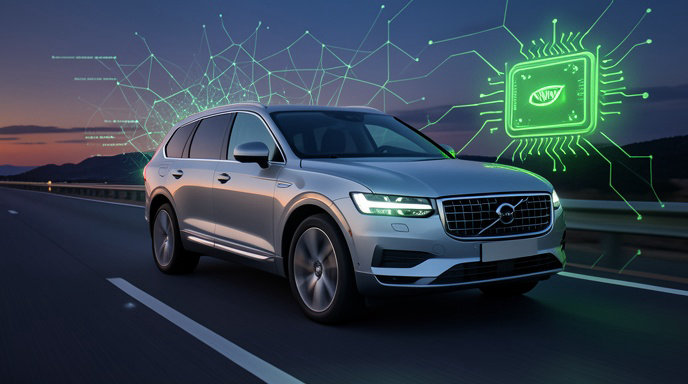
- Volvo is expanding its nearly decade-long partnership with Nvidia to make Nvidia Drive AGX Thor and DriveOS the core compute foundation for all its next-generation vehicles, not just its battery-electric flagships.
- The move centers on centralized core computing with redundant Nvidia systems to enable advanced driver assistance, unsupervised highway autonomy readiness, and continuous over-the-air AI upgrades.
- The deal positions Volvo to compete directly with Tesla, Mercedes-Benz, and Chinese rivals in the software-defined vehicle race while Nvidia cements its dominance as the auto industry's AI platform provider.
A Partnership Nearly a Decade in the Making
Volvo and Nvidia first started working together back in 2016, long before AI-defined cars became an industry buzzword. What began with early autonomous driving research using Nvidia Drive PX has evolved into one of the auto industry's most durable tech alliances.
That relationship deepened with the Volvo EX90 and Polestar 3, which adopted Nvidia Drive AGX Orin for core computing alongside Volvo's own software stack developed with Google, Qualcomm, and Luminar. Now Volvo is taking the next leap, moving from Orin to Nvidia's far more powerful Drive AGX Thor platform.
This isn't a one-model experiment. Volvo has confirmed the expanded collaboration will underpin its next-generation architecture across powertrains - including battery electric vehicles, plug-in hybrids, and range-extended models - signaling that automated driving is now central to the entire brand, not just its EV halo cars.
What Nvidia Drive Thor Actually Brings
At the heart of the expansion is Nvidia Drive AGX Thor, Nvidia's latest automotive supercomputer. Built on the Blackwell GPU architecture, Thor delivers up to 2,000 teraflops of AI compute - roughly eight times the performance of the Orin system used in the current EX90.
For Volvo, that headroom matters. Thor will power a single centralized core computer that fuses data from lidar, radar, cameras, and ultrasonics in real time. Volvo plans to run Nvidia DriveOS and its full-stack safety software on the system, paired with redundant backup compute for steering and braking.
In practice, that means faster and more reliable perception, driver monitoring, 360-degree surround understanding, automated lane change, highway pilot functions, and park assist that actually works in tight urban garages. More importantly, it gives Volvo the overhead to deploy large transformer-based perception models and generative AI in the cockpit.
Beyond Battery Electric Vehicles
The most significant shift in this announcement is scope. Previously, Volvo's Nvidia-powered centralized compute was reserved for its flagship EVs like the EX90 and ES90 on the SPA2 platform.
Under the expanded deal, future models on the new SPA3 and CMA successor architectures - including next-generation XC60 and XC90 successors with hybrid powertrains - will also get Thor-powered core computing from the factory.
The logic is straightforward: Volvo no longer wants a two-tier lineup where only EV buyers get the safest, smartest car. By standardizing on one Nvidia compute platform across EVs and hybrids, Volvo can scale software development, push the same over-the-air updates to the whole fleet, and collect far more real-world driving data to train its models.
Volvo's bet is that customers will pay for safety and software continuity, regardless of what's under the hood.
Software-Defined Safety as a Selling Point
Volvo has built its brand on safety for almost a century, and it sees automated driving as the next chapter. Unlike rivals chasing robotaxi headlines, Volvo is framing the Nvidia partnership around supervised and eventually unsupervised highway driving with full driver accountability.
The combination of Thor, lidar from Luminar on flagship models, and Volvo's in-house perception software developed with Zenseact is designed to meet the industry's toughest validation standard: eyes-off, hands-off highway pilot in select conditions.
Because the system is software-defined, Volvo says cars will get better after purchase. New features, improved emergency avoidance, and a new generative-AI Volvo assistant powered by Nvidia's in-car large language models can be delivered overnight without a dealer visit.
What It Means for the Autonomous Driving Race
Volvo's move puts it squarely in the middle of a high-stakes platform war. Mercedes-Benz, Jaguar Land Rover, BYD, Li Auto, and Zeekr have all committed to Drive Thor, while Tesla continues with its proprietary FSD Computer and others like BMW lean on Qualcomm Snapdragon Ride.
For Nvidia, Volvo is a crucial proof point in Europe - a legacy premium brand betting its safety reputation on Nvidia silicon and software. For Volvo, it is a way to move faster without building chips from scratch.
The race is no longer just about who has the best lidar or the most test miles. It is about who can ship a scalable, certifiable, AI-ready compute platform across millions of cars and keep improving it for a decade. With this expansion, Volvo is signaling it does not intend to be left behind.
What Comes Next
Expect the first Thor-powered Volvos to debut with the upcoming all-electric EX60 in 2026, followed by rapid rollout to other next-gen models. Volvo and Nvidia engineers are already co-located in Gothenburg, Stockholm, and Santa Clara, co-developing the next iteration of Volvo Cars Superset tech stack.
If Volvo delivers on its timeline, nearly every new Volvo by the end of the decade - EV or not - will be an Nvidia-powered, AI-upgradable machine. In an industry where differentiation is shifting from horsepower to compute power, that could be Volvo's most important safety innovation yet.

Get All The Latest Updates Delivered Straight To Your Inbox For Free!