
SK Hynix Seeks US Approval for China Chip Exports in Exchange for American NAND Plant
TL;DR
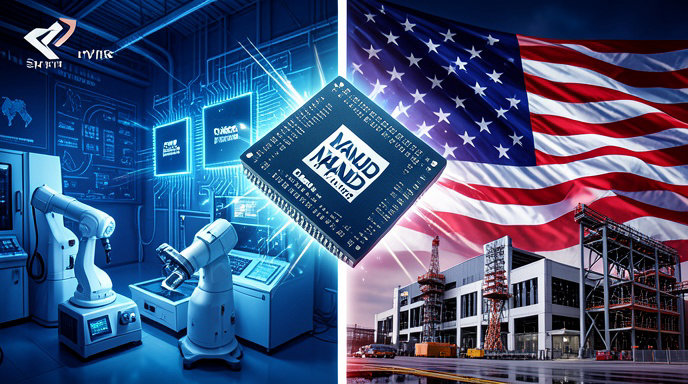
- SK Hynix and its US subsidiary Solidigm are reportedly offering to build a new NAND flash factory in the United States in exchange for Washington granting a license to ship advanced chipmaking equipment to its fabs in China.
- The proposal comes as temporary US export-control waivers for SK Hynix and Samsung in China approach uncertainty, putting SK Hynix's Dalian NAND plant and Wuxi DRAM operations at risk of technology stagnation.
- If approved, the deal could reshape NAND supply chains, bolster US onshoring goals, and set a new precedent for how allies negotiate exemptions in the US-China tech rivalry.
The Reported Bargain: A US Fab for China Access
SK Hynix is floating one of the most ambitious quid-pro-quo deals in the chip war to date. According to Korean media reports circulating in early October 2026, the world's second-largest memory maker, together with its US-based subsidiary Solidigm, has approached US officials with a proposal: approve exports of critical chipmaking tools to its Chinese fabs, and SK Hynix will invest in a new NAND manufacturing facility on American soil.
The company has not publicly confirmed the specifics, but sources familiar with the discussions say the plan would involve a large-scale NAND plant, potentially paired with advanced packaging or R&D operations linked to Solidigm's US presence. The move is seen as a direct response to tightening US export controls on semiconductor equipment bound for China, particularly for NAND above 128 layers and DRAM at 18nm and below.
For SK Hynix, the stakes are enormous. After acquiring Intel's NAND business and forming Solidigm in 2021, and then acquiring the Dalian NAND fab in China, the company now operates a split manufacturing footprint. Roughly a third to 40% of its NAND output still comes from Dalian, while its Wuxi site produces about 40% of its DRAM. Without continued tool upgrades, those fabs risk falling a generation or more behind its Korean plants in Cheongju, Icheon and Yongin.
Why Washington Holds The Keys
The United States has steadily tightened the noose around China-bound chip equipment since October 2022. While South Korean chipmakers initially received one-year waivers, those were later converted into indefinite Validated End-User authorizations in 2023 and 2024, allowing Samsung and SK Hynix to continue bringing in US-origin tools.
That status quo is now wobbling. Under the current US administration, officials have revisited VEU designations amid concerns that advanced memory produced in China could support AI and military applications. In recent months, Washington has signaled it may revoke or narrow the exemptions, or require case-by-case licenses for next-generation tools for high-layer 3D NAND and EUV-adjacent processes.
SK Hynix is particularly exposed because NAND technology is advancing fast toward 300+ layers and a transition to QLC and PLC for AI storage. Without access to etchers, deposition tools and metrology from US vendors like Applied Materials, Lam Research and KLA, Dalian cannot make that leap. The reported proposal tries to turn that vulnerability into leverage by aligning with Washington's core goal: onshoring.
Solidigm's American Card
This is where Solidigm becomes central. Headquartered in Rancho Cordova, California, Solidigm is legally a US company and a major supplier of enterprise SSDs for AI data centers. It already operates R&D and sales in the US while manufacturing NAND in coordination with SK Hynix.
By fronting the US fab proposal through Solidigm, SK Hynix can frame the project as an American investment in leading-edge storage for AI infrastructure, not just a foreign chipmaker seeking favors. Industry analysts say a US NAND fab would be unique — the US currently has no large-scale NAND flash production, with Micron focused primarily on Idaho and New York for DRAM and NAND R&D, TSMC Arizona on logic, and Intel and Samsung on other segments.
A Solidigm-branded NAND plant, potentially in Arizona, Texas, Ohio or Indiana where subsidies and talent are available, could fill a strategic gap in US memory sovereignty. It would also dovetail with surging US demand for high-capacity enterprise SSDs to power AI servers from Nvidia, Microsoft, Amazon and Google.
What It Means For US-China Tech Rivalry
Washington faces a difficult calculation. On one hand, granting SK Hynix permission to upgrade its China fabs runs counter to the broader strategy of slowing China's progress in advanced semiconductors. US hawks argue any advanced NAND capacity in China ultimately helps Huawei, YMTC and other domestic players through talent diffusion and supply chain spillover.
On the other hand, rejecting the request risks pushing a key ally closer to Beijing or forcing SK Hynix to divest or downgrade its China operations in a disruptive way that could spike global NAND prices. South Korea has repeatedly lobbied that its chipmakers should not be collateral damage in US-China competition. A deal that secures billions in US investment, creates American jobs, and gives Washington visibility into what tools go to China could be presented as a win-win.
There is also precedent. In 2023-2025, the US allowed similar investment-linked assurances from Samsung and TSMC in exchange for continued engagement. A formal SK Hynix-Solidigm NAND fab tied to CHIPS Act funding and export licenses would take that transactional model to a new level.
Global Supply Chain Impact
For the memory market, the implications are huge. NAND is notoriously cyclical, and any shift of capacity from Dalian to the US could tighten supply in the short term but stabilize it long-term. Customers — from Apple and Dell to hyperscale data centers — are watching closely, as uncertainty over Dalian's future has already contributed to NAND price volatility in 2026.
If the US plant moves ahead, equipment makers would benefit from a new greenfield fab order at a time when WFE spending is concentrated in logic and HBM. It could also accelerate the divergence of two supply chains: cutting-edge NAND and HBM for AI produced in Korea, the US and Japan, and legacy NAND maintained in China.
Chinese competitor YMTC would be watching most intently. Restricted from buying the most advanced tools itself, YMTC has been gaining share in domestic markets. If SK Hynix is allowed to upgrade Dalian while YMTC remains blocked, it would preserve SK Hynix's competitiveness in China. If blocked, SK Hynix may cede share to YMTC.
What Happens Next
Neither the US Commerce Department nor SK Hynix has officially confirmed negotiations, and any deal would likely take months of review involving BIS, the NSC and Congressional stakeholders. Key questions remain: what technology node would the US fab use, how much CHIPS Act money would be involved, what specific tools would be licensed for China, and for how long?
Analysts in Seoul say SK Hynix is playing a long game — signaling commitment to the US while buying time for Dalian. Even if the fab takes 3-5 years to build, an interim export license would protect its China assets from immediate degradation.
In the broader picture, the talks underscore a new reality: in 2026, market access, export controls and fab investments are all bargaining chips in the same high-stakes negotiation. Whether Washington accepts NAND-for-tools will be a defining test of how flexible its chip containment strategy can be.

Get All The Latest Updates Delivered Straight To Your Inbox For Free!