
Volvo Goes Hands-Free: Expanding Nvidia Partnership for Next-Gen Automated Driving
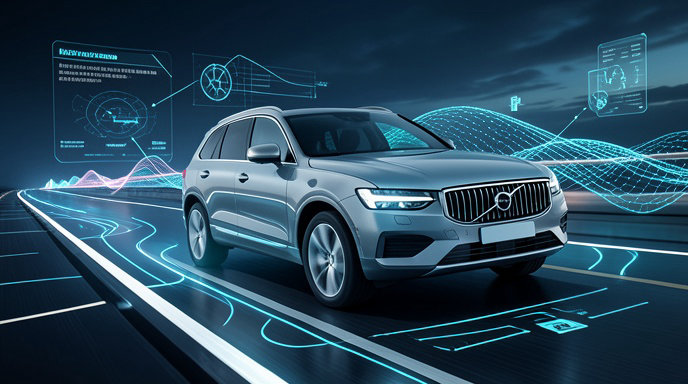
TL;DR
- Volvo is expanding its 10-year partnership with Nvidia to bring hands-free, eyes-off supervised autonomy powered by Nvidia DRIVE Thor and DriveOS to more models, including hybrids and next-gen SPA3 vehicles, not just EVs like the EX90 and ES90.
- The move centralizes vehicle compute on a single Nvidia-powered core stack, enabling continuous over-the-air upgrades, advanced driver-assistance, and a path to unsupervised driving as Volvo builds its own software with Nvidia AI infrastructure.
- The deal positions Volvo to compete with Mercedes-Benz, BMW, Tesla and Chinese rivals in the premium self-driving race by betting on scalable, safety-first autonomy rather than robotaxi hype.
A Decade In The Making Gets Much Bigger
Volvo and Nvidia are no strangers. The Swedish automaker has been working with the chip giant since 2016, first on early Drive PX prototypes and later on the DRIVE Orin-powered core computer inside the all-electric EX90 flagship SUV.
This week that relationship took its biggest leap yet. Volvo confirmed it is deepening the collaboration to make Nvidia's next-generation DRIVE Thor system-on-a-chip and DriveOS operating system the standard brain for a far wider swath of its lineup.
Crucially, it's not just an EV play anymore. Future multi-powertrain models — including next-generation plug-in hybrids built on Volvo's new SPA3 architecture, starting with the upcoming fully electric EX60 — will share the same centralized compute backbone. That is a major shift from the industry norm of reserving top-end self-driving hardware for halo EVs.
What Nvidia Tech Is Actually Going Inside
At the heart of the expansion is Nvidia DRIVE Thor, the successor to Orin that delivers up to 2,000 teraflops of compute — roughly eight times the performance of the current EX90 setup — while being more power efficient.
Thor will run Nvidia DriveOS, a safety-certified full-stack platform that handles everything from 360-degree sensor fusion using lidar, radar, cameras and ultrasonics, to automated emergency steering, lane change assist, and hands-free highway pilot functions.
Volvo isn't just buying chips. It is co-developing its own Volvo Cars Superset tech stack on top of Nvidia's platform, using Nvidia DGX and Omniverse cloud infrastructure to train, simulate and validate its autonomous driving software in virtual worlds before real-world deployment. All Thor-based Volvos will ship with hardware ready for continuous over-the-air upgrades.
From Supervised Hands-Free To Eyes-Off Autonomy
Volvo is careful with its wording: this is about safe, supervised autonomy first.
The near-term goal is a true hands-free driving experience on divided highways — Volvo's Ride Pilot — where drivers can legally take hands off the wheel and eyes off the road under specific conditions, with the car responsible for monitoring the environment. A driver monitoring camera ensures the human is ready to take back over when prompted.
Unlike Tesla's camera-only Full Self-Driving approach, Volvo is sticking with a redundancy-first strategy, anchored by standard Luminar lidar on its flagship models. Volvo executives say the Thor compute headroom is what will finally allow that sensor set to deliver unsupervised driving capability later this decade, without needing a hardware retrofit.
Mass-market Volvos will also benefit. Even base models on the shared architecture get a massive leap in active safety and Level 2+ features like hands-free highway assist, automated parking, and predictive collision avoidance.
Not Just EVs Anymore: Why That Matters
Limiting autonomy hardware to EVs made sense when compute was expensive and power-hungry. Thor changes the math.
By standardizing on one core computer across SPA3 and future CMA-based models, Volvo can scale production volumes, cut costs per unit, and speed up software development. One software stack to maintain, validate once, and deploy everywhere.
That also protects residual values and brand identity. Volvo's pitch has always been safety for everyone, not tech for the wealthy. Bringing the same Nvidia-powered safety brain to its best-selling XC60 successor and next-gen hybrids lets Volvo democratize autonomy while rivals still tier-gate features by price.
How Volvo Stacks Up In The Self-Driving Race
The premium autonomy battle is heating up fast.
Mercedes-Benz already offers SAE Level 3 DRIVE PILOT in Germany, Nevada and California. BMW has Personal Pilot L3 in the 7 Series. Tesla is pushing unsupervised Robotaxi trials in Austin. Meanwhile, Chinese players like NIO, Zeekr and Huawei-backed Aito are shipping city-level Navigate on Autopilot at breakneck speed, mostly on Nvidia Thor as well.
Volvo's bet is different: don't race to robotaxis, race to trust. By aligning early and deeply with Nvidia — the same partner powering Mercedes, Jaguar Land Rover and BYD — Volvo secures chip supply, software leverage, and development speed without trying to build silicon itself like Tesla.
Analysts see it as a smart hedge. Volvo gets world-class AI performance and a massive developer ecosystem, while retaining control of the driving experience, safety validation and data.
What Comes Next
Volvo says the first Thor-powered production car, based on SPA3, will arrive with the next-generation EX60 due in 2026, with hands-free capability rolling out via software update after launch pending regulation.
Next steps to watch include U.S. and EU homologation for eyes-off highway use, details on lidar standardization across non-flagship models, and pricing — whether Volvo will bundle autonomy as standard Volvo safety or as a subscription like rivals.
If Volvo delivers, your next XC60 hybrid could drive itself hands-free on the interstate using the same supercomputer as a $90,000 electric flagship. For a brand built on the seatbelt, that might be the most Volvo move of all.

Get All The Latest Updates Delivered Straight To Your Inbox For Free!