
AI-Driven Tech Outages: Are Airline, Banking, and Productivity Failures the New Y2K?
TL;DR
- Recent outages across airlines, banks, and workplace software are not evidence of one universal failure, but they expose the same fragile web of cloud providers, identity systems, vendors, and software dependencies.
- The 2024 CrowdStrike incident and other major disruptions showed how a routine update or configuration error can produce worldwide consequences without a conventional cyberattack.
- AI agents could amplify future failures by acting across interconnected systems at machine speed, making testing, access controls, and recovery planning more important than ever.
The New Outage Reality
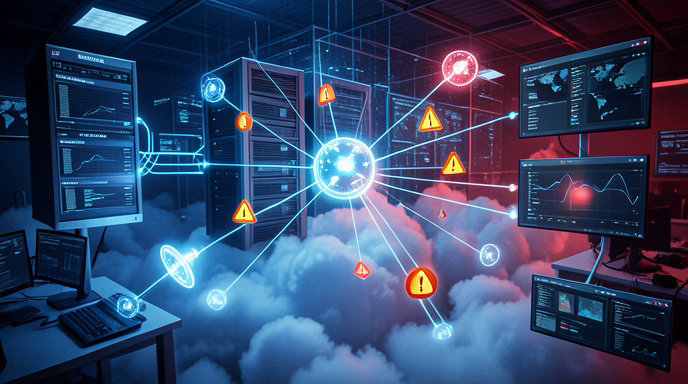
A flight reservation system stops accepting bookings. A bank’s mobile application becomes unreachable. Employees cannot sign in to email, collaboration platforms, or cloud-based business tools. To the public, these incidents may look unrelated. To cybersecurity experts, they increasingly resemble different symptoms of the same structural problem: modern organizations depend on a remarkably small number of technology providers and shared digital foundations.
The comparison with Y2K is tempting. At the turn of the millennium, businesses feared that date-processing errors embedded across old software could trigger a synchronized global breakdown. Extensive preparation prevented the worst-case scenario. Today’s concern is different. The risk does not come from one calendar bug hidden in legacy code, but from dense connections among cloud platforms, identity services, cybersecurity products, payment processors, application programming interfaces, and automated software tools.
A single failure can now move through that network in minutes.
That does not mean airline, banking, and productivity outages are necessarily connected to one another. Most are not. They may involve different companies, software defects, maintenance mistakes, cyberattacks, capacity problems, or telecommunications failures. But they can still share a common cause at the infrastructure level: concentration around a few critical vendors and software components.
What the CrowdStrike Outage Revealed
The clearest recent warning came in July 2024, when a faulty update distributed by cybersecurity company CrowdStrike caused Windows computers around the world to crash. Airlines canceled or delayed flights, hospitals disrupted operations, broadcasters went offline, and businesses struggled to restore affected machines.
The incident was not a sophisticated artificial-intelligence attack. It was not caused by a hostile nation-state taking down the internet. It was a defective software update interacting with systems that had privileged access to the operating system.
Its impact was extraordinary because the affected software sat deep inside the technology environments of thousands of organizations. Once the update propagated, the failure was replicated across airports, banks, retailers, manufacturers, and government agencies.
The outage demonstrated several uncomfortable facts:
- Security software can become a single point of failure.
- A trusted vendor may have more operational reach than an attacker.
- Automated distribution can spread a bad change faster than human teams can detect and reverse it.
- Recovery is difficult when affected machines require manual intervention.
The event also exposed a practical weakness in modern resilience planning. Organizations may have redundant applications and backup networks, yet still depend on the same operating system, endpoint agent, identity provider, cloud region, or hardware-management tool. Redundancy is less meaningful when every backup relies on the same underlying dependency.
Airlines Are Especially Exposed
Airline technology is a patchwork of reservation platforms, departure-control systems, airport operations software, crew scheduling tools, baggage systems, payment services, weather feeds, identity systems, and government databases. Many of these systems must exchange data in real time.
A disruption in one layer can quickly affect the passenger experience. A reservation platform may remain available while a check-in service fails. An airport may have aircraft and crews ready but lack the software needed to issue boarding passes. A carrier may process a booking but be unable to synchronize the transaction with another airline or a global distribution system.
Airlines also operate under conditions that make outages highly visible. A software problem at a single hub can strand thousands of travelers, while cascading delays spread through aircraft and crew schedules for the rest of the day.
The sector has invested heavily in cloud services and digital automation, but modernization can introduce new dependencies. Cloud migration may improve scalability and disaster recovery, yet it can also centralize risk when multiple airlines, airports, or vendors use the same provider or identity service.
Banking’s Concentration Problem
Banks face a different form of exposure. Their most sensitive dependencies include payment networks, core banking systems, fraud-detection services, cloud infrastructure, telecommunications providers, data centers, and third-party application programming interfaces.
A banking outage does not have to compromise customer data to cause serious harm. If customers cannot access accounts, move money, authenticate themselves, or complete card transactions, confidence can deteriorate rapidly. Businesses may be unable to meet payroll, merchants may lose sales, and financial institutions may face a surge of support requests and suspicious activity.
The financial sector is generally more regulated and operationally mature than many industries. Banks conduct resilience testing, maintain recovery procedures, and monitor critical suppliers. Yet regulation cannot eliminate systemic concentration. Many institutions depend on the same major cloud platforms, software vendors, market-data providers, and payment processors.
The danger is not only simultaneous failure. A problem at one provider can force banks to switch to backup arrangements at the same time, overwhelming systems that were designed for occasional use rather than an industry-wide emergency.
Why Workplace Tools Fail So Broadly
Productivity software has become a central operating layer for modern companies. Email, identity management, file storage, video meetings, messaging, project management, and document editing are often delivered through a handful of cloud platforms.
When one of these services fails, the damage extends beyond inconvenience. Employees may be unable to authenticate into other applications because those applications use the same single sign-on provider. Support teams may be unable to communicate because their collaboration tools are also unavailable. Engineers may be locked out of deployment dashboards, while executives cannot access business continuity documents stored in the affected environment.
This creates a feedback loop. The systems needed to respond to an outage are often hosted on the same systems that have failed.
Cloud concentration makes this problem more pronounced. Cloud providers offer separate regions and availability zones, but those safeguards do not protect against every failure. A defective software release, identity outage, certificate problem, control-plane error, or flawed configuration can affect services across many customers at once.
The Software Supply Chain Is the Common Thread
Modern software is assembled from thousands of external components. Organizations rely on open-source libraries, commercial platforms, managed databases, application programming interfaces, container images, security tools, and automated deployment pipelines.
This supply chain improves speed and reduces costs, but it also makes accountability complicated. A company may know its direct suppliers while having limited visibility into the suppliers of those suppliers. An outage may begin with a small dependency buried deep inside a product used by a critical provider.
The most dangerous components are not always the largest applications. A logging library, authentication module, software update service, certificate authority, or device-management agent may have extraordinary reach even if it is invisible to end users.
Security teams have traditionally focused on confidentiality and unauthorized access. Resilience requires equal attention to availability and change management. A trusted update can be as operationally disruptive as a malicious intrusion if it is distributed widely without adequate testing, staged deployment, or rollback capability.
Where AI Changes the Risk
Artificial intelligence introduces a new dimension to this problem. AI systems are increasingly being connected to business data, software tools, ticketing systems, databases, cloud consoles, and payment or purchasing workflows. The most capable systems are not merely answering questions; they are beginning to take actions.
An AI agent might open support tickets, modify configurations, deploy code, provision cloud resources, reset accounts, or route financial transactions. If carefully constrained, this can improve efficiency and shorten recovery times. If poorly controlled, it can turn a small mistake into a rapidly expanding incident.
Several risks stand out.
First, AI agents may misunderstand ambiguous instructions. A request to “restore service” could lead an agent to make broad configuration changes that create new failures.
Second, agents may act on incomplete or manipulated information. Attackers could place misleading instructions in documents, tickets, web pages, or system logs that an agent later treats as authoritative.
Third, multiple agents may interact in ways their developers did not anticipate. One system could scale infrastructure while another interprets the change as suspicious and blocks access. A third could repeatedly retry a failed operation, increasing load on an already unstable service.
Fourth, AI can accelerate change beyond the pace of human review. That is useful when the action is correct and dangerous when it is not. The traditional software failure caused by one bad update could become a chain of automated decisions made across several platforms.
AI is therefore not the root cause of every current outage. But it may increase the speed, complexity, and blast radius of future incidents.
Are These Events Connected?
The evidence does not support the idea that every recent disruption is part of one coordinated campaign or one hidden technical failure. Outages have different immediate causes, and correlation alone is not proof of a common source.
The stronger connection is systemic. Airlines, banks, and workplaces increasingly share the same categories of dependency:
- Major cloud infrastructure providers
- Centralized identity and authentication services
- Widely deployed security software
- Common operating systems
- Payment and communications networks
- Software-update pipelines
- Third-party application programming interfaces
- Concentrated data-center and telecommunications infrastructure
This creates what engineers sometimes describe as correlated risk. Independent organizations can experience failures at the same time because they have made similar technology choices.
The issue is comparable to a power grid. A local appliance failure is not a national emergency. But if many regions depend on the same transmission component, a problem in that component can have consequences far beyond the original site.
Why This Is Not Quite Y2K
The Y2K comparison is useful because it highlights the danger of invisible technical debt and shared assumptions. It is misleading if it suggests that one deadline or one bug will produce a single synchronized catastrophe.
Y2K was primarily a known software defect with a fixed trigger date. Today’s outages are more dynamic. They can result from vendor updates, cloud-control failures, identity problems, supply-chain compromises, cyberattacks, human error, extreme weather, or interactions among automated systems.
The modern equivalent of Y2K is not one event. It is a permanent condition of dependency. Organizations must continuously identify what they rely on, how quickly they can recover, and whether their alternatives would work during a widespread incident.
In that sense, the comparison may be even more relevant now. Y2K prompted a concentrated, deadline-driven preparation effort. Today’s infrastructure risks require ongoing investment that is harder to justify until something breaks.
What Organizations Should Do Next
Resilience begins with dependency mapping. Companies need an accurate inventory of critical services, including indirect suppliers and shared authentication systems. It is not enough to know that a business application has a backup. The organization must know whether the backup depends on the same cloud provider, network, identity system, or software agent.
Critical changes should be released gradually, with canary deployments, automated validation, and rapid rollback. Security products and endpoint agents deserve especially careful treatment because they operate with high privileges and can affect large numbers of machines.
Organizations should also maintain recovery procedures that work when primary communication and identity systems are unavailable. That may require offline credentials, alternate communication channels, tested manual processes, and independent access to essential documentation.
For AI systems, the central requirement is controlled autonomy. Agents should receive only the permissions they need, operate within narrow boundaries, and require human approval for high-impact actions. Every action should be logged, reversible where possible, and evaluated against predefined safety rules.
Finally, resilience testing must include suppliers. A company can perform flawless internal drills and still fail if a key vendor cannot recover. Contracts should address outage notification, recovery objectives, software-update controls, incident cooperation, and access to meaningful operational information.
The Next Major Outage May Look Ordinary
The next broad technology disruption may not begin with a dramatic cyberattack. It could start with a routine update, an expired certificate, a misconfigured access policy, a failing cloud control plane, or an AI agent acting on a mistaken assumption.
That is what makes the current risk difficult to manage. The systems powering travel, finance, and work are designed to be seamless, and their complexity is mostly invisible until something goes wrong.
Airline, banking, and productivity failures are not necessarily chapters in one coordinated incident. They are warnings about the same architectural reality: a small number of digital foundations support an enormous share of economic activity.
The lesson of Y2K was that preparation can prevent a technical problem from becoming a social crisis. The lesson of today’s outages is that preparation cannot be a one-time project. As cloud platforms, software supply chains, and AI agents become more deeply embedded in essential services, resilience must become a permanent feature of how technology is designed, purchased, deployed, and governed.

Get All The Latest Updates Delivered Straight To Your Inbox For Free!