
Nvidia CEO Jensen Huang Returns to HQ Amid Heroic Employee Welcome
TL;DR
- Reports describe an enthusiastic employee welcome for Nvidia CEO Jensen Huang at the company’s headquarters.
- Huang’s reported pledge to improve as a leader highlights the demands of managing Nvidia during an unprecedented AI boom.
- His leadership will remain central to Nvidia’s efforts in AI chips, software, data centers and next-generation computing.
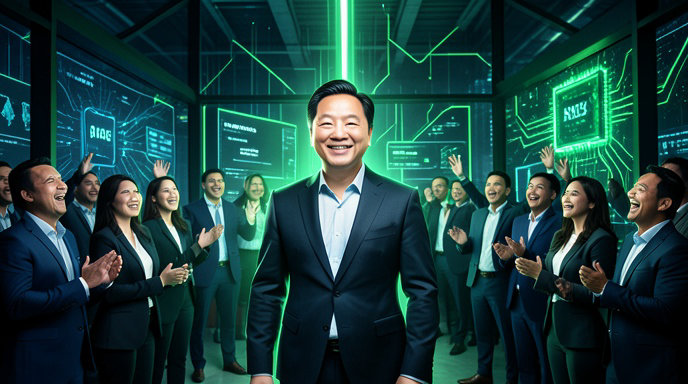
A celebratory homecoming reportedly greeted Nvidia CEO Jensen Huang as he returned to the company’s headquarters, underscoring the unusually personal connection he has built with employees during Nvidia’s transformation into one of the world’s most influential technology companies.
The welcome comes at a pivotal moment. Nvidia is no longer viewed primarily as a specialist graphics-chip maker. Its processors have become foundational infrastructure for generative artificial intelligence, powering systems developed by cloud providers, governments, research institutions and the world’s largest technology companies.
That expansion has placed extraordinary expectations on Huang. Nvidia must continue delivering increasingly powerful chips while managing supply constraints, intense competition, geopolitical risks and scrutiny over the broader impact of its dominance in AI computing.
A Founder’s Return to the Center of Nvidia
Huang co-founded Nvidia in 1993 and has led the company throughout nearly all of its history. His return to headquarters therefore represents more than a routine executive appearance. For employees, Huang is closely associated with Nvidia’s culture, product strategy and long-term willingness to pursue technically difficult markets before they become mainstream.
The reported reception reflects that reputation. Huang is known for maintaining a visible presence inside the company, speaking directly with employees and using informal interactions to reinforce Nvidia’s focus on speed, technical ambition and execution.
His leadership style has also become part of Nvidia’s public identity. The company’s black leather jacket, intense product launches and emphasis on accelerated computing are strongly linked to Huang’s personal brand.
A Promise to Become a Better CEO
The most notable element of Huang’s reported return is his promise to become a better CEO during a second stint in the role. While Huang has never left Nvidia’s leadership, the language suggests a renewed commitment to adapting his management approach as the company enters a far larger and more complex phase.
Leading Nvidia today requires more than designing successful processors. The company now operates at the intersection of chip design, software, cloud infrastructure, networking, robotics and enterprise computing. Its products influence the pace of AI development across the global technology industry.
That scale creates new leadership challenges. Huang must preserve the urgency and risk-taking that helped Nvidia succeed while building systems capable of coordinating a company with a massive workforce, a global customer base and a supply chain spread across multiple regions.
Becoming a better CEO could mean delegating more effectively, strengthening management teams, improving communication across a rapidly expanding organization and ensuring that Nvidia’s culture remains productive rather than simply intense.
The AI Infrastructure Race
Nvidia’s growth remains closely tied to demand for AI infrastructure. Its graphics processing units and specialized accelerators are widely used to train and run large AI models. The company’s CUDA software platform has also helped create a powerful developer ecosystem around its hardware.
That combination of hardware and software is one of Nvidia’s most important competitive advantages. Rival chipmakers can develop alternative processors, but persuading developers and cloud providers to adopt a different software stack is considerably more difficult.
Nvidia’s data-center business has benefited enormously from this position. Customers are investing in complete computing platforms that include accelerators, networking equipment, software and systems for operating AI workloads at scale.
Huang’s challenge will be maintaining that lead as competitors become more aggressive. Advanced chip designers, cloud companies developing their own silicon and established semiconductor manufacturers are all seeking a larger share of the AI-computing market.
Beyond Chips: Nvidia’s Expanding Ambitions
Nvidia’s strategy increasingly extends beyond individual processors. The company has positioned itself as a full-stack computing provider, combining silicon, networking, software libraries and enterprise tools.
Its ambitions also reach into robotics, autonomous machines, digital simulation and industrial computing. These markets could provide important long-term growth opportunities, particularly if AI systems move from data centers into factories, vehicles and physical machines.
The expansion raises the stakes for Huang’s leadership. Nvidia must decide where to invest aggressively, which partnerships to pursue and how to prevent its sprawling product portfolio from becoming difficult for customers and employees to navigate.
A stronger management structure could help Nvidia sustain innovation while reducing dependence on any single executive. At the same time, Huang’s continued visibility may remain valuable for motivating employees and reassuring customers that the company is committed to its long-term strategy.
Risks Alongside the Growth
Nvidia’s success has brought substantial risks. The company faces periodic concerns about whether AI spending can continue at its current pace, whether customers will eventually develop more of their own chips and whether the economics of large-scale AI infrastructure will justify the enormous investments being made.
Geopolitical restrictions are another challenge. Limits on advanced semiconductor exports can affect Nvidia’s ability to serve important markets, while manufacturing remains dependent on a highly concentrated global supply chain.
Competition is also intensifying. Major technology companies are designing internal AI accelerators, while semiconductor rivals are developing competing products. Nvidia must continue improving performance, energy efficiency and total cost of ownership to justify the premium associated with its platforms.
Huang’s leadership will be tested by how effectively he balances these pressures with the optimism that has defined Nvidia’s public messaging.
Why the Homecoming Matters
The enthusiastic employee response to Huang’s return illustrates the symbolic importance of leadership at Nvidia. In many technology companies, a chief executive’s appearance may attract attention, but at Nvidia, Huang is deeply woven into the company’s identity.
That connection can be a strategic asset. Employees who believe strongly in the company’s mission may be more willing to accept demanding workloads and ambitious deadlines. Customers and investors may also view Huang’s continued leadership as a source of consistency during a period of rapid change.
But personal loyalty must be matched by durable institutional strength. Nvidia’s next phase will require experienced executives, disciplined operations and a culture that can scale without losing its innovative edge.
The Road Ahead
Huang’s reported pledge to improve as CEO offers a revealing perspective on Nvidia’s future. The company’s next challenge is not simply to capitalize on the AI boom, but to build an organization capable of leading through multiple technology cycles.
If Nvidia succeeds, it could remain a defining force in semiconductors and artificial intelligence for years to come. Its influence may extend from cloud data centers to scientific research, industrial automation, robotics and consumer applications.
The homecoming at headquarters therefore carries significance beyond its celebratory atmosphere. It signals employee confidence in the leader who guided Nvidia from a small graphics-chip startup into a central player in modern computing—and highlights the responsibility Huang now faces as he prepares the company for its most consequential chapter yet.

Get All The Latest Updates Delivered Straight To Your Inbox For Free!