
Solar and Batteries: The Future Power Solution for AI Data Centers
TL;DR
- Solar paired with batteries could supply a meaningful share of the rapidly expanding electricity demand from AI data centers.
- Next-generation AI infrastructure may require tens of gigawatts of new power capacity each year, making speed and flexibility as important as cost.
- The model faces major hurdles, including intermittency, land and transmission constraints, battery costs, permitting delays and the need for firm backup power.
The AI Boom Is Becoming an Energy Story
The artificial-intelligence boom is colliding with a basic physical constraint: there may not be enough electricity, or enough grid capacity, to power the data centers needed to train and run the next generation of models.
The largest AI facilities are no longer ordinary server farms. They are industrial-scale power consumers filled with high-density accelerators, advanced cooling systems and networking equipment. A single campus can require hundreds of megawatts, while future clusters built around increasingly powerful AI chips could consume electricity on the scale of a small city.
That demand is arriving faster than conventional power infrastructure can be built. Natural-gas plants, nuclear facilities, transmission lines and large substations can take years to develop. Solar generation and battery storage, by contrast, can often be deployed in stages and expanded as computing demand grows.
That combination is central to the argument from investors associated with Crusoe, the data-center and energy-infrastructure company. Their thesis is not that solar and batteries will immediately replace every traditional power source. Rather, renewable generation and storage could become one of the fastest ways to add large amounts of electricity for AI infrastructure while reducing exposure to fuel prices, grid bottlenecks and carbon-intensive generation.
A Tens-of-Gigawatts Construction Challenge
Forecasts for AI electricity consumption vary widely, but the direction is clear. Data-center developers, utilities and chip companies are planning a wave of facilities that could add tens of gigawatts of annual power demand over the coming years.
The scale is difficult to compare with earlier technology expansions. Conventional cloud computing grew through thousands of relatively small facilities distributed across existing power networks. AI infrastructure is more concentrated. Training frontier models can require enormous clusters of accelerators operating together, while inference workloads are spreading across regions as companies add AI features to search, productivity software, customer service and industrial applications.
The International Energy Agency has estimated that global data-center electricity use could roughly double by the end of the decade, with AI among the fastest-growing sources of demand. In the United States, technology companies and data-center operators have announced plans that could add many gigawatts of new load, although the final amount will depend on project cancellations, efficiency improvements and the pace of AI adoption.
The most aggressive projections imply a need to build generation at a speed rarely seen in the modern power sector. Even if individual AI campuses consume “only” a few hundred megawatts, dozens of projects can quickly create a national infrastructure requirement measured in tens of gigawatts.
Why Solar Is Attractive to Data-Center Developers
Solar power has several characteristics that make it appealing for AI infrastructure.
First, projects can be built incrementally. A developer can add solar fields in phases rather than waiting for a single large power plant to be completed. That flexibility matters when demand forecasts are changing quickly and when data-center operators want to bring computing capacity online as soon as possible.
Second, solar has relatively predictable operating costs. Once a project is built, it does not require a continuous supply of fuel. That can protect operators from volatile natural-gas prices and from the long-term cost of carbon regulation.
Third, solar installations can be located near data centers when suitable land and interconnection capacity are available. Co-locating generation with computing loads can reduce pressure on transmission networks, which are increasingly viewed as one of the largest barriers to new data-center construction.
Solar also aligns with the climate commitments of major technology companies. Microsoft, Google, Amazon and Meta have all made substantial clean-energy investments or commitments. As their AI workloads grow, purchasing renewable power only through conventional long-term contracts may not be enough. Directly financing or building generation could give them greater control over timing and supply.
The fundamental weakness is equally clear: solar production falls at night and varies with weather. AI data centers, however, are expected to operate around the clock. That mismatch makes storage essential.
Batteries Turn Intermittent Power Into a More Useful Resource
Battery systems can store excess solar electricity during the day and discharge it during the evening or during short periods of cloud cover. They can also reduce sharp spikes in a data center’s demand, provide backup during grid disturbances and help stabilize local power systems.
For AI operators, the value of batteries extends beyond simply shifting solar power by a few hours. Batteries can serve as a flexible buffer between the data center and the grid. They can charge when electricity is plentiful and inexpensive, then discharge when the grid is constrained or wholesale prices rise.
That flexibility could allow a solar-and-storage facility to provide a more dependable power profile than solar alone. A data center might combine solar generation, several hours of battery capacity, grid electricity and a firm backup resource such as natural gas, geothermal power or nuclear generation.
Battery deployment is also becoming faster and more modular. Utility-scale lithium-ion systems are already being installed in multiple gigawatt-hours globally, and developers are evaluating alternatives including iron-air, sodium-ion and other long-duration technologies. These systems are intended to cover longer periods when renewable output is low, although many remain less commercially mature than lithium-ion batteries.
The economics depend heavily on how much storage is required. A battery designed to smooth solar output for four hours is far less expensive than one designed to provide uninterrupted electricity through several days of unfavorable weather.
The Case for Co-Located Energy and Computing
The strongest version of the solar-and-battery strategy involves building power and computing together.
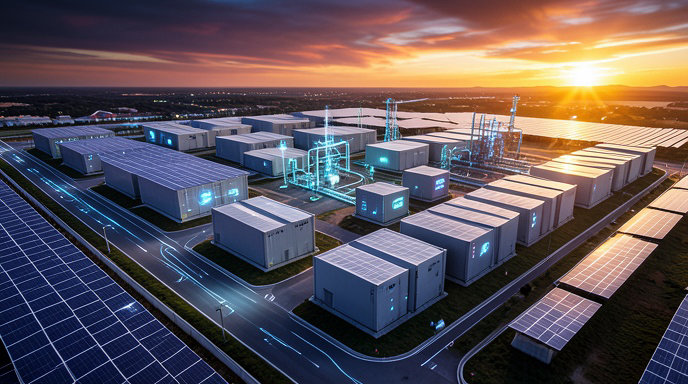
A co-located facility could use solar generation directly, charge batteries on site and draw from the grid when necessary. This arrangement may avoid some transmission charges and reduce dependence on overloaded substations. It could also help developers bring capacity online in areas where the grid cannot immediately support a large new load.
Crusoe has focused on unconventional approaches to powering data centers, including using energy that might otherwise be wasted from oil-field operations. The company has also expanded into purpose-built AI infrastructure. The broader lesson from that business is that computing operators are increasingly treating energy access as a primary design consideration rather than a utility detail.
For solar developers, large AI customers offer the possibility of long-term contracts and predictable demand. For data-center operators, dedicated generation can provide an additional layer of supply certainty. The partnership can be attractive if both sides are willing to share the cost of new infrastructure.
However, co-location does not eliminate the need for grid connectivity. Data centers need extremely high reliability, and solar output can fall for extended periods. A facility that runs exclusively on local solar and batteries would require substantial overbuilding and very large storage reserves.
Reliability Remains the Central Problem
AI workloads are unusually sensitive to interruptions. Training jobs can involve thousands of processors operating as a synchronized system. A short disruption can waste substantial computing time, damage hardware or force workloads to restart.
Inference services may be even less tolerant of outages. Businesses increasingly expect AI systems to respond continuously, often across multiple geographic regions. That means a data center cannot rely on average annual renewable production. It must have electricity available at the precise moment it is needed.
This is why the likely future is a portfolio rather than a single technology. Solar and batteries may provide a large share of annual energy, but firm generation and grid connections will remain important for reliability.
Natural gas is likely to remain part of that mix in many markets because gas turbines can be dispatched when renewable output falls. Some developers are exploring lower-carbon fuels, carbon capture and hydrogen, although the costs and availability of those options remain uncertain.
Nuclear power is also receiving renewed interest from technology companies seeking constant, carbon-free electricity. Existing nuclear plants can offer reliable output, while new reactors could eventually serve large industrial loads. The problem is timing: new nuclear projects generally require long development schedules, complex licensing and significant capital.
Geothermal power could fill a similar role in regions with suitable resources. Enhanced geothermal systems may expand the geographic footprint of the technology, but they remain at an earlier commercial stage than solar, wind and lithium-ion storage.
The Grid Is Still the Bottleneck
Adding solar and batteries does not automatically solve the power problem. Many of the best solar regions are far from major population centers and technology hubs. Even a data center located next to a solar field may need transmission capacity to import electricity during periods of low production and export surplus power when batteries are full.
Interconnection queues in the United States contain thousands of gigawatts of proposed generation and storage projects. Many will never be built, while others face years of studies, permitting and upgrades. Transformer shortages, limited transmission equipment and delays in substation construction are adding to the challenge.
Data-center developers are responding by looking for sites with available power rather than simply cheap land. Some are considering former industrial locations, retired power-plant sites and regions with existing high-voltage infrastructure. Others are negotiating directly with utilities to fund transmission upgrades or secure special power arrangements.
This creates a tension between speed and efficiency. Building a data center in a remote area with abundant solar resources may provide cheaper energy, but it can increase network latency and require new fiber, roads and transmission lines. Building near major cities can improve connectivity and access to customers, but land and power are more expensive.
Battery Supply and Environmental Costs
A rapid buildout of storage would create its own supply-chain demands. Lithium, nickel, graphite, cobalt and other materials are used in many battery technologies, although newer chemistries can reduce dependence on some of them.
Manufacturers have expanded production substantially, and battery prices have fallen over the long term. Still, demand from electric vehicles, grid storage and data centers will compete for factories and raw materials. Prices can rise when supply expansion lags expectations.
Battery projects also require careful management of fire risk, recycling, replacement cycles and degradation. A system that is economically attractive at commissioning may need additional investment as its usable capacity declines.
Solar farms bring land-use questions as well. Large installations can compete with agriculture, affect habitats and face local opposition. Developers are exploring agrivoltaics, brownfield sites, rooftops and dual-use land, but these approaches cannot eliminate every permitting conflict.
The carbon footprint of manufacturing solar panels, batteries and power electronics also matters. Clean electricity at the data center does not mean the infrastructure has no environmental impact. The industry will face growing pressure to account for materials, construction and end-of-life recycling rather than focusing only on operational emissions.
Efficiency Could Change the Equation
The amount of power required by AI will depend not only on the number of data centers but also on the efficiency of the entire computing stack.
New accelerator generations can deliver more performance per watt, while software improvements can reduce unnecessary computation. More efficient models, quantization, sparsity and specialized inference hardware could reduce the energy required for a given task.
Cooling is another major variable. Traditional air cooling becomes less practical as chip power densities rise. Direct liquid cooling and other advanced systems can improve efficiency, although they add plumbing, control and maintenance requirements.
These gains may slow the growth of electricity demand, but they may not reverse it. Lower computing costs can encourage more usage, a pattern often described as a rebound effect. If AI becomes cheaper and more capable, companies may deploy it in more applications, offsetting efficiency improvements.
What the Energy Mix May Look Like
The most realistic near-term model is a layered one.
Solar and wind can supply low-cost energy when conditions are favorable. Batteries can shift renewable generation, manage short-term variability and reduce peak grid demand. Grid power can provide additional flexibility, while firm resources cover prolonged periods of low renewable output.
The proportions will differ by region. A data center in a sunny market with strong transmission may rely heavily on solar and four-hour batteries. A facility in a cloudy region may need more wind, long-duration storage or firm generation. Markets with constrained grids may favor on-site power even when it is more expensive.
Over time, data centers may also become more flexible consumers. Some AI training workloads can potentially be scheduled around renewable availability, allowing operators to run intensive jobs when electricity is abundant and reduce activity during grid emergencies. Real-time inference and critical services will be less flexible, but not every workload requires the same reliability profile.
That flexibility could make AI data centers part of the solution to grid congestion rather than simply a source of additional demand. Whether regulators and operators can coordinate such behavior at scale remains an open question.
The Investment Thesis
For investors, the opportunity extends beyond solar panels and batteries. It includes land, transmission, substations, power electronics, cooling, backup generation, energy-management software and financing.
The companies best positioned to benefit may be those that can deliver an integrated package: secure a site, obtain interconnection rights, build generation, install storage and operate the data center. That favors well-capitalized developers and technology companies willing to make long-term infrastructure commitments.
The risks are substantial. AI demand forecasts could prove too optimistic. Chip efficiency could improve faster than expected. Projects could face local opposition, regulatory delays or equipment shortages. Battery prices may fluctuate, and grid upgrades may take longer than data-center construction.
There is also a risk that companies overbuild in response to short-term excitement. If AI workloads become more geographically distributed or if model development slows, some power projects could struggle to find customers.
Even so, the underlying need for new electricity is unlikely to disappear. Data centers, electric vehicles, industrial electrification and reshoring of manufacturing are all increasing pressure on power systems. AI is accelerating a broader transformation in how electricity is generated, stored and consumed.
A Complement, Not a Silver Bullet
Solar and batteries are unlikely to power every AI data center on their own. The technology cannot guarantee round-the-clock supply without substantial overbuilding, long-duration storage or firm backup generation.
But the combination can address several of the industry’s most urgent problems. It can add capacity faster than some conventional power projects, reduce exposure to fuel prices, support corporate clean-energy goals and relieve pressure on constrained grids when deployed intelligently.
The Crusoe-linked investment thesis is therefore less about replacing the power system than rebuilding it around the needs of large-scale computing. AI data centers will require a diverse energy portfolio, and solar paired with storage is emerging as one of its most scalable components.
The question is no longer whether AI will need vastly more electricity. It is whether the energy industry can build that supply quickly, reliably and affordably. Solar and batteries will be part of the answer—but making them work at data-center scale will require new transmission, firm power, better storage and a willingness to treat energy infrastructure as core technology infrastructure.

Get All The Latest Updates Delivered Straight To Your Inbox For Free!