
Bill Gates Proposes Robot Tax and Human-Reserved Jobs to Fight AI Job Loss
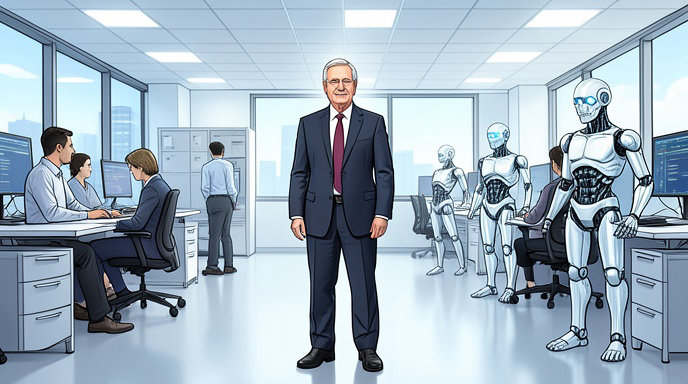
TL;DR
- Bill Gates has revived and expanded his long-standing "robot tax" idea, proposing that companies pay a tax when AI or robotics replace human workers, with revenue used to fund retraining, healthcare, and social safety nets.
- His broader Responsible AI vision includes legally designating certain "human-reserved" jobs in sectors like education, healthcare, and caregiving where human empathy and judgment are considered irreplaceable.
- The proposals aim to slow disruptive automation, fund worker transitions, and create a new regulatory framework for AI, but face major questions over implementation, global competitiveness, and corporate pushback.
A Familiar Idea for a New AI Era
The concept of a robot tax is not new for Bill Gates. He first floated the idea in a 2017 interview, arguing that if a robot takes a human job, it should be taxed at a similar level to the human worker's income tax. Now, as generative AI moves from experimental to enterprise-wide deployment, Gates says the threat to white-collar and blue-collar work is far more immediate and widespread.
In recent commentary and interviews framing his Responsible AI vision, Gates has argued that AI-driven productivity gains should not come at the cost of mass economic displacement. Without intervention, he warns, automation could hollow out the labor market faster than workers can adapt, concentrating wealth while straining government support systems. The robot tax, in his view, is a way to balance innovation with responsibility.
How the Robot Tax Would Actually Work
Unlike a traditional corporate tax, Gates' proposed robot tax would be triggered specifically when automation displaces human labor. While no formal legislation has been drafted, the framework he describes would work like this:
Companies that deploy AI systems, robotics, or autonomous software to perform tasks previously done by employees would be assessed a fee comparable to the payroll taxes and income taxes that would have been paid on that human labor. For example, if a logistics company replaces 50 warehouse workers with an autonomous system, it would continue to pay a tax equivalent to the lost payroll tax contribution.
The revenue would not go into general funds. Gates proposes it be ring-fenced to finance three critical areas: large-scale worker retraining and reskilling programs, expansion of the social safety net including healthcare and unemployment support, and incentives for businesses that create new human-centric jobs. The tax would also intentionally slow the speed of automation just enough to give labor markets and policy time to adjust, without halting progress entirely.
What Are Human-Reserved Jobs?
The more novel part of Gates' current proposal is the call for "human-reserved" jobs. This goes beyond taxation and into labor regulation.
The idea is to legally or normatively designate certain professions where humans must remain the primary provider, even if AI could technically do the job. Gates has pointed to roles that rely heavily on human connection, empathy, moral judgment, and trust.
Early examples he has highlighted include teachers and early childhood educators, nurses and elder-care providers, and mental health counselors. In these fields, AI could serve as a powerful assistant — handling paperwork, personalizing lesson plans, or monitoring patient data — but not as a replacement. The goal is twofold: to preserve employment in high-empathy sectors and to protect the quality of human interaction in areas where society values it most.
Some versions of the proposal also suggest a certification system, similar to "organic" or "fair trade" labels, where companies could advertise services as "human-provided" to meet consumer demand for human interaction.
Impact on the Labor Market and the Future of Work
Economists are divided on how disruptive AI will truly be. Some forecasts predict AI will automate or augment up to 30% of current work hours in the US by 2030, while others argue new jobs will emerge as quickly as old ones disappear. Gates' position is that even if long-term job creation balances out, the short-term transition could be brutal.
A robot tax could provide a crucial funding mechanism for what Gates calls the "transition economy." By taxing the efficiency gains of automation, governments could fund free community college programs, vocational training in AI maintenance and green energy, and wage insurance for displaced workers. Human-reserved jobs, meanwhile, would create a stable floor of employment that is insulated from pure cost-based automation.
Critics, however, warn that such policies could backfire. Taxing robots could disincentivize investment and cause US companies to fall behind competitors in China and other nations that do not impose similar levies. Defining which jobs are "human-reserved" also raises difficult legal and ethical questions about government overreach into hiring decisions.
The Road to AI Regulation
Gates' proposals are not meant to stand alone. He frames them as part of a comprehensive Responsible AI agenda that includes stronger AI safety testing, transparency requirements for frontier models, and global cooperation on AI governance.
For now, a robot tax and human-reserved jobs remain concepts rather than concrete bills in Congress or parliament. No country has yet implemented a direct robot tax, though South Korea scaled back tax incentives for automation in 2017 and European lawmakers have debated similar measures. In the US, the idea has drawn cautious interest from labor advocates and some progressive lawmakers, but faces strong opposition from the tech industry, which argues that innovation should be encouraged, not penalized.
What Gates' renewed advocacy does is shift the conversation. Instead of asking whether AI will take jobs, he is pushing policymakers, CEOs, and the public to ask how the financial rewards of AI should be shared and what kind of work should always remain human.

Get All The Latest Updates Delivered Straight To Your Inbox For Free!